


Request a Quote
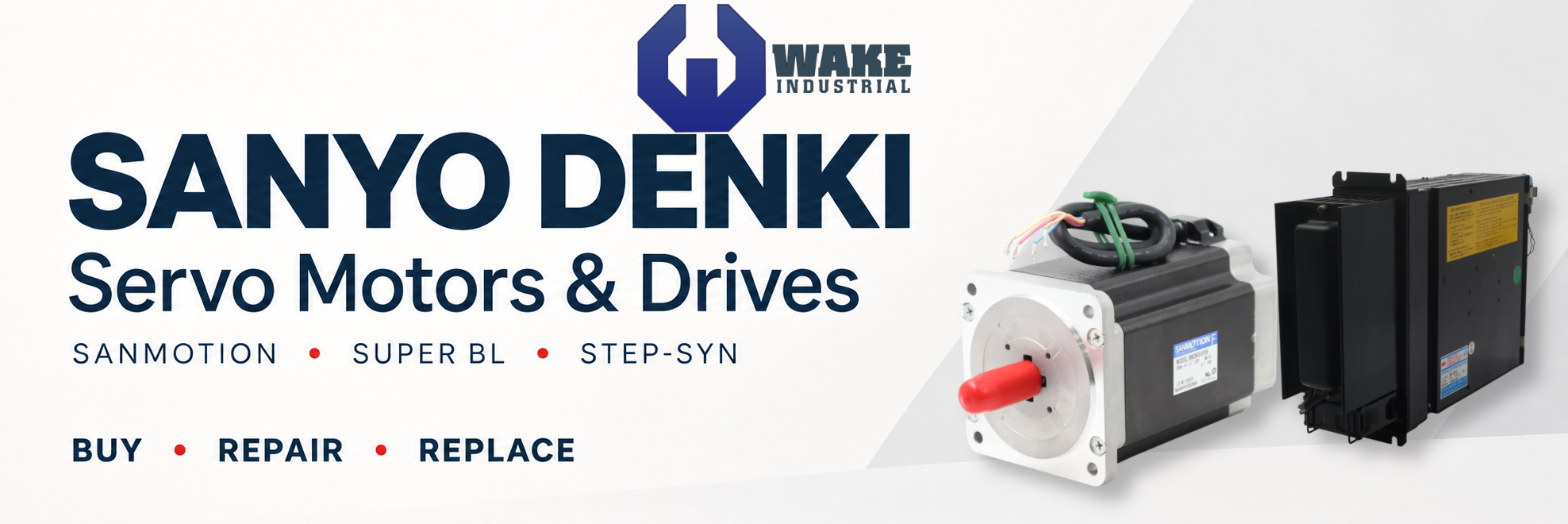
Sanyo Denki Servo Motors, Drives, and Stepping Motors
Get a quote NOW for Sanyo Denki servo motors, drives, and controllers. Request a quote now by sending an email to sales@wakeindustrial.com or call 1‑919‑443‑0207 to speak to a Wake Industrial representative immediately. Wake Industrial supplies Sanyo Denki servo motors, servo amplifiers, and stepping motors, with purchase, replacement, and repair options for SANMOTION and Super BL equipment. SANMOTION R and G servo systems provide position, speed, and torque control through their respective amplifier platforms. Q-series and Super BL P motors offer multiple rotor, feedback, and brake configurations, while STEP-SYN stepping motors are available with unipolar and bipolar windings.
SANMOTION R Servo Motors
SANMOTION R motors are permanent-magnet AC servomotors built around medium-inertia rotors, continuous-duty windings, and flange mounting. Within a servo system, the amplifier regulates motor current to produce torque, while the feedback device reports shaft movement for closed-loop control. The family includes 100 V and 200 V configurations, with different frame sizes and winding designs to accommodate changes in load, operating speed, and available installation space.
The R series supports incremental feedback, battery-backed absolute feedback, and absolute encoders intended for incremental-system operation. These configurations determine how the control system establishes and tracks shaft position. R2 motors use totally enclosed, self-cooling construction with Class F insulation and a 0–40 °C operating ambient range. Most R2 configurations have IP67 protection excluding shaft passages and cable ends, while the R2AA13 frame group is rated IP65. Optional oil seals address the shaft interface, and 24 VDC or 90 VDC holding brakes retain the stationary shaft when the application requires a mechanical holding function.
Part number | Rated output | Rated torque | Rated speed | Maximum speed |
100 W | 0.318 N·m | 3,000 rpm | 6,000 rpm | |
200 W | 0.637 N·m | 3,000 rpm | 6,000 rpm | |
750 W | 2.39 N·m | 3,000 rpm | 6,000 rpm |
SANMOTION R Servo Drives
SANMOTION R Servo Drives convert machine-controller commands into regulated motor current. Position mode accepts pulse commands, while speed and torque modes accept analog commands. An IGBT PWM power stage supplies sinusoidal motor drive, and electronic gearing scales position-command pulses to the required motor movement. This allows the amplifier to work with different controller pulse resolutions and mechanical transmission ratios.
Automatic and manual tuning adjust the servo response to the connected motor and machine. Notch filters suppress mechanical resonances associated with couplings and structural rigidity, while vibration-suppression functions address lower-frequency movement remaining after positioning. These functions help the axis settle at its commanded position without requiring the machine controller to generate every corrective action.
The amplifier also manages energy and operating status. Regenerative circuitry handles energy returned by the motor during deceleration, with resistor arrangements varying by amplifier size. A built-in dynamic brake provides a separate electrical stopping function. The front display, alarm outputs, and analog speed and torque monitors support commissioning and fault diagnosis by showing how the drive is responding to commands and load conditions.
Part number | Supply class | Amplifier capacity designation | Regenerative resistor |
200 VAC | 15 A | External, when required | |
200 VAC | 30 A | External, when required | |
200 VAC | 50 A | Built in |
SANMOTION G AC Servo Motors
SANMOTION G motors combine compact mechanical construction with low-cogging operation and high-resolution feedback. GAM1 motors use low-inertia rotors, while GAM2 motors use medium-inertia rotors, giving machine builders different acceleration and load-matching characteristics. An optimized electromagnetic design and brake structure reduce motor length and mass, helping accommodate servo axes where the motor’s installation envelope and moving weight affect machine design.
The standard GAER battery-less absolute encoder provides 23-bit single-turn resolution and 16-bit multi-turn information. It tracks both angular position and accumulated revolutions without a backup battery, eliminating periodic encoder-battery replacement. GAEN single-turn encoders provide 23-bit angular information in a thin-profile assembly, while optional configurations extend single-turn resolution to 27 bits. This fine position feedback supports stable positioning when combined with the amplifier’s control functions.
Mechanical and connection features simplify installation. Motors in the 40–86 mm square frame range combine power and brake connections in one connector, while 100–130 mm square frames use push-pull connectors, with alternative connector arrangements available. IP67 protection applies with the connectors mounted and excludes the shaft-seal portion. The motors operate at 0–40 °C, with shaft, oil-seal, and holding-brake options determining the final mechanical configuration.
Part number | Inertia class | Flange size | Rated output | Rated torque |
Low | 40 mm square | 50 W | 0.159 N·m | |
Medium | 40 mm square | 100 W | 0.318 N·m | |
Medium | 60 mm square | 100 W | 0.318 N·m |
SANMOTION G Servo Amplifiers
SANMOTION G amplifiers provide position, speed, and torque control through analog/pulse or EtherCAT interfaces. The range includes single-axis amplifiers and integrated two-axis EtherCAT versions. A two-axis amplifier combines control of two motors in one assembly, reducing installation space and wiring. It can also reuse regenerative energy from a decelerating axis to help power the other axis.
Advanced tuning measures mechanical resonance, friction, and load inertia, then adjusts servo gains and filters to suit the machine. Friction and gravity compensation help reduce position error as an axis approaches its target. These functions address settling time, the interval between completing a movement and reaching a stable commanded position. Smooth switching between position and torque control also supports operations that move into contact and then apply controlled force, such as pressing.
Supported single-axis configurations can use both motor feedback and a separate load encoder for fully closed-loop control. Measuring the load directly allows the control system to respond to actual machine movement as well as motor-shaft movement; this function is unavailable on the integrated two-axis versions. Safe Torque Off, detailed alarm reporting, and software-based status monitoring provide additional control and diagnostic functions.
Part number | Nominal AC input | Amplifier capacity designation | Command interface |
200–240 VAC, three-phase or configured single-phase | 10 A | Analog/pulse | |
200–240 VAC, three-phase or configured single-phase | 30 A | EtherCAT | |
100–120 VAC, single-phase | 30 A | EtherCAT |
SANMOTION Q Servo Motors
SANMOTION Q motors offer three rotor-inertia classes: Q1 low inertia, Q2 medium inertia, and Q3 high inertia. Rotor inertia determines how much torque is required to accelerate the motor itself and influences the relationship between the motor and its mechanical load. Low-inertia construction reduces the rotor’s contribution to acceleration demand, while the medium- and high-inertia designs provide additional choices for matching the axis’s mechanical behavior.
The Q series includes incremental encoders, battery-backed absolute encoders, and battery-less absolute sensors. Incremental feedback supplies movement information, while multi-turn absolute feedback also identifies position across successive revolutions. The resolver-based RA062C provides battery-less absolute feedback, allowing multi-turn position tracking without a backup battery. These sensor options affect the motor’s feedback connection and the amplifier configuration used to interpret shaft position.
Mechanical protection varies across Q frame groups. Compact Q1 motors in the 40, 60, and 76 mm frame groups have IP40 protection, while larger Q1 configurations use IP67 construction with the required mating and sealing components. Q1 and Q2 motors use permanent-magnet excitation, Class F insulation, and continuous-duty ratings. Optional holding brakes and different winding-speed configurations adapt the motor assembly to the axis’s stopping, holding, and operating-speed requirements.
Part number | Rated output | Rated torque | Rated speed | Maximum speed |
100 W | 0.318 N·m | 3,000 rpm | 5,000 rpm | |
200 W | 0.637 N·m | 3,000 rpm | 5,000 rpm | |
750 W | 2.38 N·m | 3,000 rpm | 5,000 rpm |
P3 Super BL Servo Motors
P3 Super BL motors are a compact, low-inertia brushless servo family covering rated outputs from 30 W to 750 W. Their low rotor inertia reduces the torque spent accelerating the motor itself, supporting frequent starts, stops, and direction changes. The family emphasizes high power rate and compact dimensions, with 40, 60, and 80 mm square flange sizes for installation on smaller motion axes.
The motors use permanent-magnet excitation, continuous-duty windings, and Class F insulation. Their totally enclosed, self-cooling construction operates without a separate motor cooling fan. Standard P3 protection is IP40, with IP55 available as an option. This makes the enclosure configuration a meaningful distinction within the series, particularly when the motor is installed near contamination or moisture.
P3 feedback configurations include wiring-saving incremental encoders and absolute sensors. The wiring-saving design eliminates separate commutation-sensor wiring, reducing the number of feedback connections required between motor and amplifier. Optional 24 VDC and 90 VDC holding brakes provide stationary retention, with the brake and sensor assemblies affecting overall motor length and inertia.
Part number | Rated output | Rated torque | Rated speed | Maximum speed |
30 W | 0.098 N·m | 3,000 rpm | 4,500 rpm | |
50 W | 0.157 N·m | 3,000 rpm | 4,500 rpm | |
200 W | 0.637 N·m | 3,000 rpm | 4,500 rpm |
STEP-SYN Stepping Motors
STEP-SYN stepping motors provide shaft movement in defined angular increments. The 1.8° designs divide one mechanical revolution into 200 full steps, providing a basis for incremental positioning and indexing. The range includes compact square-frame motors and larger cylindrical designs, with different motor lengths and rotor sizes to accommodate changes in torque demand.
Unipolar and bipolar winding configurations provide different electrical arrangements for connection to a stepping-motor driver. Within a frame family, winding variants can have different phase-current, resistance, and inductance values while retaining a common mounting footprint. These winding characteristics govern the electrical relationship between motor and driver and influence how phase current develops during operation.
Part number | Frame size | Winding | Rated current | Minimum holding torque |
56 mm square | Unipolar | 2 A/phase | 0.39 N·m | |
60 mm square | Unipolar | 3 A/phase | 2.1 N·m | |
86 mm diameter | Bipolar | 6 A/phase | 7.44 N·m |

Contact Wake Industrial today to request a quote or to discuss your specific needs. We’ll help you find the perfect Sanyo Denki servo solution for your industrial application and ensure you get the support you need.
Don’t let your machinery fall behind – upgrade with Sanyo Denki servo technology and experience improved precision, speed, and productivity. Call 1-919-443-0207 to take the next step toward optimizing your automation systems with top-tier servo solutions with Wake Industrial. Your success is our priority, and we’re ready to assist you in selecting and sustaining the best motion control equipment for your business.









