


Sanyo Denki SANMOTION R Fault Codes and Reset Guide
Technical Error and Fault Guides26 August, 2026 | Sanyo Denki fault codes, Sanyo Denki drive fault codes, Sanyo Denki alarm codes, SANMOTION R fault codes, SANMOTION R alarm reset, Sanyo Denki servo drive troubleshooting, Sanyo Denki servo amplifier repair, SANMOTION R Type S alarms, Sanyo Denki code 21, Sanyo Denki code 41, Sanyo Denki code 51, Sanyo Denki overvoltage fault, Sanyo Denki undervoltage fault, Sanyo Denki encoder communication error, SANMOTION overload alarm, Sanyo Denki drive reset procedure, Sanyo Denki drive repair,
Looking for the easy to read error table? Click Here
Sanyo Denki drive fault codes help maintenance teams identify problems involving the amplifier, motor, encoder, power supply, wiring, regenerative circuit, machine load, and control settings. On the SANMOTION R Type S amplifiers covered here, the front display shows a two-character alarm code that points technicians toward the affected part of the motion system.
Record the complete code before cycling power or attempting a reset. If the alarm returns after the external causes have been checked, Wake Industrial can repair, refurbish, or replace legacy Sanyo Denki servo amplifiers. Call 1-919-443-0207, email sales@wakeindustrial.com, or use the quote form on the page to request pricing and availability.
Safety notice: This information is intended as a reference for qualified industrial maintenance personnel. Follow the machine manufacturer’s procedures, observe lockout/tagout requirements, and consult the documentation for your exact controller, firmware, motor, and installed modules. Wake Industrial does not provide technical troubleshooting support by phone or email. It is the user's responsibility to exercise independent judgment and caution when implementing these instructions.
What Do Sanyo Denki SANMOTION R Fault Codes Indicate?
An alarm identifies the area that needs attention. It does not always mean the servo amplifier has failed. A code may originate in the incoming power, motor cable, encoder circuit, holding brake, mechanical load, operating profile, or parameter settings.
This guide focuses on SANMOTION R Type S analog/pulse-input AC servo amplifiers for rotary motors. The RS1A03AA, for example, belongs to this analog/pulse amplifier family.
Do not apply these codes automatically to SANMOTION Q, SANMOTION R ADVANCED MODEL, SANMOTION R 3E Model, SANMOTION G, or Sanyo Denki stepping systems. The complete part number matters even within one family. The RS1A05AA is also an analog/pulse amplifier, but it is not automatically interchangeable with another RS1 model. Check the nameplate before diagnosing or replacing the drive.
What Should You Check Before Resetting the Drive?
A reset clears the stored alarm after the cause is gone. It will not correct a shorted output stage, damaged encoder, loose connector, overheated component, unstable supply, or blocked axis. Repeatedly resetting an active electrical or thermal fault can cause more damage.
Record the alarm code, axis, machine state, load condition, commanded motion, and point in the cycle where the fault occurred. Note whether it appeared at startup, main-power application, servo-on, acceleration, steady motion, deceleration, or emergency stop. This information is just as important on a larger unit such as the RS1A10AA as it is on a lower-capacity RS1 amplifier.
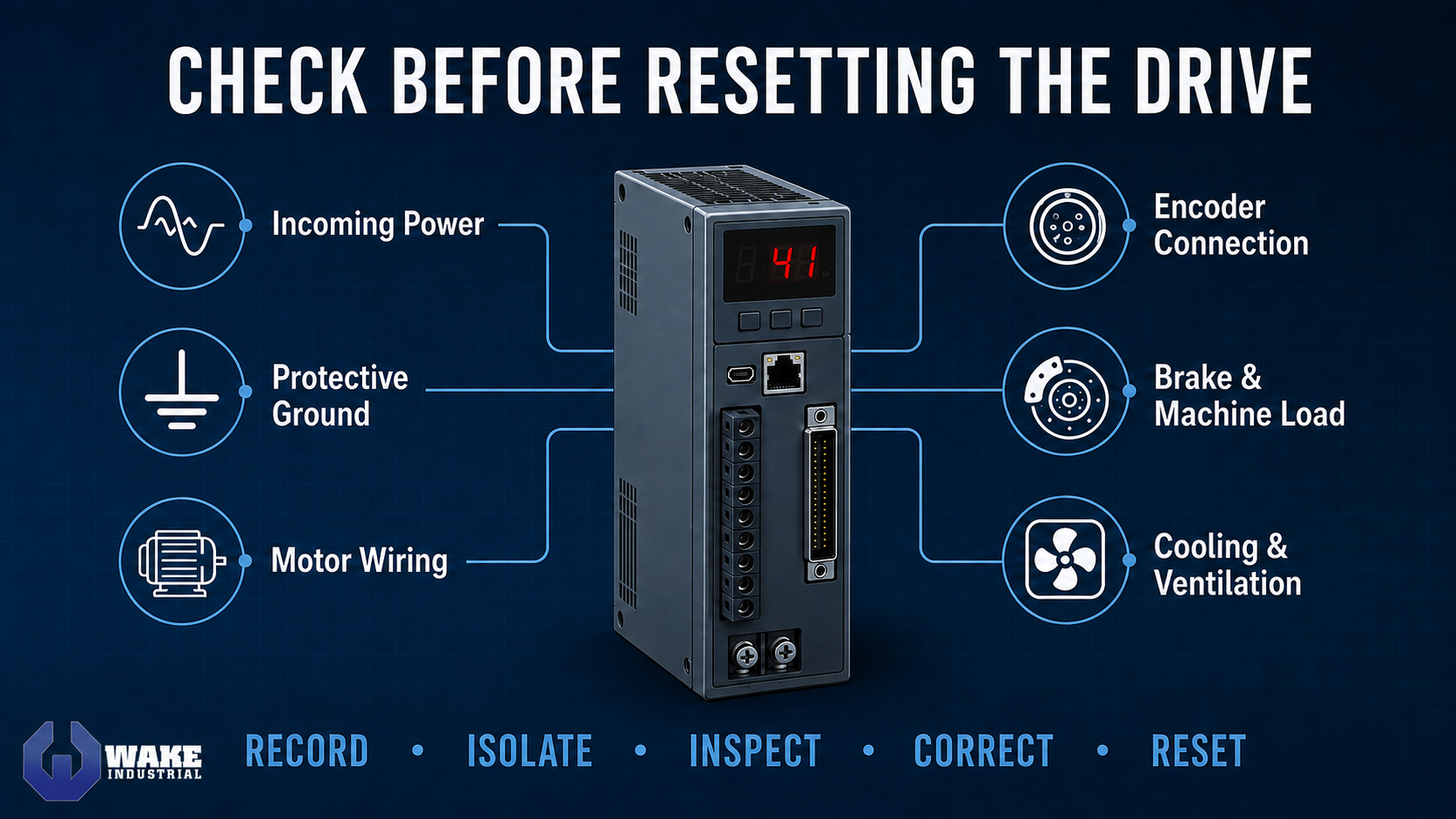
Qualified personnel should verify the incoming power, protective grounding, U/V/W motor conductors, encoder connections, cable shielding, holding-brake release, ventilation, mechanical freedom of movement, and amplifier-to-motor combination. Isolate power and follow the machine builder's lockout/tagout and stored-energy procedures before touching wiring or connectors.
How Are SANMOTION R Alarm Codes Cleared?
On the SANMOTION R Type S amplifiers covered here, many alarms can be cleared through the general-purpose input assigned to alarm reset. The reset input must remain active for at least 20 milliseconds. Confirm that the alarm signal has cleared before enabling servo operation again.
Some alarms require control power to be cycled or the encoder to be cleared. Encoder clearing can change stored position information, so verify axis position and machine safety first. The same caution applies to a unit such as the RS1A15AA, where an incorrect restart can create a machine hazard even if the code disappears.
Use this sequence: record the code, place the machine in a safe state, remove the cause, verify that the axis can restart safely, and apply the correct reset method. If the code immediately returns, stop resetting and continue the diagnosis.
When Does a Sanyo Denki Servo Amplifier Need Repair?
Codes 41, 45, 61, 62, 81, 83, 84, C2, and C3 can be caused by equipment outside the amplifier. Check the power supply, motor cable, encoder circuit, holding brake, machine load, motion profile, and settings before condemning the drive.
Professional evaluation becomes more likely when code 21 remains after the motor and cable have been tested, current-detection codes 23 or 24 return after grounding and noise problems have been corrected, or thermal and feedback alarms continue under verified operating conditions. Visible heat damage, contamination, failed cooling components, unstable output, or failure to complete startup are also reasons to remove the drive from service.
What Warning Messages Require Attention?
SANMOTION R drives can report warning conditions before a shutdown. These include overload, regenerative overload, amplifier temperature, main-circuit charging, voltage sag, forward or reverse overtravel, serial-encoder battery, torque or speed restriction, and excessive position deviation.
Do not ignore a warning because the axis is still running. An overload warning can progress to an overload alarm, regenerative warnings point to excessive deceleration energy, and temperature warnings show that the drive is approaching its thermal limit. Record the warning and correct the load, cooling, power, feedback, battery, or travel-limit condition before returning the machine to normal duty.
Sanyo Denki Drive Repair and Replacement from Wake Industrial
A fault code is the start of the diagnosis, not proof that a reset will restore reliable operation. Record the code and complete part number, correct external causes, and stop cycling the amplifier if the alarm returns.
Wake Industrial provides repair, refurbishment, and replacement options for Sanyo Denki SANMOTION servo amplifiers, including legacy units that can be difficult to source. Call 1-919-443-0207, email sales@wakeindustrial.com. Wake Industrial does not provide troubleshooting support by phone or email, but the sales team can assist with repair and replacement quotes.
Common Sanyo Denki SANMOTION R Fault Codes
Code | Fault or Warning | Likely Causes | Recommended Maintenance Response |
21 | Main circuit power device error | U/V/W short or ground fault, motor winding fault, or internal amplifier failure | Isolate power and test the motor cable and motor. If the code returns after the external circuit is verified, arrange amplifier repair or replacement. |
23 / 24 | Current detection error 1 or 2 | Internal current-detection fault or electrical noise | Check grounding, shielding, and nearby noise sources. If the code returns after these are corrected, have the amplifier evaluated. |
41 | Overload 1 | Excess torque, wrong motor combination, holding brake not released, phase-wiring problem, collision, binding, or incorrect encoder setting | Check the load, duty cycle, brake, motor combination, wiring, and encoder setting. If excessive effective torque caused the alarm, power down and allow at least 30 minutes for cooling. |
45 | Excessive continuous rotational speed | Average motor speed exceeds the permitted continuous operating speed | Reduce the average speed or change the operating cycle. Confirm that the motor is suitable for the required duty before resetting. |
51 | Abnormal amplifier temperature | Poor cooling, high ambient temperature, excessive regeneration, severe emergency-stop duty, or internal failure | Stop operation, allow the unit to cool, and inspect airflow, spacing, fans, filters, load cycle, and regenerative duty. Keep the measured control-board temperature at 40°C or lower. |
61 | Overvoltage | High supply voltage, excessive load inertia, regenerative energy, or internal failure | Verify the supply and review acceleration, deceleration, inertia, and regeneration. A recurring code under correct conditions can indicate amplifier damage. |
62 | Main circuit undervoltage | Low input voltage, voltage sag, momentary interruption, poor connection, or internal failure | Measure incoming power under load and inspect contactors, terminals, and protection devices. Reset after stable voltage is restored. |
81 / 83 / 87 | Encoder connector or CS disconnection | Loose connector, wiring error, unsuitable cable, encoder mismatch, incorrect fully closed setting, or encoder/amplifier fault | Inspect the full feedback circuit, connector seating, cable specification, and configuration. Confirm at least 4.75 V at the motor-side encoder check point. |
84 | Serial encoder communication error | Encoder fault, electrical noise, connector problem, or wiring error | Inspect encoder wiring, shields, grounding, and connectors. Reset only after communication is stable. |
C2 | Velocity control error | Incorrect motor or encoder wiring, oscillation, overshoot, or undershoot | Correct wiring and review servo tuning. Verify stable motion at a safe speed before clearing the alarm. |
C3 | Velocity feedback error | Motor does not rotate, motor-power fault, oscillation, or internal motor/amplifier failure | Check the motor conductors and mechanical movement, then correct unstable tuning. Recurrence may require motor or amplifier repair. |
Request a Quote

Cary, NC 27513












