


Breaking Down the Differences in Bosch Rexroth Power Supply Units: HVE, HVR, TVD, and TVM
31 October, 2025
Bosch Rexroth Indramat power supply units are the lifeblood of many industrial motion control systems. Four common series of these legacy power supplies – HVE Power Supply Units, HVR Power Supply Units, TVD Power Supply Modules, and TVM Power Supply Modules – each have distinct technical features and roles. Understanding their differences is crucial for engineers, technicians, and plant owners who maintain or retrofit older servo drive systems. In this article, we’ll delve into the technical specs and functionalities of HVE vs. HVR, and TVD vs. TVM, highlighting how they differ in power capacity, DC bus regulation, energy regeneration, and system integration. By the end, you’ll have a clear picture of which supply unit fits which scenario – and how to keep your production running with the right choice.
For immediate help with any Bosch Rexroth Indramat power supply repair or replacement contact Wake Industrial via the quote form on the page or call 1-919-443-0207 and a representative will get back to you as soon as 15 minutes during normal business hours. (Wake Industrial is not an authorized Bosch Rexroth distributor).
HVE vs. HVR – Unregulated vs. Regenerative Power Supplies
Indramat HVE and HVR power supplies are part of the DIAX04 drive system (a modular Rexroth/Indramat servo drive platform from the 1990s). Both HVE and HVR units connect to 3-phase mains (typically 3×380–480 VAC) and produce a high-voltage DC bus (~530–670 V DC) for multiple servo drives. The key difference lies in how they handle the DC output and excess energy from motors:
- HVE provides an unregulated DC bus. It simply rectifies the AC input to DC without active voltage regulation. As a result, the DC bus voltage will vary with the incoming AC (within ±10% of ~560 V nominal). HVE units are robust, straightforward power supplies – ideal in applications where a “raw”
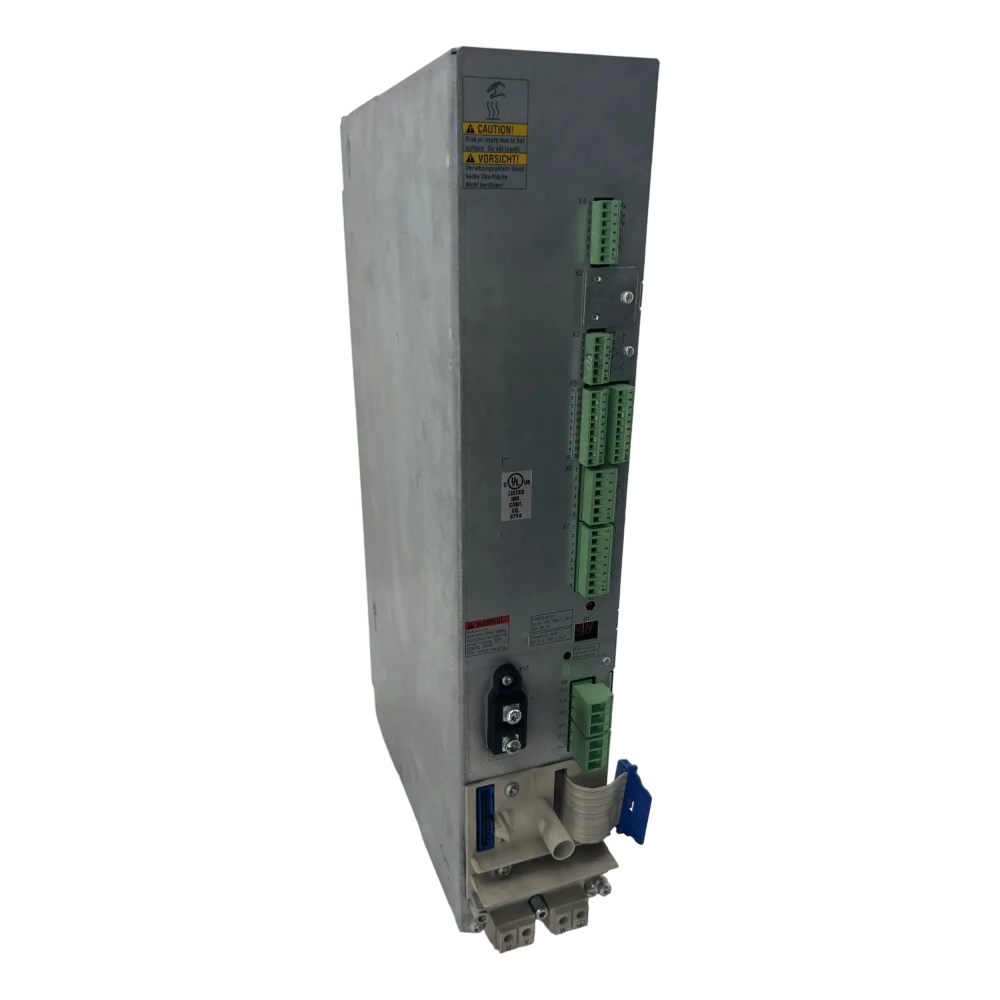 DC link is acceptable and cost or simplicity is important. For example, many CNC machines, printing presses, and packaging lines use HVE modules to power their drives when precise DC stabilization isn’t critical.
- HVR is the advanced counterpart to HVE, featuring an actively regulated DC bus and regenerative capability. An HVR maintains a consistent DC output voltage even if the AC supply fluctuates. More importantly, when servomotors brake or back-drive (entering generator mode), the HVR doesn’t simply burn off that energy as heat – it feeds the excess energy back into the mains. This regenerative feature means less waste heat and potential energy savings, especially in systems with frequent deceleration cycles.
In practical terms, HVR units keep voltage stable and recycle energy, whereas HVE units provide a simpler, unregulated supply and dump brake energy as heat via resistors. The HVR’s advantages come with added complexity – they have built-in inverter circuitry to push energy to the grid and typically include internal cooling fans and large capacitors to handle surges and regeneration currents. HVE supplies, by contrast, include internal bleeder resistors that automatically dissipate surplus energy as thermal losses during motor braking.
Power and usage differences: HVE/HVR modules are high-power units designed for multi-axis drive systems. Common HVE models (e.g. HVE02.2-W018N, HVE04.2-W075N) range from ~18 kW up to ~75 kW nominal capacity. HVR models (e.g. HVR02.2-W025N and HVR03.2-W045N) provide regulated DC with continuous ratings around 25–45 kW. In a DIAX04 cabinet, typically one HVE or HVR supply feeds multiple drive controllers from a common DC bus. An HVR is preferred when stable voltage is needed for precision or when the machine’s duty cycle has heavy braking. On the other hand, an HVE is perfectly adequate for machines where the inertia and regeneration are modest or where a simple robust supply is desired – the excess energy will just be safely converted to heat internally.
HVE vs. HVR Power Supply Comparison
|
Feature / Specification |
HVE Power Supply |
HVR Power Supply |
|
Type |
Unregulated DC Power Supply |
Regulated & Regenerative Power Supply |
|
Voltage Regulation |
Unregulated DC bus (voltage varies with AC input) |
Actively regulated DC bus maintains stable output |
|
Energy Handling |
Dissipates excess energy through internal/external braking resistors |
Regenerates excess energy back to AC mains |
|
Input Voltage |
3×380–480 VAC |
3×380–480 VAC |
|
DC Bus Voltage |
~530–670 V DC (varies with input) |
~560 V DC regulated |
|
Continuous Power Range |
18 kW – 75 kW depending on model |
25 kW – 45 kW continuous, up to ~60 kW peak |
|
Cooling Method |
Natural or fan-assisted convection |
Active forced-air cooling with built-in fans |
|
Braking Function |
Requires bleeder resistor for braking energy |
Integrated regenerative braking circuitry (less resistor use) |
|
System Type |
Non-regenerative; dissipative |
Regenerative; energy-efficient |
|
Applications |
Standard motion systems, moderate braking loads |
High-inertia, frequent start/stop systems |
|
Compatible Drive Series |
DDS, DKR, HDS, HDC (DIAX04 systems) |
DDS, DKR, HDS (DIAX04 systems) |
|
Efficiency |
Lower (energy lost as heat) |
Higher (energy returned to grid) |
|
Maintenance Considerations |
Fewer electronic components, simpler design |
More complex; inverter section and cooling fans require periodic service |
|
Use Case Example |
Basic automation line with low braking frequency |
CNC machine or press with frequent deceleration cycles |
TVD vs. TVM – Classic Indramat Power Modules and Their Capabilities
Prior to the DIAX04-generation HVE/HVR, Indramat offered the TVD and TVM series power supplies for their servo drive systems. These older modules perform the same basic role of converting three-phase AC into a DC bus for multiple drives, but they differ in generation, power capacity, and how they integrate into the system.
- TVD Power Supply Modules: The TVD series are high-voltage supply units that can power large multi-axis systems. A single TVD module can support up to 10 servo drives on its DC bus. Bosch Rexroth offered TVDs in two main versions: one rated around 7.5 kW continuous output, and a larger model around 15 kW continuous. For example, a TVD 1.2-08-03 module delivers ~7.5 kW, while a TVD 1.3-15-03 handles ~15 kW. Peak power handling is higher (on the order of 2–3 times continuous for short durations, ensuring stable DC supply during transient surges. TVD units are non-regenerative – like the HVE, they cannot return energy to the AC line. Excess braking energy is bled off via internal resistors or external Dynamic Braking Resistors This means a TVD will protect itself and drives from overvoltage during motor braking by converting that kinetic energy into heat.
TVD modules typically work in conjunction with a front-end NAM Power Line Form module for mains connection. The NAM unit contains the three-phase rectifier bridge, input contactor, line filter chokes, pre-charge circuitry (soft start), and sometimes additional bleed circuitry. In essence, the NAM conditions the AC input and handles inrush current limiting, then the TVD takes that DC and buffers/distributes it to the drives. This split design was common in Indramat’s modular drives – for instance, a NAM1.3-15 would be paired with a TVD 1.2-08 to support a ~15 kW system. The TVD’s built-in status indicators help technicians diagnose issues in the field. TVDs were often used with Indramat drive controllers of the same era – including analog drives like TDM/TDA and early digital drives like KDA and DDS series. These power supplies bridged Indramat’s transition from purely analog drives to digital motion control, making them quite versatile in 1990s automation systems.
- TVM Power Supply Modules: The TVM series represents an earlier generation of Indramat power supply, generally used for smaller systems or previous-generation drives. A single TVM can power up to 6 drives with a total continuous DC output of about 4 kW. For example, a unit like TVM 2.4-050-220 is a common model, indicating a certain voltage and capacity class. TVM modules reliably convert three-phase AC to DC for multiple axes, but at a lower power scale than TVD. Like the TVD, the TVM
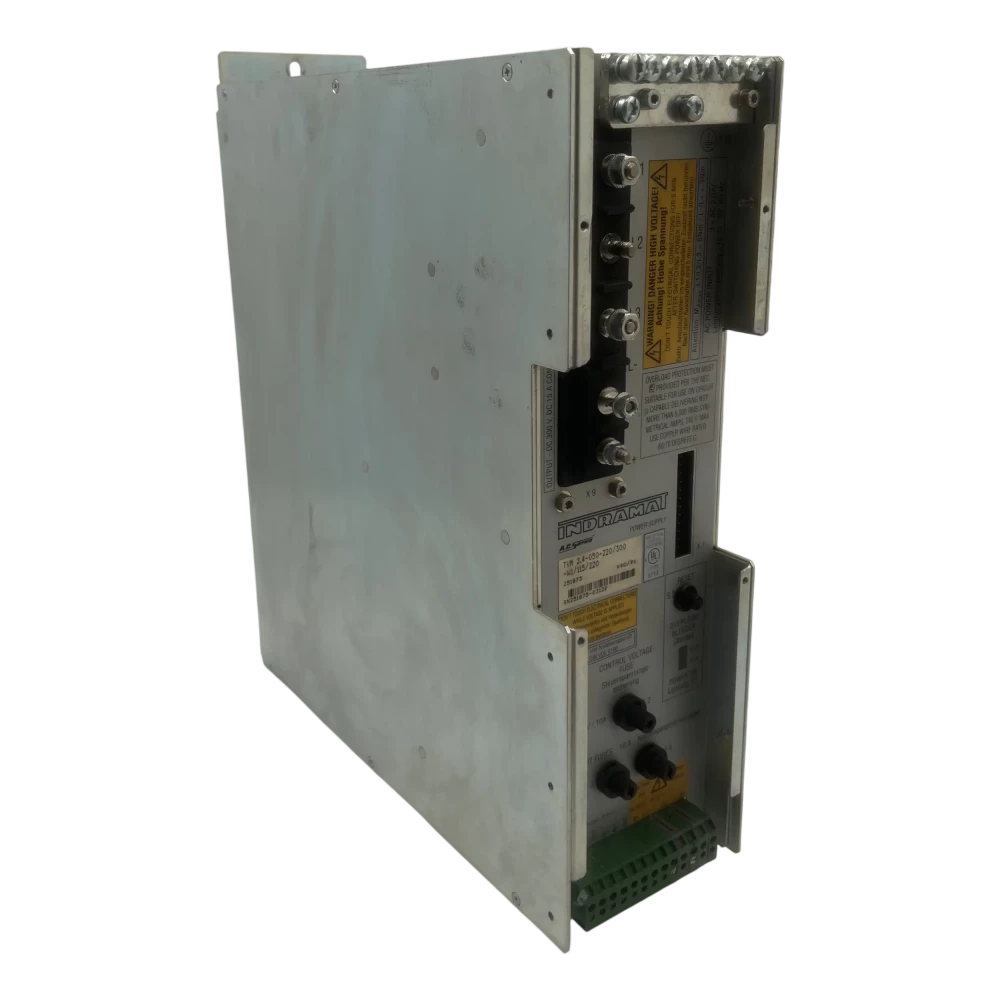 units are also non-regenerative – any energy fed back from decelerating motors is dissipated as heat, not returned to the grid. However, because of their smaller size, TVMs have the advantage of simpler integration: in many cases, a TVM includes the necessary rectifier and filtering internally for its power level, meaning it can be directly connected to the mains without a separate NAM front-end. The design emphasis for TVM was on reliability and straightforward operation in compact motion systems. They were optimized for minimal heat loss given their era’s technology, and often provided basic system monitoring (some could signal faults or ready status to the machine control). Indramat used TVM supplies in earlier CNCs, printing machines, and packaging equipment where 1 to 6 servo axes required a common DC power source.
In summary, TVD vs. TVM can be viewed as high-power vs. lower-power, and newer modular design vs. older generation design. A TVD handles roughly 7–15 kW and up to 10 drives, usually with an external line module for large installations. A TVM handles around 4 kW and ~6 drives, in a more self-contained unit for smaller installations. Neither TVD nor TVM actively regulates DC voltage (they output a rectified bus proportional to AC input), and neither can regenerate energy to the mains – they rely on resistors to absorb surplus energy. Many legacy machines in factories today still run on TVD or TVM modules – for example, an older printing press might use a TVD or TVM unit to power its servo drives. Understanding which one you have is important when seeking service or replacements.
TVD vs. TVM Power Supply Comparison
|
Feature / Specification |
TVD Power Supply |
TVM Power Supply |
|
Type |
High-Power DC Supply (Modular) |
Compact DC Supply (Legacy/Smaller Systems) |
|
Voltage Regulation |
Unregulated DC output |
Unregulated DC output |
|
Energy Handling |
Uses internal/external braking resistors |
Uses internal resistors for small loads |
|
Input Voltage |
3×380–480 VAC (via NAM module) |
3×220–480 VAC (varies by model) |
|
DC Bus Voltage |
~530–670 V DC |
~300–670 V DC depending on configuration |
|
Continuous Power Range |
~7.5 kW – 15 kW continuous |
~4 kW continuous |
|
Peak Power Capability |
2–3× continuous rating for short durations |
1.5–2× continuous rating |
|
Cooling Method |
Forced air cooling |
Natural convection or light forced cooling |
|
Drive Support |
Powers up to 10 servo drives |
Powers up to 6 servo drives |
|
Required Modules |
Works with separate NAM (Line Power Module) |
Usually self-contained, no NAM required |
|
System Type |
Modular high-power architecture |
Integrated low-power design |
|
Regeneration Capability |
Non-regenerative (TVD only; TVR variant regenerative) |
Non-regenerative |
|
Typical Applications |
Large multi-axis machines, printing lines, and CNC systems |
Smaller servo systems, early-generation automation cells |
|
Compatible Drives |
TDM, KDA, DDS, and TDA |
TDM and early analog drives |
|
Maintenance Considerations |
May require NAM inspection and fan replacement |
Simple construction, capacitor aging common issue |
|
Use Case Example |
Multi-axis printing press or packaging line |
Compact machine or single-station automation setup |
Conclusion – Keep Your Legacy System Running with the Right Support
Bosch Rexroth’s HVE, HVR, TVD, and TVM power supplies each serve a specific niche in legacy automation systems – from the simple, rugged HVE and TVM to the energy-efficient HVR and high-capacity TVD. By understanding their differences in technical capability, you can make informed decisions when troubleshooting issues or sourcing a replacement. Always consider your system’s power needs and whether regenerative functionality is worth the investment for your use case. And remember, these units are no longer in production, so having a reliable partner for spares and repairs is essential.
Wake Industrial offers a one-stop solution to keep these power supplies operational. Whether you need to buy a refurbished HVR/HVE or get your faulty TVD/TVM repaired, Wake Industrial has the technical expertise to help. Our team is experienced with all Indramat series mentioned and can quickly diagnose problems. While not an authorized Bosch Rexroth distributor, Wake Industrial provides quality surplus units and repair services backed by warranty, so you can trust the longevity of the solution. Don’t let a power supply failure bring your production to a halt – contact Wake Industrial either by emailing sales@wakeindustrial.com or calling 1-919-443-0207 for prompt support, expert repair, or to purchase a replacement unit. With the right knowledge and the right partner, you can ensure your legacy Indramat-driven systems continue to run reliably and efficiently for years to come.
Request a Quote

Cary, NC 27513