


SERCOS Interface Explained: Deterministic Motion Control over Real‑Time Ethernet
13 February, 2026 | SERCOS interface, Sercos III, real‑time Ethernet, Sercos telegram, MDT AT, UC channel, Sercos topology, Sercos ring redundancy, Bosch Rexroth Sercos, cyclic data, acyclic data, service channel, deterministic Ethernet, motion control network, multi‑axis synchronization, IDN parameters, SDDML, Sercos hot plug, IndraDrive, IndraControl
(Please be advised that Wake Industrial does not offer troubleshooting assistance through phone or email. For repair, replacement, or refurbishment needs, we invite you to use our quote form or call us at 1-877-968-1360.)
SERCOS (Serial Real‑time COmmunication System) is an open, standardized industrial motion interface built to synchronize many axes and I/O with deterministic timing. It began as a fiber‑optic ring bus for drives (SERCOS I/II) and evolved into an Ethernet‑based real‑time system (SERCOS III) that preserves the “hard real‑time” time‑slot and synchronization mechanisms while using IEEE 802.3 Ethernet media and frames.
Bosch Rexroth implements SERCOS across controllers, drives, and I/O. For example, the IndraDrive CSH Advanced Controllers (CSH01.1C, CSH01.2C) act as SERCOS masters via fiber links, and the RMK02.2-LWL-SER-FW is a SERCOS I/O coupler enabling up to 15 RECO I/O Drive modules. The IndraControl XM21 System safety module XFE01.1‑SY‑01 supports Sercos (CSoS) for integrated safety functions. Additionally, depending on the installed option card DKC Drive Controllers can use SERCOS. In commissioning, each device’s SERCOS address (often set by rotary switches or IDNs) is verified and its cyclic data containers mapped.
What SERCOS is
Origins and standardization
SERCOS was developed as a digital drive interface in the mid‑1980s by an industry consortium supported by Verein Deutscher Werkzeugmaschinenfabriken e.V. and Zentralverband Elektrotechnik- und Elektronikindustrie e. V., then accepted as an international standard (IEC 61491) in 1995 and as a European standard (EN 61491) in 1998 for drives on production machines.
A defining design goal was vendor‑neutral interoperability: the standard targets problem‑free operation between controllers and drives from different manufacturers, plus standardized parameters to reduce commissioning and maintenance friction.
SERCOS Technical Overview
SERCOS began as a fiber-optic ring bus for drives (2/4 Mbit/s), evolving to 8/16 Mbit/s (SERCOS II) and now 100 Mbit/s Ethernet (SERCOS III). It is widely used in machine tools, packaging, and robotics for multi-axis synchronization. The bus is strictly master/slave: only the master sends real-time telegrams in each cycle, and slaves process on-the-fly to insert their data. A two-part cycle includes: (1) MDT/AT frames for real-time (cyclic) data exchange, and (2) a UCC (Unified Communication Channel) for acyclic/diagnostic data and standard TCP/IP traffic. Hardware-based synchronization (built into the SERCOS protocol) delivers jitter often less than 1 µs even at millisecond cycle times.
Each slave’s process data occupies a fixed “device channel” in the MDT/AT telegrams. Master and slaves share a common cycle clock (via a global sync pulse). SERCOS also defines a “service channel” for asynchronous parameter access. Topology is typically a line or (redundant) ring: devices daisy-chain (or loop back) via 2-port interfaces. Ring redundancy can re-route traffic within one cycle if a cable breaks.
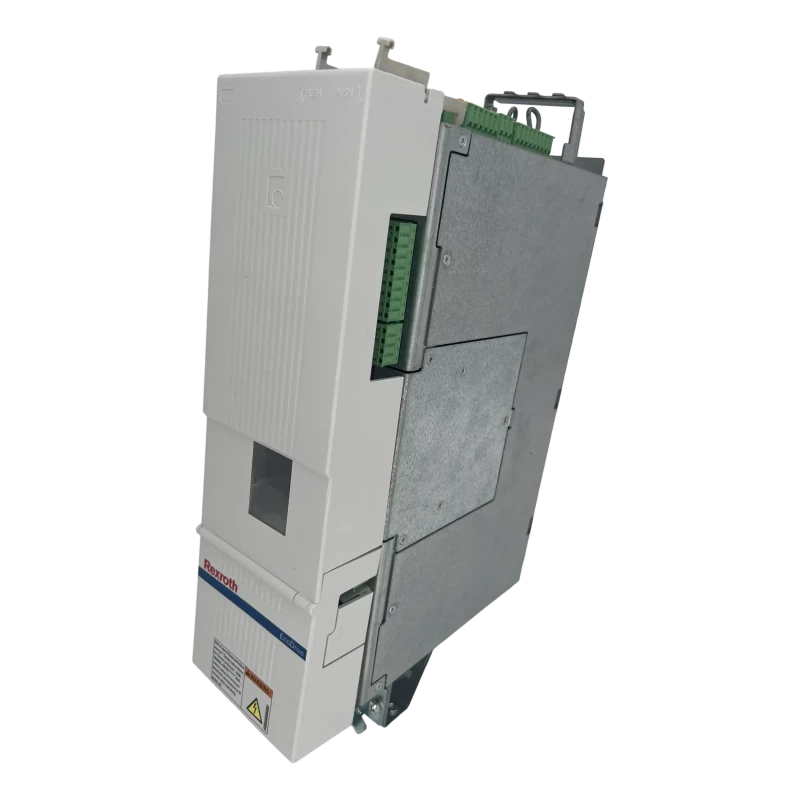
This DKC02.3-100-7-FW uses a SERCOS interface.
Version evolution: SERCOS I, II, and III
SERCOS I (first generation) supported 2 and 4 Mbit/s and was used primarily in advanced machine tool applications.
SERCOS II (second generation) (launched 1999) increased rates to 8 and 16 Mbit/s and extended the service channel for asynchronous (acyclic) data.
SERCOS III keeps the proven SERCOS I/II mechanisms but moves to Fast Ethernet media. SERCOS technology sources describe raising transmission speed from 16 to 100 Mbit/s while transferring the RT (real‑time), SVC (service channel), and hardware synchronization concepts to SERCOS III, and adding Ethernet‑enabled features such as ring redundancy and hot plugging.
Product Examples
|
Product |
Role |
SERCOS Version |
Key Spec |
|
Control Section (Master) |
SERCOS (fiber-optic) |
Fiber SERCOS interface (10 km optical) |
|
|
Control Section (Master) |
SERCOS (fiber-optic) |
Fiber SERCOS interface, RJ45 cross‑comm |
|
|
I/O Coupler (Slave) |
SERCOS I/II (2–4 Mbit) |
Min. cycle 0.5 ms, up to 15 I/O devices |
|
|
Safety I/O Module (Slave) |
Sercos CSoS (Safety) |
Supports Sercos CSoS + PROFIsafe |
Commissioning and Configuration
In Rexroth systems, each SERCOS device must be assigned a unique address. The RMK02.2 coupler, for example, uses two 9-step rotary switches for address 1–99. Control sections like the CSH can set communications parameters via the control panel or serial interface. Once the network topology and addresses are set, the master is programmed (e.g. in IndraWorks or DriveTop) with SERCOS channel mappings. Each slave’s “cyclic container” (input/output block) is linked to process data objects (IDNs). For instance, the RMK coupler uses list parameters (e.g. S-0-1500 series) to expose combined I/O data. Proper mapping and verifying IDs via diagnostics completes setup.

Conclusion
In closing, SERCOS remains one of the most practical ways to achieve truly deterministic, multi-axis motion—whether you’re dealing with classic fiber-optic SERCOS I/II rings or modern SERCOS III over Ethernet—because its cycle-based telegram structure, fixed device channels, and tight synchronization are purpose-built for repeatable machine performance and clean diagnostics when something changes on the network. In Bosch Rexroth ecosystems, the fundamentals stay the same: confirm topology, set unique addresses, map cyclic containers correctly, and use the service/diagnostic channels to validate configuration so commissioning is predictable and downtime is easier to contain.
If you’re supporting legacy Rexroth motion platforms and need help sourcing replacements or arranging repair/refurbishment for SERCOS-based components (controllers, drives, or I/O), Wake Industrial is set up to keep older systems running with dependable turnaround and availability. Just call 1-877-968-1360 or email sales@wakeindustrial.com to get a comprehensive and competitive quote from Wake Industrial.
(Please be advised that Wake Industrial does not offer troubleshooting assistance through phone or email. For repair, replacement, or refurbishment needs, we invite you to use our quote form or call us at 1-877-968-1360.)
Request a Quote

Cary, NC 27513