


The Hidden Threat of Humidity on Industrial Motors and Drives
12 June, 2025 | Humidity, Automation, Industrial Motors, Industrial Drives, Bosch Rexroth, Bosch Rexroth replacements, Bosch Rexroth Water Damage, humidity effects on industrial motors, moisture damage in electric motors, Bosch Rexroth servo motor failure, industrial drive insulation resistance, condensation in control cabinets, Bosch Rexroth Indramat repair, motor replacement, industrial motor insulation resistance drop, IP rating for manufacturing equipment, drive failure due to humidity, MKD, MHD, DKC, MKE, MSK

The Hidden Threat of Humidity on Industrial Motors and Drives
Industrial facilities often focus on obvious challenges like heavy loads or high temperatures, but humidity is an often underappreciated threat. Excess moisture in the air can silently wreak havoc on electric motors, drives, and other industrial equipment. In manufacturing plants – and even in sectors like food processing or oil & gas – uncontrolled humidity can lead to corrosion, electrical failures, and unplanned downtime. This blog dives into the effects of humidity on industrial equipment with a technical lens, using examples from Bosch Rexroth motors and drives to illustrate key points. We’ll also explore practical maintenance tips, early warning signs of moisture damage, and what steps you can take – including when to seek repairs or replacement from Wake Industrial – to protect your investment. Use the embedded quote form to place a quote on a product NOW. (Note: Wake Industrial is not an authorized distributor of Bosch Rexroth, but offers extensive repair services and refurbished equipment.)
Humidity: The Invisible Equipment Killer in Manufacturing
Water and electricity are a notoriously bad mix, so it’s no surprise that humid environments pose a risk to industrial electrical equipment. High relative humidity means the air is carrying a lot of moisture, which can eventually find its way into motors, drives, and control cabinets. When humidity exceeds about 95%, water can start condensing on cool surfaces – forming films of liquid that penetrate into crevices. Manufacturing environments without climate control, or those subject to washdowns (as in food processing), often struggle with high humidity levels. In oil & gas fields or coastal plants, warm moist air can infiltrate equipment enclosures. Over time, this moisture can reduce the integrity of insulation materials and corrode metal components, making humidity a silent killer of industrial machinery.
Studies on motor reliability underscore the risk. In fact, industry sources estimate that a significant portion of motor failures – on the order of 16% – are attributed to external factors like moisture and harsh environments. It’s easy to see why: a thin film of water inside a motor or drive can trigger short circuits, rust bearings, or cause insulation to break down. Humidity doesn’t usually destroy equipment overnight; instead, it sets in motion a slow decay of materials and performance that, if left unchecked, leads to failures and costly downtime.
How Humidity Damages Electric Motors
Electric motors are the workhorses of manufacturing, and they are particularly vulnerable to moisture. Excessive humidity can cause a motor to run abnormally hot, because water absorbed into the winding insulation creates leakage currents and degrades the insulation’s ability to resist electricity. Essentially, moisture provides a path for electricity to “leak” across motor windings or to the motor’s frame, which not only wastes energy but also heats up the motor. Over time, this stress can lead to insulation breakdown – a leading cause of motor burnouts. The moisture buildup reduces the insulation resistance (IR) of the motor windings, a critical parameter for safe operation. Technicians often perform IR tests, and a sudden drop in insulation resistance is a red flag for moisture inside the motor. In extreme cases, motors in very damp conditions have shown IR values dropping below 1 MΩ after just an hour offline, meaning the motor is too wet to run without risking a short. If a motor’s insulation resistance is below safe levels (many manufacturers advise 1 MΩ or 2 MΩ minimum), powering it on could result in a catastrophic failure.
The mechanical parts of motors suffer as well. High humidity encourages rust on steel components – for example, the laminated iron core of a motor stator or the rotor can start to corrode, which over time increases friction and reduces efficiency. Bearings inside the motor are typically grease-lubricated, but moisture can invade the bearing housing, emulsifying the grease and causing the bearings to corrode or seize. In Bosch Rexroth’s Indramat motors – such as the MKD and MHD synchronous motor series – the housings are precision machined and often painted or coated to resist corrosion. However, even a durable epoxy coating can’t fully protect a motor if moisture manages to condense inside the housing or on the windings. High humidity has also been known to swell or soften insulation materials and even promote mold growth on insulation. In exceptionally damp environments, microscopic mold can grow on windings; the by-products of that mold are acidic and can further eat away at insulation and metal parts.
One telltale sign of moisture in a motor is unexplained performance issues. The motor may run hotter than normal or draw higher current due to leakage paths, even if the mechanical load hasn’t changed. Operators might also notice the motor’s internal cooling fans or external surfaces accumulating a thin fog or droplets when the motor cools down. Unusual noise can occur if rust begins to form on the rotor or in the bearings. If you suspect a motor has moisture inside, resist the urge to simply run it hoping the heat will dry it out. Experts warn that running a wet motor will likely cause more harm – the stress of operation with compromised insulation can rapidly damage the windings. Instead, the motor should be thoroughly dried and reconditioned before being returned to service. Wake Industrial offers repair and replacement services for motors damaged by humidity. If your motor has incurred severe damage from humidity contact Wake Industrial today by calling 1-919-443-0207 or by filling out the quote form above.
Bosch Rexroth offers various motor designs with different ingress protection (IP) ratings for moisture resistance. For instance, many of their IndraDyn series servo motors (like the MSK series) come with at least an IP65 rating at the body, meaning they are dust tight and can resist water jets. Some models, especially the explosion-proof MKE series, are built for severe environments. Even so, IP65 does not guarantee condensation won’t form internally if temperature cycles cause moist air to get sucked in. Proper seals and drain mechanisms are vital. It’s worth inspecting the shaft seals and cable gland seals on motors; over time these can wear out or crack, letting humidity creep past. For example, a food processing plant’s Bosch Rexroth servo motor (an Indramat 2AD 3-phase induction motor used for a conveyor) showed rust around the shaft because the water seal had worn – a clear sign that humid cleaning procedures were taking a toll. Regularly replacing or upgrading seals can help keep moisture out.
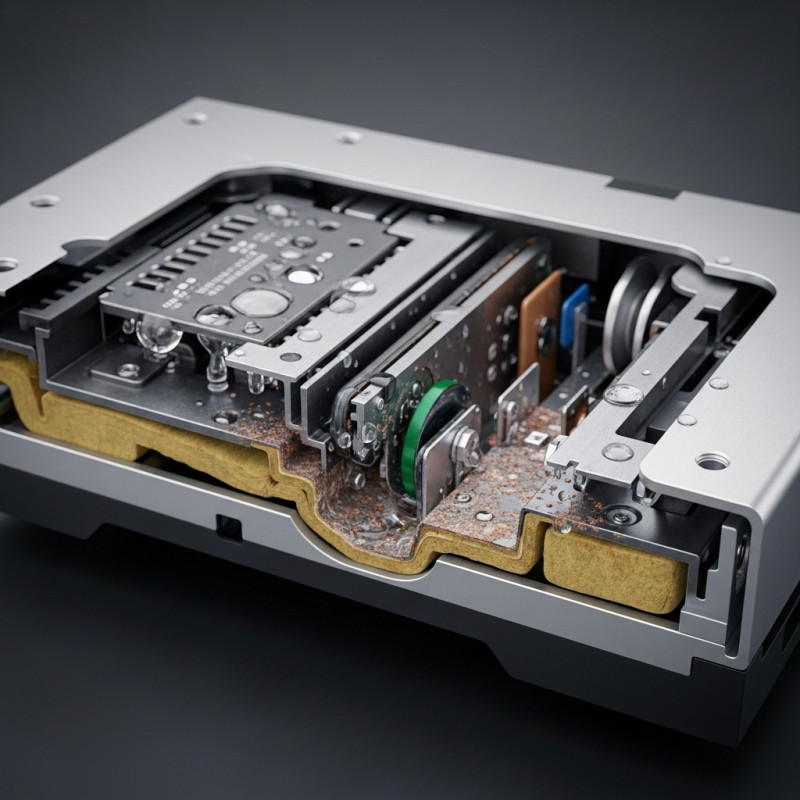
Condensation on electronic components can cause immediate short circuits or long-term corrosion of printed circuit boards, connectors, and IC chips.
Condensation and Corrosion in Electronic Drives and Controllers
It’s not just the big motors – the drives and electronic control units that run these motors are also at risk. Modern variable frequency drives (VFDs) and servo drives, like Bosch Rexroth’s DKC series drive controllers, are packed with sensitive electronics. These drives are often installed in control cabinets on the factory floor. Even if the ambient air is humid, as long as the electronics stay slightly warmer than the air, condensation might be avoided. But problems arise when there’s a drop in temperature or when a drive is powered down in a humid environment – that’s when moisture can settle onto circuit boards. Condensation on electronic components can cause immediate short circuits or long-term corrosion of printed circuit boards, connectors, and IC chips. A drive that has been exposed to a moist atmosphere might not fail right away; instead, it could develop intermittent faults, communication errors, or strange behavior as corrosion slowly bridges circuits or increases resistance in connectors.
Bosch Rexroth Indramat drives are generally specified to operate in high humidity (often up to 95% relative humidity) but only if no condensation occurs. Manufacturers include this caveat because liquid water is the real danger – pure humidity in vapor form doesn’t short electronics, but the moment it turns to liquid water on a cooler surface, all bets are off. For example, an IndraDrive DKC01.1-040-7-FW might function flawlessly in a 90% RH factory on a hot day, but if the factory cools down at night while the air is still humid and the drive is off, morning might reveal water droplets on the drive’s control boards. Over time, even trace amounts of condensation lead to oxidation of solder joints and IC pins. You might open a malfunctioning drive to find a white or greenish powdery residue – that’s oxidation or corrosion from moisture exposure.
To combat these issues, industrial drive units sometimes come with conformal coating on their circuit boards – a thin protective varnish that shields against moisture and dust. It’s worth checking if your Bosch Rexroth drive’s internal PCBs have such coating. Additionally, pay attention to the enclosure where the drives reside. An IP-rated cabinet (e.g., IP54 or higher) with proper gasketing can keep humid air out. However, remember that even a sealed cabinet can trap moisture inside if there was humidity present when it was closed, leading to a greenhouse effect when temperatures fluctuate.
One practical tip for drives is to use anti-condensation heaters or small heating elements in the cabinet. These low-wattage heaters (or even just keeping the drive in a powered standby mode) maintain the temperature a bit above the dew point, so water never condenses. For instance, if you have a Bosch Rexroth DDS drive or a DKC EcoDrive installed in a large outdoor control box in a cold climate, adding a tiny thermostatic heater inside can prevent the drive from ever getting colder than the humid air, thereby avoiding internal dew. This approach is commonly used in oil & gas and water treatment facilities where drives in remote panels must survive overnight temperature drops. Breather plugs are another accessory often recommended – these allow a sealed drive enclosure to expel moisture. Some Bosch Rexroth motors and drives have optional breather or drain plugs at low points; ensure these are present and kept clear so that any accumulated water can drain out. Even with all these measures in place, water damage can still occur. Wake Industrial specializes in replacing and repairing damaged Bosch Rexroth servo drives and motors. Our technicians are familiar with both new and legacy Rexroth equipment so you can rest assured that your line will be back up in no time. Contact Wake Industrial now at sales@wakeindustrial.com or call 1-919-443-0207 to get prompt, expert help.
| Recommended Minimum IP Ratings by Environment | |||
| Industrial Environment | Motors | Drives / VFDs | Control Cabinets |
|---|---|---|---|
| General manufacturing (humid but no direct washdown) | IP 55: otally enclosed, dust-protected, water-jet resistant (e.g., IEEE 841 TEFC motors). | IP 54: Drives themselves are often IP20, but when housed in an IP54 panel they meet dust-splash protection. | IP 54: NEMA 12 enclosures meet the same dust-splash protection. |
| Food processing & wash-down areas | IP 66: Stainless “wash-down duty” motors must survive powerful jets. | IP 66: Drives need the same wash-down sealing when exposed. | IP 66/NEMA 4X: Required for frequent high-pressure sanitation |
|
Oil & Gas |
IP 56: IEEE 841 severe-duty (petro-chem) motors specify at least IP55; many vendors up-rate to IP56 for salt-spray. | IP 66: Drives in salt-fog zones are normally put in sealed, corrosion-resistant cabinets. | IP 66/NEMA 4X: Matches the harsh, wet, corrosive environment requirements. |
| Clean-room (pharma / semiconductor) | IP 65: Dust-tight and low-pressure wash-down tolerated without particle release. | IP 65: Same logic for servo drives mounted inside clean-room machinery. | IP 65: Electrical cabinets must allow wipe-down while keeping particulates out. |
5 Preventative Measures and Maintenance Tips for Humid Environments
Dealing with humidity is all about prevention and early intervention. Here are several strategies, explained in practical terms, to mitigate moisture damage in industrial settings:
1. Environmental Control: Where feasible, regulate the environment of your equipment. This could mean installing dehumidifiers or HVAC systems in sensitive areas. Keep drive cabinets and motor rooms at stable temperatures. If a facility is not fully climate-controlled, even localized solutions like placing desiccant (silica gel packs) inside larger cabinets can help absorb moisture. In some cases, painting or coating the walls and floors of an equipment room with vapor-barrier paints can reduce the ingress of ambient humidity.
2. Use Proper Sealed Equipment: Always choose motors, drives, and components with appropriate IP ratings for the environment. A Bosch Rexroth motor specified as IP65 or IP67 has sealing against dust and water, which is essential in humid or washdown settings. Make sure all wiring glands, conduit entries, and junction boxes are likewise rated and properly sealed with gaskets. Remember that seals age – what was once IP65 might not remain so after years of vibration and heat. Schedule periodic replacement of critical seals and gaskets, especially on older Bosch Rexroth Indramat units that may have been in service for decades.
3. Anti-Condensation Heaters and Drains: As mentioned earlier, consider adding space heaters or heating strips in motor enclosures and electrical cabinets. Many large motors come with built-in heater coils for this exact reason – they energize when the motor is off to keep windings warm and dry. Ensure these heaters are functional and turned on during downtimes. Additionally, use drain plugs or breather valves if the equipment is designed for them. For example, if you have a vertically mounted motor, check the lowest point for a drain – open it during maintenance to see if any water comes out. It’s better to let it out than let it accumulate inside.
4. Regular Inspection and Testing: Include moisture checks in your routine maintenance schedule. This can be as simple as using an insulation resistance tester (Megger) on motors during yearly overhauls. Track the IR values of critical motors over time; a downward trend might indicate rising moisture content in the windings. Visually inspect for condensation inside control panels early in the morning (when it’s often coolest and most humid) – this is when you’ll catch water droplets if they form. If you find any, you need to improve enclosure sealing or add anti-condensation measures immediately. Also, inspect for corrosion: if you see green or white deposits on copper or circuit boards, that’s a sign of oxidation from moisture. Clean it carefully and investigate the source of the moisture.
5. Protective Coatings and Treatments: For extremely humid or corrosive environments, consider special protective measures. Motor windings can be vacuum pressure impregnated (VPI) with varnish for a higher degree of moisture resistance – many Bosch Rexroth motors will have their windings varnished at the factory, but a re-varnish can be done during a rewind. External metal parts can be coated with rust-inhibiting paint. You might also opt for stainless steel motor shafts or hardware to avoid rust. On the electronics side, if you send a drive or PCB out for repair, request conformal coating application. This extra layer can prolong the life of repaired drive boards in humid settings.
It’s clear that an ounce of prevention is worth a pound of cure when it comes to humidity. But what if your equipment is already showing signs of moisture damage?
Early Warning Signs of Humidity-Related Damage
Recognizing the symptoms of humidity damage early can make the difference between a minor repair and a major failure. Electrical symptoms are often the first to appear. For motors, one early warning is difficulty in maintaining insulation resistance. If periodic Megger tests show dropping IR values, it’s a sign the motor could be absorbing moisture. Operationally, you might see nuisance tripping of motor protection relays or ground fault alarms on drives. These can occur if moisture creates transient short paths to ground. A drive like a Bosch Rexroth DKC01.3-016-7-NN-FW might suddenly throw an overcurrent or grounding fault if condensation formed on its control board overnight. If a drive resets in the morning but trips again the next day, suspect moisture as a culprit – it could be drying out as the day warms, then condensing again during the night cycle.
Visual cues are also telling. Any visible condensation on or inside equipment is a big red flag. For instance, if you open a control cabinet door and see fog on the back of a VFD’s display panel or water beading on cables, that’s an immediate call to action. Rust is another visible indicator – rust on motor fan covers, mounting flanges, or the bolts of a Bosch Rexroth MKD025A-144-GP0-KN motor could indicate that humid air has been condensing on those surfaces regularly. Discoloration or a chalky residue on circuit boards (often bluish-green for copper corrosion) means moisture has been present enough to oxidize metals. Unusual noises can be a subtle sign: a motor with slight rust on the rotor or bearings might hum or whine differently, or its bearings might squeal from lubricant washout. Likewise, a drive with a corroded fan might develop a noisy or failed cooling fan.
A notable symptom is overheating without apparent cause. As noted, moisture in windings can make a motor run hot, so if a typically reliable motor starts overheating under the same load, it’s worth checking for moisture ingress. Similarly, a drive that frequently overheats might have clogged filters or dust mixed with moisture forming an insulating layer on heat sinks – a double whammy of dust and humidity. If you observe any of these signs, do not ignore them. Early intervention can save the equipment. This might involve drying out the device or sending it for a professional inspection with Wake Industrial.
| Temperature vs. Insulation Resistance under Humid Conditions | ||
| Temperature (°C) |
Insulation Resistance ≈50 % RH (MΩ) |
Insulation Resistance ≈90 % RH (MΩ) |
|---|---|---|
| 20 | 100 | 10 |
| 30 | 50 | 5 |
| 40 | 25 | 2.5 |
| 50 | 12 | 1.2 |
| 60 | 6 | 0.6 |
Drying Out and Repairing Moisture-Damaged Equipment
If you do find that an electric motor or drive has been compromised by humidity, the first step is thoroughly drying the equipment before further use. For motors, never simply run a wet motor and hope it dries – this can cause immediate damage. Motors can sometimes be dried by placing them in a warm, dry room or using infrared lamps. It’s critical that such drying is done until the insulation resistance recovers to normal. Only then should the motor be re-energized. If the IR cannot be restored, it may mean the insulation has been irreversibly damaged and a rewind or replacement is needed.
For drives and electronic units, drying is a bit trickier due to sensitive components. You can still use gentle heat – for instance, placing the unit in a drying cabinet or a room with a dehumidifier. Do not exceed the temperature ratings of the electronics. Sometimes isopropyl alcohol rinses are used by repair technicians to displace water and then evaporate, but this should only be done by professionals who know the process. If corrosion is present on a PCB, it may need to be cleaned with electronic-safe solvents and possibly have damaged components replaced. Bosch Rexroth drive owners might opt to send the unit to a service center like Wake Industrial’s repair service where experts can fully disassemble, clean, dry, and test the drive under load.
In cases of severe humidity intrusion – for instance, a motor that sat in a flooded area or a drive cabinet that was exposed to heavy condensate – you should strongly consider professional refurbishment or replacement. The cost of failure in production (lost product, safety risks, collateral damage) can far outweigh the repair costs. Fortunately, Wake Industrial specializes in exactly these scenarios. Wake Industrial carries a full inventory of Bosch Rexroth Indramat motors and drives (including popular lines like the DKC drives, MKD and MSK servo motors) and offers both repair and replacement options to get your facility back up and running quickly. Whether your Bosch Rexroth Indramat MKD motor needs a complete rewind due to moisture damage or your IndraDrive controller needs swapping out, our expert staff can guide you on the best course. Wake Industrial even provides one-year warranties on repairs giving you peace of mind that the repaired unit will perform reliably.

Conclusion: Stay Ahead of the Moisture Menace
Humidity may be unavoidable in many industrial environments, but its damaging effects on motors, drives, and other equipment certainly are avoidable. By understanding how moisture attacks insulation and electronics, engineers and plant operators can implement smart preventative measures to safeguard their equipment. From ensuring a Bosch Rexroth servo motor has proper seals and heaters, to keeping a VFD cabinet dry and clean, a proactive approach will extend the life of your machinery and prevent those sudden, costly breakdowns. Always stay vigilant for the early warning signs of humidity-related trouble – a bit of rust here, a tripped circuit there – and address them promptly before they escalate.
If you’re already facing issues due to humidity – be it a corroded drive or a motor that needs rewinding – don’t hesitate to act. Sometimes the best course is a professional repair or a high-quality replacement part. Wake Industrial stands ready as a resource in this regard, with rapid support for Bosch Rexroth Indramat equipment repairs and a stock of refurbished units to minimize your downtime. Our technicians can help identify whether a motor can be saved or if it’s more prudent to replace it with an equivalent model from our comprehensive inventory. Get in touch with Wake Industrial either via the quote form embedded on this page or by calling 1-919-443-0207.
Moisture might be an ever-present adversary in industrial settings, but with knowledge, vigilance, and the right support, you can keep your motors humming and your drives blinking dry and bright. Don’t let humidity steal productivity from your plant – take action to weather-proof your equipment today, and reach out for expert help from Wake Industrial when needed to ensure a long, efficient life for your industrial assets.
(Note: Wake Industrial is not an authorized distributor of Bosch Rexroth, but offers extensive repair services and refurbished equipment.)
Request a Quote

Cary, NC 27513












