


P21NRXC-LDN-NS-00 Pacific Scientific
Wake Industrial LLC is not an authorized distributor of this product.
- Straightforward Pricing: No Rush Fees, No Credit Card Fees
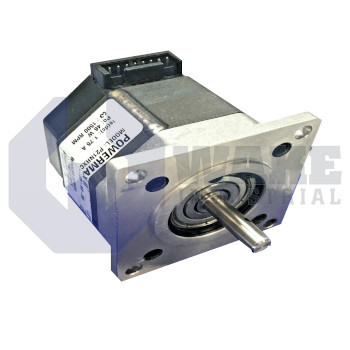
The Pacific Scientific P21NRXC-LDN-NS-00 is part of the POWERMAX II P Motors series and features a NEMA 23 frame size with standard construction. It has a holding torque of 0.82 Nm, operates with a rated current per phase of 3.5 Amps, and supports a double smooth shaft configuration. The motor weighs 0.68 kilograms, measures 52.4 mm in length, and provides a step angle of 1.8 degrees with 200 steps per revolution.


To contact sales for pricing and lead time:
Payment Methods


Shipping Methods


Our Credentials


Product Description:
The P21NRXC-LDN-NS-00 is a hybrid stepper motor produced by Pacific Scientific within the POWERMAX II P Motors series. It converts pulse commands from a drive into incremental motion for pick-and-place modules, indexing tables, and other automation axes. A NEMA 23 frame, standard construction, and a double-ended smooth shaft give flexible coupling options for mechanical loads or external sensors.
During operation, the motor can develop a holding torque of 0.82 Nm with a single-stack rotor driven at a rated phase current of 3.5 A. Each full step advances 1.8 degrees, giving 200 discrete positions per revolution and a step accuracy of ±1.5%. The winding inductance of 2.3 mH balances low-speed torque with mid-range resonance control, while Class B insulation supports an ambient range of -20 °C to +40 °C and a permissible coil temperature of 130 °C. At only 0.68 kg, the 52.4 mm long body minimizes inertia loads on lightweight gantries. Electrical isolation is assured by 100 MΩ resistance and a 340 Vdc withstand rating. Lead-wire terminations exit through a receptacle in the regular connection style, and because there is no feedback device, the drive operates open loop. The smooth double shaft has a diameter of 6.35 mm and follows NEMA mounting conventions for coupling.
The mechanical envelope is rated for axial loads up to 60 N and radial loads up to 90 N, allowing the bearings to support belts, gears, or encoder wheels without early fatigue. Surface temperature can reach 95 °C at maximum duty, so ventilation should be arranged to stay below the insulation limit. With only 0.03 Nm of detent torque, low-current microstepping remains smooth when the drive is energized but unloaded. The standard rotor and single-stack layout reduce mass while maintaining linear torque across each 200-step revolution, and the regular lead-wire connection removes the need for specialized feedback cabling.









