


Comparing Bosch Rexroth DKC Drives vs. DKS Drives – A Technical Deep Dive
25 July, 2025 | DKC, Ecodrive, DKS, Bosch Rexroth, Indramat, Bosch Rexroth Indramat, Drive Controllers, Servo Drives, DKS01.2-W100A-DL05-01-FW, DKC05-3-200-7-FW, MKD, MHD, MDD,
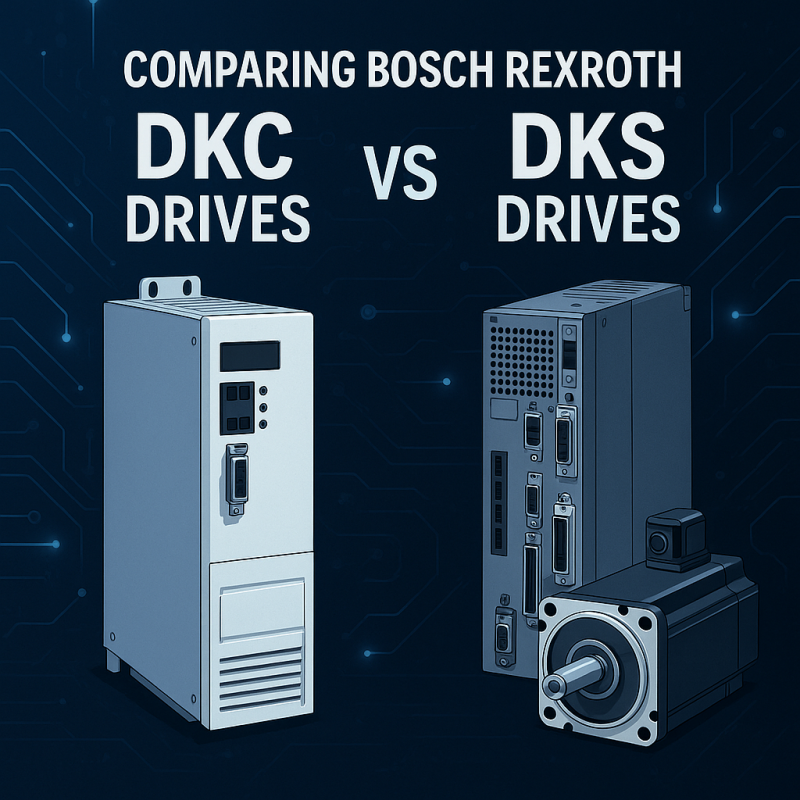
Bosch Rexroth (formerly Indramat) produced both the DKS and DKC series servo drive controllers, which are widely used in industrial motion control. Both series are legacy digital AC servo drives designed to precisely control brushless servo motors in automation systems. However, there are key differences in their design, capabilities, and typical applications. Today we’ll provide a detailed comparison of DKC and DKS drives – highlighting their technical features, use cases, and considerations for maintenance. Wake Industrial offers comprehensive support for both DKS and DKC drives, call 1-919-443-0207 now to speak with a representative and get a quote.
Understanding Indramat DKS Servo Drives
Indramat DKS Servo Drive (Integrated Drive/Controller): The DKS series drives from the Indramat era are fully integrated digital AC servo drive controllers, meaning each unit contains both the power supply section and the control electronics in one package. Unlike older modular drive systems that required a separate power supply module, a single DKS drive can be directly connected to mains AC and a servo motor – providing a space-saving, all-in-one solution. The DKS was introduced in the mid-1990s as a “digital positioning module” aimed at cost-optimized single-axis motion control tasks. It supports three-phase 230 VAC input (50–60 Hz), internally rectifying it to a DC bus (~300 V DC). Models were produced with peak current ratings of 30 A, 50 A, or 100 A, corresponding roughly to drives handling up to ~8 kW of power for dynamic motion control. An example is the DKS01.2-W100A-DL05-01-FW, which accepts 3×230 V AC and can deliver 50 A continuous / 100 A peak to the motor. Because the DKS is integrated, no external power supply or DC bus module is needed; you simply wire in the AC line, connect the servo motor and feedback, and the unit is ready to control the axis. This self-contained design results in simpler installation and wiring, which was a major advantage for machine builders in its time.
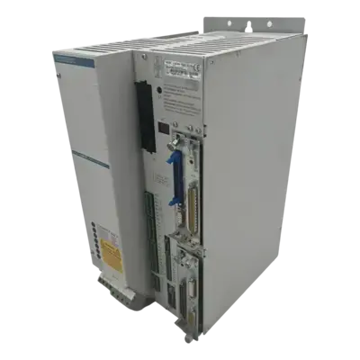
The compact controller has a current rating of 100 A and a power requirement of 11 kVA. This controller also has a supply voltage of 230 V and standard noise emission.
The front panel of a DKS drive features multiple plug-in option slots (U1–U5) that allow the drive to be adapted to different control interfaces and functionalities. Indramat offered various auxiliary plug-in cards for the DKS, including: analog and digital I/O interface cards, an incremental encoder interface, high-resolution position feedback interface, and the DLC single-axis positioning card for standalone motion control. By inserting the appropriate modules, a single DKS base unit could be configured for different control modes. For example, one common configuration uses a SERCOS interface module for tightly synchronized multi-axis control, while another might use the DLC positioning module to let the DKS execute pre-programmed motion sequences on its own. In fact, a DKS with a DLC card can act as an indexer – storing and moving to preset positions triggered via I/O – providing simple point-to-point motion control capabilities built into the drive. This flexibility was a significant benefit for end users, as the DKS could either be integrated into a higher-level automation network or perform basic motions autonomously.
From a performance standpoint, DKS drives were known for their robust torque, velocity, and position control of AC servo motors. They are compatible with Indramat’s MDD series AC servo motors (and even the early MKD motors), forming a matched drive-motor system for precise motion. The DKS performs closed-loop control of the motor using feedback and can achieve high dynamic response for industrial tasks. Indramat offered the DKS in two main versions: DKS 1.1 and DKS 1.2. The two look nearly identical externally and share the same footprint, but the Version 1.2 units include some heavier-duty internal components and provisions for an external capacitor bank to better handle regenerated energy during rapid moves (improving high-speed indexing performance). In practice, this means a DKS01.2 can absorb more kinetic energy from a decelerating load without tripping an overvoltage fault, thanks to optional external capacitors, compared to a DKS01.1 model. Aside from that, the versions operate similarly, and many fundamental specs are the same between 1.1 and 1.2. All DKS drives include an alphanumeric status display on the front for diagnostic codes, making it easier for maintenance personnel to identify faults or operational status at a glance.
Applications
Indramat DKS drives were widely used in industrial automation throughout the 1990s, and many are still in service today. According to Bosch Rexroth documentation, the DKS module’s performance and features made it ideal for applications such as machine tools, handling systems, assembly equipment, material conveying, packaging machines, textile machinery, and printing presses. Essentially, anywhere a precise single-axis motion needed to be automated (up to ~8 kW), the DKS could be deployed. For example, a DKS might drive the spindle or tool axis of a CNC machine, or control a conveyor/feed roll in a packaging line, or position parts in an assembly station. The all-in-one nature of the DKS simplified the design of equipment since it reduced the number of separate components in the control cabinet. Many engineers appreciated the DKS for its reliability and longevity – these units are robust and can often be refurbished if they fail.To read more on operating DKS drives click here.
Today, DKS drives are considered legacy products. Wake Industrial supplies and services all varieties of Indramat DKS drives to keep legacy systems running. Wake Industrial can provide refurbished DKS units or repair your existing drives. With proper maintenance and available spare parts from Wake Industrial, a DKS-based motion control system can continue to operate effectively for years. To speak with a Wake Industrial representative about repairing your DKS drive call 1-919-443-0207 or fill out the quote form embedded on the page.
Understanding Bosch Rexroth DKC “EcoDrive” Servo Drives
Bosch Rexroth Indramat DKC Drive Controller (EcoDrive series): The DKC series, often branded as EcoDrive, was introduced by Indramat as a successor/alternative to the DKS drives for digital motion control. DKCs are a range of intelligent servo drive controllers that were designed to be low-cost, high-functionality solutions for single-axis or multi-axis automation tasks. Like the DKS, the DKC drives are also integrated drive/controllers that connect directly to the AC mains and drive the servo motor without a separate supply module. The EcoDrive DKC Type 1 series was launched in the late 1990s as a “compact AC controller” that could fill the same roles as the DKS while being more economical and modular. These Type 1 DKC drives (model codes DKC**.1-***-FW) had the firmware embedded internally and came in a single power size but with two available line voltage ratings. Specifically, Type1 DKC controllers were all 40 A drive units for the high-voltage version, and when configured for lower voltage (230 V class) they were limited to about 30 A output due to the reduced DC bus voltage. In other words, Indramat offered a 40 Amp, 700 V DC nominal drive (for 3×380–480 VAC mains) and a 30 Amp drive for 3×230 VAC mains – covering both common industrial supply standards. This dual-voltage approach was useful for different markets, but all Type1 drives shared the same physical size and 40 A hardware design.
One drawback of the initial DKC Type 1 series was that they were purpose-built and not easily reconfigurable – the firmware was stored on an internal EEPROM, so changing or upgrading firmware required opening the unit, and each model had a fixed interface. To address these limitations, Bosch Rexroth later introduced the EcoDrive DKC Type 3 series (model codes DKC**.3-***-FW), which brought significant improvements in flexibility and power range. The DKC Type 3 drives moved the control firmware and parameters to a removable ESM module (External Storage Module) that plugs into the drive. This means if a drive fails, the module carrying its firmware and parameter set can be simply transferred to a new drive unit, allowing fast replacement and minimal downtime without needing a PC to reload all settings. Type 3 drives also introduced a modular I/O interface (the “BGR” card) design – essentially, the power section of the drive could accept different interface cards so that one spare drive could be configured for multiple interface options. In practice, this meant a maintenance team could stock one DKC power module and a few interface cards and cover many different axes, rather than stocking numerous specific drive variants. Additionally, two higher power ratings were added in DKC Type 3: 100 Amp and 200 Amp models. These larger drives allowed the DKC series to handle more powerful motors and heavier loads. Notably, for the Type 3 generation the 230 V low-voltage version was dropped entirely – all Type 3 DKC drives are for the 700 V DC bus (380–480 VAC input) and cover 40 A, 100 A, and 200 A ranges.
The DKC05.3-200-7-FW is a versatile and robust AC servo amplifier drive controller designed for use in machines used in commercial environments.
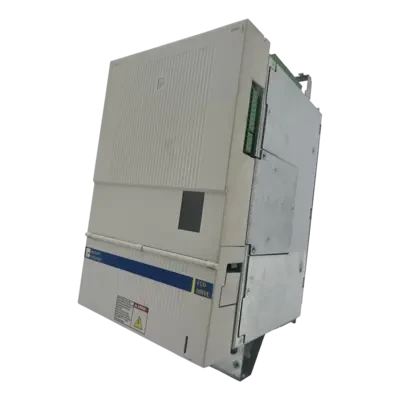
The DKC series covers a wide array of communication interfaces and control modes, thanks to its model variants. Indramat designated the interface by the model code: for example, DKC01 and DKC11 units use an analog/±10V interface, with the ability to accept analog velocity or torque commands and also support a simple position/indexing mode. The analog models often also included a parallel encoder input or even a step/direction interface. By contrast, a DKC02 model is equipped with a SERCOS digital interface for fiber-optic communication with a motion controller. Similarly, DKC03 units have a Profibus-DP fieldbus interface, DKC04 supports Interbus, and DKC05 like the DKC05-3-200-7-FW supports CANopen, each of those also including the ability to store up to 64 position setpoints for point-to-point motions. There were even further extensions, but the main idea is that DKC drives could natively speak the popular industrial networks of the time or operate on analog commands, depending on the model. This made the DKC very versatile – an engineer could choose the drive that best fit their control system architecture. For instance, in a packaging line controlled by a PLC with Profibus, a DKC03.x drive could integrate seamlessly on the bus; whereas a standalone machine tool might use a DKC01.x with analog interface and an onboard positioning capability to execute moves from simple I/O triggers.
In terms of motor pairing, the DKC EcoDrive family was typically matched with Indramat’s later servo motors such as the MKD and MHD series AC servomotors. The combination of a DKC compact controller plus an MKD servo motor offered an efficient, maintenance-free motion axis with high accuracy. The DKC’s control loop and power electronics provided tight velocity and position control, and features like integrated holding brake control, software travel limits, and diagnostic displays improved the overall system functionality. The drives have built-in protections and an RS-232/RS-485 serial port (X6) for commissioning via PC software. Technicians use the DriveTop software utility to configure DKC parameters, tune servo loops, and monitor status. For daily operation, the DKC has an LED display for status/fault codes, much like the DKS, aiding in troubleshooting on the factory floor. To read more on operating DKC drives click here.
Applications
The DKC EcoDrive controllers are found in a broad range of industrial applications very similar to those of the DKS – but generally in slightly more modern systems (late 1990s through 2000s). Their high flexibility and network connectivity made them popular in multi-axis automated machines. According to Bosch Rexroth, DKC drives provide precise multi-axis motion control for applications like machining operations, material handling and transporting systems, positioning and pick-and-place machines, palletizing systems, and more. They are commonly used in assembly lines, packaging machinery, printing machines, and CNC equipment, among other areas. Essentially, any task requiring accurate speed and position control of a servo motor (up to about 10 kW) could leverage a DKC drive. For example, a DKC might control an axis of a printing press ensuring registration and proper indexing of the print rollers or drive a robot arm joint in an assembly cell with a Profibus interface to the robot controller. Many OEM machine builders standardized on the EcoDrive DKC due to its reliability and cost-effectiveness – the DKC series earned a reputation for unrivaled reliability in its class and a favorable price-to-performance ratio for automation projects. This balance of performance and affordability was a key selling point, hence the “EcoDrive” name. The DKC drives also simplify integration by allowing up to 32 motion setpoints to be stored internally for executing simple motion sequences via standard I/O, which can eliminate the need for an external motion controller in some cases. All these factors made the DKC a workhorse in many plants.
Like the DKS, the DKC series is now a legacy product line. Nonetheless, countless machines in service still rely on DKC drives. Companies such as Wake Industrial specialize in supporting these legacy DKC units: Wake Industrial can provide refurbished DKC drive controllers, repair faulty units, or supply replacement parts (note: they operate as an independent reseller, not an authorized Rexroth dealer). If you’re a plant owner or engineer maintaining equipment with DKC drives, having a partner for repairs and spare units is crucial. Wake Industrial’s expertise with Rexroth/Indramat hardware can help extend the life of your automation system by keeping the DKC drives running smoothly. Get in touch with Wake Industrial about DKC services today by calling 1-919-443-0207 or emailing sales@wakeindustrial.com.
DKC vs. DKS – Key Differences and Comparison
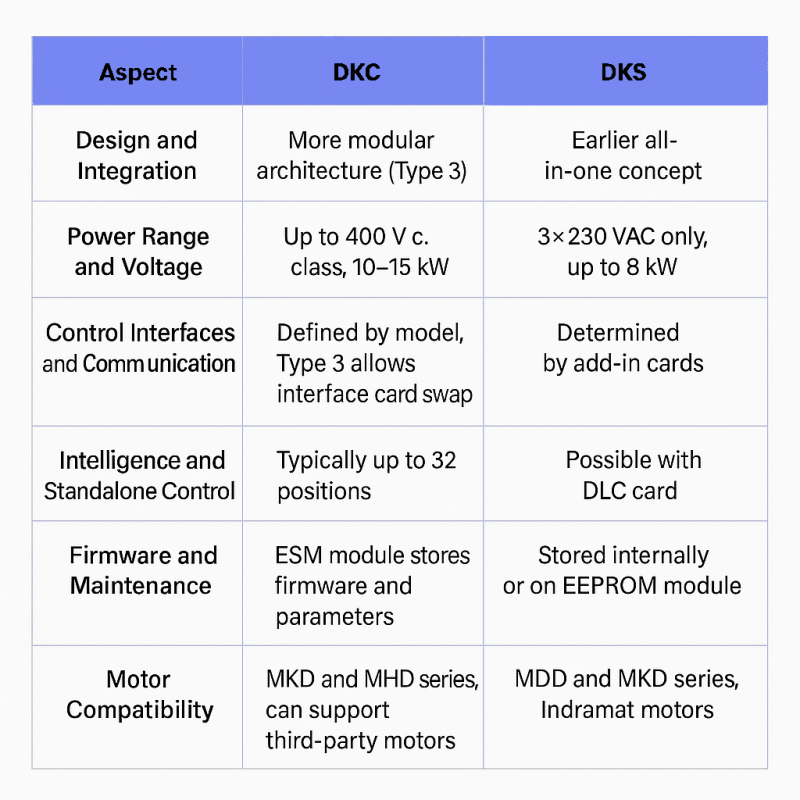
Both the DKS and DKC series are digital servo drive controllers used to run AC servo motors in industrial applications. They share some similarities – for instance, both are integrated single-axis drives, both support closed-loop motion control with fast response, and both were known for reliability in factory settings. However, there are important differences stemming from their generation and design philosophy. Below is a comparison of key aspects:
Design and Integration
The DKS and DKC are each self-contained drives that don’t require separate power supply modules. The DKS was Indramat’s earlier implementation of this concept – essentially a “drive + power supply in one box” approach to simplify installation. The DKC continued this integrated design but was introduced later with a more modular architecture in the Type 3 version. In general, DKS drives came in a single hardware style with plugin card slots for customization, whereas DKC drives were produced in multiple hardware versions and model variants tailored to specific interfaces. Physically, a DKS is a larger gray box with multiple front slots and a top-mounted heatsink, designed to mount inside a cabinet. A DKC is typically more compact for the given power, with a streamlined form factor and different sizes corresponding to its power rating. Both have front-panel LED displays for status codes.
Power Range and Voltage
The DKS series is limited to nominal 3×230 VAC input voltage. It provides roughly up to 8 kW of power output (e.g. 100 A peak at ~300 V DC bus) for the largest models. The DKS 1.1 and 1.2 drives come in 30 A, 50 A, 100 A flavors (peak currents) all on 230 V-class mains. By contrast, the DKC series covered both 230 V and 400 V class operation in its early generation (Type1), and then focused on 400 V class for the later generation (Type3). DKC Type1 drives had a 30 A unit for 230 VAC and a 40 A unit for 380–480 VAC. DKC Type3 drives all run on 3×380–480 VAC and expanded the current range with 40 A, 100 A, and 200 A models. Thus, a DKC system can handle higher power motors when using the 100 A or 200 A drives (on ~700 V DC bus) – roughly up to 10–15 kW or more, depending on motor voltage – whereas the DKS tops out at around the 8 kW level on a 300 V DC bus. This means in applications requiring very high torque or larger motors, a DKC100 or DKC200 drive would be needed.
Control Interfaces and Communication
One of the biggest differences is how each series handles control interfaces. The DKS relies on plug-in option cards to determine its control method. Every DKS base unit can be outfitted with, say, a DS card for SERCOS, or an DA analog interface card in the appropriate slots, and it can even host multiple auxiliary cards simultaneously. This gives the DKS flexibility, but configuration changes involve physically changing cards. The DKC, on the other hand, was sold in pre-configured model variants: e.g. DKC02 is inherently a SERCOS drive, DKC03 a Profibus drive, etc.. In DKC Type1, you could not swap an analog drive to become a fieldbus drive without changing the whole unit. However, DKC Type3 introduced a hybrid of both approaches – a common power section with a removable BGR interface card, so you could change the interface by swapping that card. For example, a DKC06.3 drive could be changed from DeviceNet to CANopen by using a different option card in the BGR slot. In summary, the DKS is customized by add-in cards, while the DKC is defined by model but later allowed interface card swaps. Both series ultimately offered a similar range of interfaces, but DKC also natively supported newer protocols like Profibus and CANopen that became standard in the 2000s. DKS did not have direct Profibus or CANopen cards commonly available.
Intelligence and Standalone Control
Both drives can perform basic motion indexing internally, but the capacity differs. A DKS with a DLC positioning module can execute programmed motion sequences and store target positions, acting as a single-axis position controller. The DKC typically allows up to 32 positions to be stored and triggered via I/O using an indexing functionality. Some fieldbus DKC models even mention 64 storable positions for the Profibus/CANopen variants. In practice, both DKS and DKC can run point-to-point moves without a separate motion controller – ideal for simpler automation like indexing tables or feeder systems. The DKC’s on-board intelligence is part of the EcoDrive firmware; in DKS it’s enabled by the DLC card. In terms of feedback, both support standard motor feedback devices. One interesting feature: the DKC analog units support adding a direct linear feedback for dual-loop control in precision positioning applications – something not typically advertised for DKS.
Firmware and Maintenance
The DKS firmware resides internally and is specific to the hardware/options installed. If a DKS unit fails, replacing it requires parameter re-entry or having a matching firmware; the configuration might be stored on an EEPROM module. The DKC Type1 similarly had internal firmware EPROM. The big improvement was in DKC Type3, where the ESM holds the firmware and parameters. This is a huge maintenance advantage – a plant engineer can pull the ESM module from a failed drive and plug it into a new one, and the system is back up with minimal configuration. With DKS or DKC Type1, one typically needs to connect with a laptop and download parameters or swap an internal board to migrate parameters. From a reliability standpoint, both series are high quality industrial units, but as they age, users might encounter worn capacitors or other components – these can be refurbished by specialists. It’s common for DKC drives to be repaired or exchanged on an as-needed basis, since Rexroth no longer manufactures them new. Wake Industrial, for example, keeps refurbished DKC drives of every power rating on the shelf for exchange, to minimize downtime for customers. Likewise, they service DKS drives even though those are older – ensuring that even legacy drives can be kept operational.
Motor Compatibility
There is a slight generational difference in the servo motors each drive was most associated with. The DKS drives were initially designed to run Indramat’s MDD series AC servo motors. They can also drive MKD motors. The DKC drives were commonly paired with MKD and MHD series motors. Essentially, DKS and DKC overlap in motor compatibility to a large degree – both can run standard Indramat servo motors in the 0.5 kW to ~15 kW range, given the appropriate feedback interface. One notable difference: DKC analog drives support third-party motor control to an extent. DKS, being a fully integrated system, is almost always found driving Indramat’s own motors in a matched set.
In summary, DKC drives represent an evolution of the DKS concept, offering greater modularity, a broader power range, and updated communications, while maintaining the core function of precise servo control. DKS drives are simpler in model structure whereas DKC drives proliferated into many specific models and eventually a more service-friendly design. For an engineer or plant owner, the practical differences are seen in maintenance and expansion: a DKS-based system might be straightforward and proven, but expanding it could be challenging since the product line is fixed to 230 V and limited card options. A DKC-based system offers more flexibility to integrate into modern control systems and to scale up power, but comes with the need to manage different model numbers and firmware modules.
Supporting Legacy Drives and Conclusion
When it comes to buying or repairing DKC and DKS drives, OEM channels no longer supply these legacy models. This is where Wake Industrial steps in. Wake Industrial stocks refurbished Indramat DKC and DKS drives of various types and power ratings. They also have the capability to service and repair these drives and have experience with the common failure modes and error codes. It’s important to note that they are not an authorized Bosch Rexroth distributor – rather, they operate in the aftermarket. For end users, such services are invaluable: you can extend the life of expensive industrial machinery without a complete control system overhaul. Call 1-919-443-0207 or email sales@wakeindustrial.com to learn how Wake Industrial can help you.
In conclusion, Bosch Rexroth’s DKS and DKC drives each played key roles in the evolution of servo drive technology. The DKS brought fully integrated drives to the factory floor, simplifying installations and reliably automating many processes. The DKC built on that foundation with improved flexibility, higher power options, and better integration into modern control architectures – earning its reputation as an economical yet powerful workhorse in automation. Engineers and plant managers dealing with these drives should leverage the technical strengths of each while also preparing for the challenges of legacy components. Fortunately, with thorough knowledge of their features and the support of industrial automation specialists at Wake Industrial, you can keep DKC and DKS-driven systems running efficiently.
Request a Quote

Cary, NC 27513












