


EEA-PAM-561-A-14 Vickers
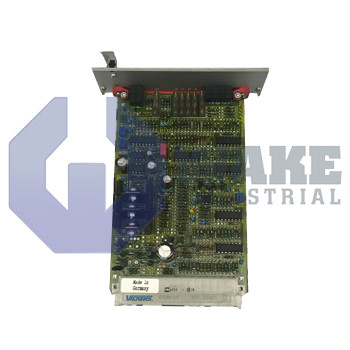
Wake Industrial LLC is not an authorized distributor of this product.
- Straightforward Pricing: No Rush Fees, No Credit Card Fees
The EEA-PAM-561-A-14 is a power amplifier card produced by Vickers and is part of the EEA-PAM Power Amplifiers series. It features a nominal input supply voltage of 24 VDC and a maximum input power of 40 W. The card measures 175.24 mm in depth and 100 mm in width, and it supports command input ranges of ±10 V voltage and ±20 mA current.


To contact sales for pricing and lead time:
Payment Methods


Shipping Methods


Our Credentials


Product Description:
The EEA-PAM-561-A-14 power amplifier card is produced by Vickers within the EEA-PAM Power Amplifiers series. This plug-in module conditions command signals and drives proportional solenoids in hydraulic valves, allowing closed-loop force or position control in automated machinery. By converting low-level current or voltage references into regulated solenoid current, the board acts as the intermediary between a machine controller and the oil-flow regulating hardware.
The card is designed for a nominal input supply of 24 VDC, with internal circuitry accepting a command signal range of ±10 V or ±20 mA. Voltage references encounter a high 47 kΩ input impedance, while current references see 100 Ω, minimizing loading on upstream PLC outputs. When supply falls below the 19 VDC low-voltage shutdown threshold, the output stage is disabled to protect connected actuators. A separate +15 VDC control rail is available at up to 50 mA for external electronics, and the board’s reference generators deliver +10 VDC and –10 VDC for sensor excitation. Under zero-command the amplifier biases the valve with 1.4 A to overcome spring forces, assuring predictable null performance.
Physically, the card measures 175.24 mm deep and 100 mm wide, conforming to European rack standards and sliding into a backplane through a DIN 41612 F48 male connector that carries all power, command, and monitor lines. Maximum drawn power is 40 W, so enclosure ventilation must accommodate this dissipation. A monitor test point, buffered by 10 kΩ impedance, allows verification of solenoid current with minimal circuit disturbance, while the board can also feed diagnostic equipment through the same port. Together these mechanical features, onboard references, and protective limits give system builders a compact interface that simplifies proportional valve integration without additional breakout wiring or custom conditioning stages.









