


Installing and Operating Danfoss VLT Drives: A Comprehensive Guide
Product Overviews2 October, 2026 | Danfoss VLT drives, VLT drive setup, Danfoss VLT troubleshooting, VLT 2800 drive, VLT 3000 drive, VLT 5000 frequency converter, VLT 6000 HVAC drive, Danfoss VLT alarm codes, legacy Danfoss drive repair, VLT drive replacement, VLT parameter setup, Danfoss frequency converter
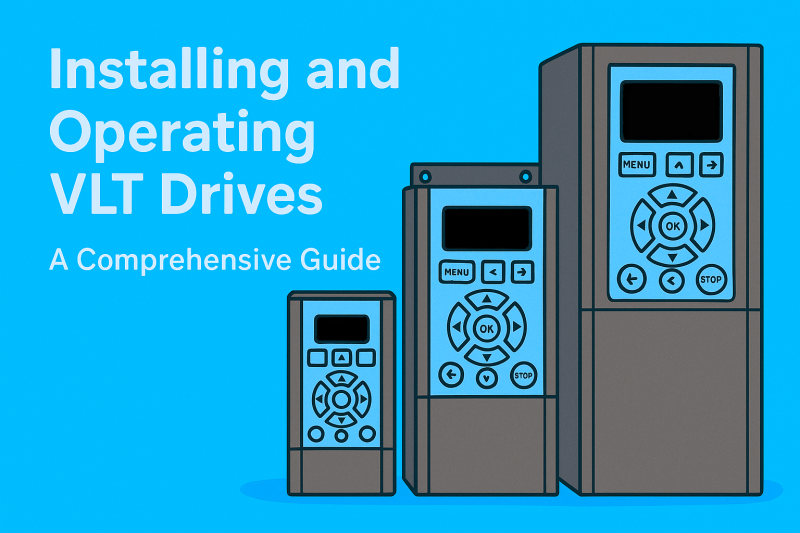
Danfoss VLT drives are variable-frequency drives used to control the speed, torque, acceleration, and stopping behavior of AC motors. Legacy VLT 2800, VLT 3000, VLT 5000, and VLT 6000 drives remain installed in conveyors, pumps, fans, production machinery, and building-automation systems.
Danfoss currently classifies these four product families as inactive. They are no longer in production, and manufacturer spare-parts availability is limited or unavailable. Correctly identifying the complete drive configuration is therefore essential when arranging a repair, sourcing a compatible replacement, or planning a modern retrofit.
Need a legacy Danfoss VLT drive repaired or replaced? Call Wake Industrial at 1-919-443-0207, email sales@wakeindustrial.com, or request a Danfoss drive repair or replacement quote.
Important: This guide provides general reference information. Installation, commissioning, electrical testing, and parameter changes must be completed by qualified personnel using the instructions for the exact VLT model and software version. Wake Industrial supplies and services surplus and reconditioned equipment but is not an authorized Danfoss distributor. Wake Industrial shall not be held liable for any direct, indirect, incidental, or consequential damages to products or individuals resulting from the use of this information.
What Is a Danfoss VLT Drive?
A Danfoss VLT drive is an adjustable-frequency drive that controls an AC motor by changing the frequency and voltage supplied to it.
The drive performs this process in three main stages:
- The rectifier converts incoming AC power to DC.
- The intermediate circuit stores and filters the DC voltage.
The inverter switches the DC power into a controlled AC output for the motor.
Changing the output frequency changes motor speed. The drive can also regulate acceleration, deceleration, current, torque, process pressure, airflow, or other operating values when the required feedback and control functions are configured.
Which Danfoss VLT Series Do You Have?
The VLT name covers several drive families with different electrical ratings, applications, enclosures, control functions, and communication options.
VLT Series | Primary Purpose | Key Characteristics |
Compact general-purpose motor control | Small book-style construction, 200–240 V and 380–480 V classes, local controls, configurable braking and fieldbus options | |
General industrial variable-speed control | Models from VLT 3002 through VLT 3250, multiple voltage classes, programmable ramps, motor protection, and several enclosure options | |
Advanced general-purpose automation | Open-loop and closed-loop control, process and speed PID, Automatic Motor Adaptation, programmable I/O, braking, and optional fieldbus communication | |
Fans, pumps, and building systems | Process PID, Automatic Energy Optimization, sleep mode, flying start, and HVAC communication options |
A series name alone is not enough to select a replacement. Two drives from the same family may have different input voltages, power ratings, brake hardware, RFI filters, enclosures, displays, coatings, fieldbus cards, or application options.
Danfoss VLT 2800 Drives
The VLT 2800 Low Voltage Drives family was designed for compact motor-control installations. The range includes 200–240 V and 380–480 V configurations, with models covering approximately 0.37 to 18.5 kW.
VLT 2800 drives support programmable motor data, reference limits, ramp times, digital and analog I/O, RS-485 communication, and Automatic Motor Tuning on applicable models. Their narrow construction allows standard units to be mounted side by side, although cooling clearance is still required above and below the drive.
One example is the Danfoss 195N0006. Its full type code is VLT2803PD2B20SBR0DBF10A00C0. This 200–240 VAC, IP20 book-style configuration includes a built-in SLCP display and standard brake hardware but does not include an RFI filter.
Danfoss VLT 3000 Drives
The VLT 3000 Variable Speed Drives family covers legacy VLT 3002 through VLT 3250 configurations. Different models were produced for 200/230 V, 380/415 V, and 440/500 V systems.
VLT 3000 drives use pulse-width modulation to regulate motor output. Available functions include adjustable acceleration and deceleration, current limiting, motor thermal protection, programmable references, and model-dependent braking and communication features.
The Danfoss 175H7240 is a 1.1 kW VLT 3000 drive with a 2.8 A rated output, 2.0 kVA rated output power, and an IP54 enclosure. Its electrical ratings and enclosure must be matched before it is used to replace another VLT 3000 configuration.
Danfoss VLT 5000 Drives
The VLT 5000 Frequency Converters family provides configurable control for three-phase AC motors. Depending on the exact drive and software, available functions include:
- Open-loop and closed-loop speed control
- Process PID and speed PID
- Torque regulation
- Automatic Motor Adaptation
- Flying start
- Programmable digital and analog I/O
- Pulse or encoder inputs
- RS-485 communication
- Optional industrial fieldbus cards
- Dynamic braking and controlled deceleration
The Danfoss 175Z0047 is identified by type code VLT5003PT5B20SBR3DLF00A00C0. It is a 2 HP, three-phase VLT 5000 drive for the 380–500/460–500 VAC class. This configuration includes an LCP, an IP20 book-style enclosure, and brake hardware but no fieldbus option.
Danfoss VLT 6000 HVAC Drives
The VLT 6000 HVAC Drives family was developed for fans, pumps, air handlers, cooling towers, and other variable-demand HVAC equipment.
Its process PID controller can regulate pressure, temperature, flow, or another process value by comparing a setpoint with feedback from a transmitter. Automatic Energy Optimization adjusts motor operation for improved efficiency, while sleep mode can stop the motor during low-demand conditions and restart it when demand rises. Flying start allows the drive to regain control of a motor that is already rotating.
The Danfoss 175Z7359 is a 5.5 kW/7.5 HP configuration for 200–240 VAC systems. It includes an LCP and compact NEMA 1 enclosure but does not include an RFI filter or conformal coating.
Looking for a specific VLT 2800, VLT 3000, VLT 5000, or VLT 6000 drive? Call Wake Industrial at 1-919-443-0207 or email sales@wakeindustrial.com.
Safety Before Working on a VLT Drive
VLT drives contain dangerous DC-link voltage after incoming power has been disconnected. Follow the waiting period printed on the drive or specified for the exact model before touching terminals or internal components.
For example, VLT 2800 instructions specify waiting at least four minutes after disconnecting mains power. Other models and power ratings can require a different discharge period. Always verify the requirement for the exact drive.
Before beginning work:
- Isolate and lock out the incoming supply.
- Verify the absence of voltage with appropriate equipment.
- Secure the motor and connected machinery.
- Prevent unexpected starts from a PLC, network, or remote input.
- Record parameters and wiring before disturbing connections.
- Do not use the drive’s Stop key as an electrical isolation method
How to Commission a Danfoss VLT Drive
1. Preserve the Existing Parameters
Create a parameter backup before changing the original drive. If software communication is unavailable, photograph or manually record the critical settings.
2. Enter the Motor Nameplate Data
The VLT 2800 quick setup uses the following parameters:
| Parameter | Motor Data |
| 102 | Motor power |
| 103 | Motor voltage |
| 104 | Motor frequency |
| 105 | Motor current |
| 106 | Rated motor speed |
| 107 | Automatic Motor Tuning |
These values must come from the connected motor’s nameplate. Parameter numbers and procedures can differ on other VLT families or software versions.
3. Select the Control Configuration
Confirm whether the drive receives its start command and speed reference from:
- The local control panel
- Digital and analog terminals
- Preset references
- RS-485 communication
- An installed fieldbus option
- A process PID loop
A drive that runs locally but not remotely often has a control-source, interlock, fieldbus, or input-assignment problem.
4. Set the Operating Limits
Review minimum and maximum frequency, acceleration time, deceleration time, current limit, motor thermal protection, and stopping behavior.
Do not shorten the deceleration ramp without confirming how regenerated energy will be handled. Aggressive stopping can raise the DC-link voltage and cause an overvoltage trip.
5. Verify Motor Direction
Test at a low reference with the machine secured. Stop immediately if the motor rotates in the wrong direction or the connected mechanism moves unexpectedly.
6. Save the Final Configuration
Record the commissioned settings and keep an untouched backup with the machine documentation. Include the drive type code, software version, motor information, date, and machine axis.
Common VLT 5000 Alarm Codes
Alarm definitions are series- and software-dependent. The following table applies specifically to documented VLT 5000 software and should not be treated as a universal code list for every VLT drive.
Code | Diagnostic | First Areas to Check |
Alarm 7 | DC-link overvoltage | Supply voltage, deceleration time, regenerative load, brake resistor, and brake chopper |
Alarm 8 | DC-link undervoltage | Incoming voltage, missing supply phase, fuses, contactors, and power connections |
Alarm 13 | Overcurrent | Mechanical binding, rapid acceleration, incorrect motor data, motor sizing, and output short circuits |
Alarm 14 | Earth fault | Motor cable insulation, motor winding insulation, moisture, contamination, and grounding |
Alarm 29 | Heat-sink overtemperature | Ambient temperature, cooling airflow, fan condition, motor-cable length, and switching frequency |
Alarms 30–32 | Motor phase U, V, or W missing | Output connections, motor cable, contactors, and motor winding continuity |
Alarm 34 | Fieldbus communication fault | Option card, network cable, termination, node settings, PLC status, and communication parameters |
Alarm 60 | Safety stop/external fault | Programmed safety-interlock input and the external safety circuit |
Remove the run command and correct the cause before resetting an alarm. If the drive immediately trips again, stop testing until the motor, wiring, load, parameters, and drive hardware have been evaluated.
When Does a VLT Drive Need Repair?
Professional evaluation is appropriate when the drive:
- Does not power up despite the correct incoming supply
- Has a blank or unstable display
- Repeatedly loses its parameters
- Produces internal power-supply, memory, or control-card alarms
- Trips with the motor disconnected after approved testing
- Has damaged power terminals or option-card connectors
- Contains burned components, contamination, or failed cooling hardware
- Produces unstable output voltage or current
- Cannot communicate through a verified interface
- Returns the same alarm after external causes have been corrected
Repair can be practical when the machine requires the original dimensions, terminal arrangement, fieldbus option, or parameter structure. A modern retrofit may require changes to mounting, wiring, communication, safety functions, PLC logic, and motor setup.
Wake Industrial provides repair, refurbishment, and replacement options for VLT 2800, VLT 3000, VLT 5000, VLT 6000, and other legacy Danfoss drive configurations.
Reduce equipment downtime by requesting a quote today. Call Wake Industrial at 1-919-443-0207, email sales@wakeindustrial.com, or submit a Danfoss VLT drive repair or replacement request.
Request a Quote

Cary, NC 27513












