


SynqNet Explained: How SynqNet Works in Automation
Industrial Automation Explained22 May, 2026 | SynqNet industrial system, SynqNet protocol, SynqNet motion control, SynqNet industrial automation, SynqNet servo drive, SynqNet communication, SynqNet network, Kollmorgen SynqNet drive, Kollmorgen S200 SynqNet, S20330-SRS, S20350-SDS, Kollmorgen AKD SynqNet, AKD-B00307-NBSQ-0000, SynqNet troubleshooting
SynqNet is a real-time industrial communication system used in motion-control applications where timing, coordination, and drive communication have to remain predictable. In many industrial machines, a servo drive does not work alone. It has to communicate with a controller, respond to motion commands, return status information, and stay coordinated with other axes across the machine. SynqNet was developed for that kind of environment.
Before advanced machine-control networks became common, many motion systems depended heavily on point-to-point wiring, analog command signals, discrete I/O, and separate feedback paths. That approach worked, but it could become difficult to maintain as axis count increased. A multi-axis machine may need several drives to move together, stop together, register material, follow a profile, or respond to a programmed sequence without communication delays creating motion errors.
That is where SynqNet becomes important. It gives machine builders and plant maintenance teams a digital communication structure for coordinated motion control. Instead of treating each drive as an isolated component, SynqNet helps connect drives and controllers into one synchronized system.
For facilities still running SynqNet-based equipment, the network is part of the machine’s working architecture. Replacing a failed drive is not just about matching voltage, current, or physical size. The replacement also has to support the correct communication interface. If your operation depends on SynqNet-capable drives or legacy motion-control hardware, Wake Industrial can help source replacement parts, repairs, and refurbished inventory. Call 1-919-443-0207, email sales@wakeindustrial.com, or use the quote form on the page to get fast expert support.
What Is SynqNet?
SynqNet is an industrial machine-control network designed for synchronized motion applications. It allows a controller to communicate with connected devices such as servo drives, I/O nodes, and other automation hardware in a predictable communication cycle. While SynqNet uses Ethernet-based physical communication, it should not be confused with ordinary Ethernet used for office networks, programming laptops, or general plant data.
The main purpose of SynqNet is motion coordination. A SynqNet controller sends commands to networked drives, receives status information, and keeps connected axes organized under one machine-control structure. This is especially useful in equipment where timing directly affects product quality, machine accuracy, or process stability.
In real-world applications, SynqNet may be found in packaging systems, printing machines, semiconductor equipment, inspection equipment, medical automation, converting machinery, and other machines that depend on coordinated servo motion. These machines often need more than a simple start/stop signal. They need drives and controllers to exchange useful information quickly and consistently.
How SynqNet Works
At its core, SynqNet works by connecting a motion controller to compatible drives and devices through a real-time digital network. The controller runs the machine’s motion program and sends commands across the network. Each drive receives those commands, controls its motor, and returns information that helps the controller monitor the axis.
That communication may include command data, drive status, fault information, I/O information, and feedback-related data depending on the system design. The important point is that SynqNet is not only moving general information. It is supporting the active motion structure of the machine.
SynqNet Component | Role in the Machine |
Motion controller | Runs the motion program and coordinates connected devices |
SynqNet network | Carries synchronized command, status, and diagnostic data |
Servo drive | Converts control commands into motor output |
Motor | Produces the physical movement required by the machine |
Feedback device | Helps confirm position, speed, and motor control information |
I/O devices | Connect sensors, machine signals, and auxiliary devices into the system |
This is different from a simple wiring layout where each command signal is handled separately. In a SynqNet system, the controller and connected devices communicate as part of a structured motion network. That makes it easier to coordinate multiple axes and monitor the condition of connected drives.
Why SynqNet Still Matters
SynqNet is not the newest industrial communication system, but that does not make it irrelevant. Many production facilities still operate machines that were engineered around SynqNet hardware. Those machines may continue to perform well for years, especially if the mechanical system, controller platform, and drive hardware are maintained properly.
The challenge usually appears when a drive, controller, or communication component fails. A replacement drive may look close on paper, but if it does not support the correct SynqNet configuration, the machine may not return to service. That can lead to missing-axis errors, communication faults, commissioning problems, or extended downtime.
For many plants, maintaining the existing SynqNet architecture is more practical than replacing the entire control system. A full retrofit can be expensive, time-consuming, and unnecessary when the machine is otherwise still productive. In those cases, sourcing the correct SynqNet-compatible hardware is often the fastest path back to production.
That is where Wake Industrial becomes a useful resource. If you are trying to keep a SynqNet-based machine online, source a discontinued drive, or find a replacement that matches both the electrical and communication requirements of the application, Wake Industrial can help. Reach out today by emailing sales@wakeindustrial.com to get pricing and availability on replacement, repair, and refurbishment options.
SynqNet vs. Standard Ethernet
SynqNet may use Ethernet-style physical communication, but its purpose is different from standard Ethernet. A standard Ethernet port may be used for programming, monitoring, HMI communication, or plant-level networking. SynqNet is used for real-time machine-control communication.
That difference matters when identifying a replacement drive. A servo drive with an Ethernet-style connector is not automatically a SynqNet drive.
Standard Ethernet | SynqNet |
Used for general communication, programming, and plant networking | Used for real-time motion-control communication |
Not automatically deterministic for servo control | Designed for synchronized machine timing |
Common on computers, HMIs, PLCs, and switches | Used with motion controllers, servo drives, and machine nodes |
Often supports general data exchange | Supports coordinated motion, status, and diagnostics |
Replacement concern is often network setup | Replacement concern includes exact drive option and machine compatibility |
Products That Use SynqNet
SynqNet appears in several Kollmorgen motion-control products available through Wake Industrial. The following examples show how SynqNet can appear in both S200 and AKD servo-drive platforms.
Kollmorgen S20330-SRS
The Kollmorgen S20330-SRS is a useful example of SynqNet at the servo-drive level. It belongs to the S200 servo-drive family and is configured for SynqNet communication with a standard RJ-style connection arrangement. In a SynqNet machine, this drive can operate as a networked axis that receives motion commands from the controller and returns drive status through the motion network.
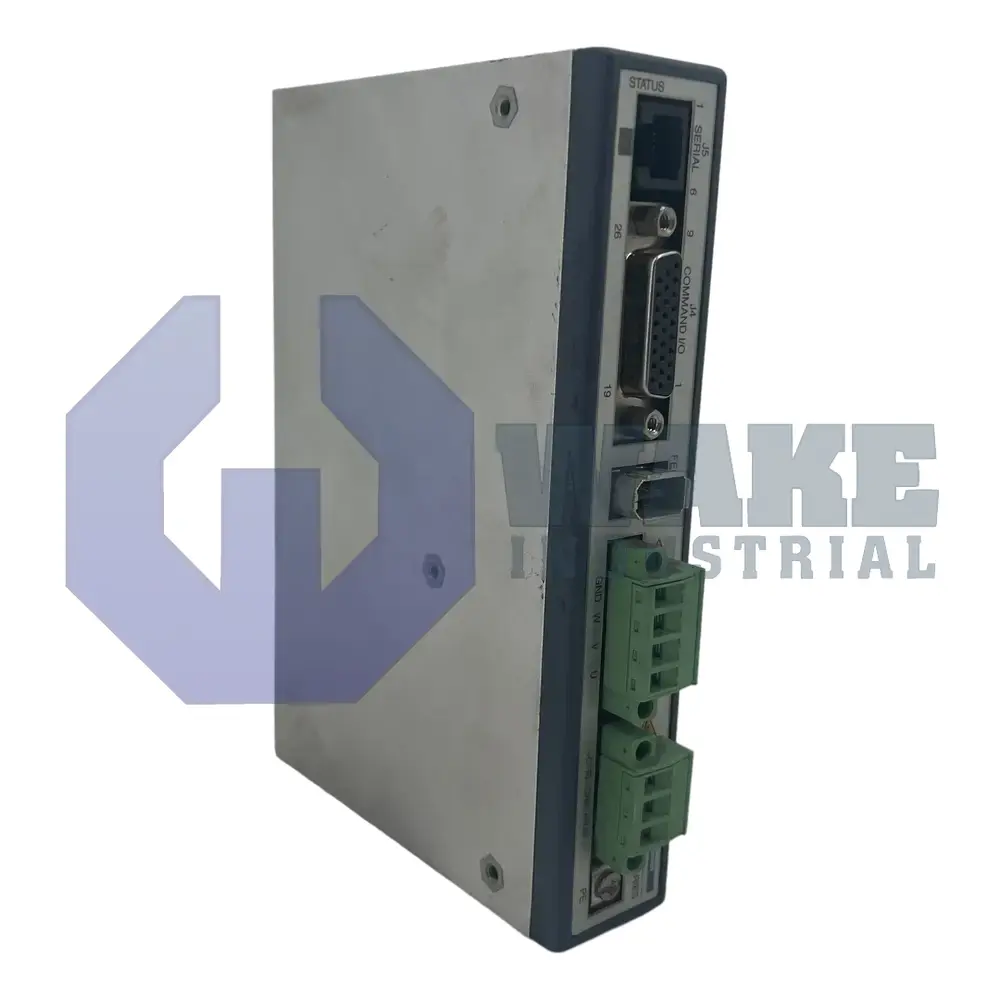
This matters because the S200 family includes more than one configuration. A base S200 drive and a SynqNet-equipped S200 drive are not the same from a replacement standpoint. If a machine expects a SynqNet drive, installing a non-SynqNet version can leave the axis unable to communicate with the controller even if the drive appears similar.
The S20330-SRS helps show why suffixes and option details matter. In a real machine, the communication interface is part of the drive’s function. If that interface is wrong, the machine may still be down after the replacement is installed.
Need this Kollmorgen S200 SynqNet drive or a compatible replacement? Call Wake Industrial at 1-919-443-0207 or use the quote form on the page for fast support.
Kollmorgen S20350-SDS
The Kollmorgen S20350-SDS is another S200 SynqNet example, but it shows a different connection style. The SDS configuration is associated with a Micro-D SynqNet connection arrangement. This makes it a good reminder that even two drives from the same family can differ in ways that affect replacement compatibility.
In a SynqNet-based system, the S20350-SDS can function as a coordinated servo axis under the machine controller. It receives network commands, controls its connected motor, and participates in the timing structure of the machine. If this drive fails, replacing it with a similar S200 unit that has the wrong interface or connector type can create immediate integration problems.
That is why maintenance teams should not rely only on the series name. The full part number, connector style, current rating, feedback setup, and communication option all need to be reviewed before ordering a replacement.
Kollmorgen AKD-B00307-NBSQ-0000
The Kollmorgen AKD-B00307-NBSQ-0000 is a strong SynqNet example because it shows the protocol outside the S200 family. The AKD series is a different Kollmorgen servo-drive platform, and this model is configured with SynqNet connectivity. That makes it useful for understanding SynqNet as a machine-control network rather than a feature tied only to one drive series.
In a SynqNet machine, the AKD-B00307-NBSQ-0000 can operate as a networked servo axis. The controller sends coordinated motion commands through the SynqNet system, while the AKD drive controls the connected motor and returns status information. The larger purpose is the same as with the S200 examples: keeping the axis integrated into a synchronized motion-control architecture. A drive that matches the AKD family name, frame style, or current rating may still be wrong if the connectivity option does not match the machine. For replacement sourcing, the complete part number should always be used.
Common SynqNet Troubleshooting Issues
SynqNet problems can come from the drive, the controller, the cable, the connector, the configuration, or the machine setup. A failed drive may stop one axis. A network issue may affect several axes. That is why troubleshooting should begin with the communication structure as well as the hardware itself.
Symptom | Possible Cause | What to Check |
Axis does not appear on the network | Wrong drive version, failed communication hardware, or configuration problem | Verify the full model number and SynqNet option |
Replacement drive powers up but will not communicate | Incorrect communication interface or connector type | Compare suffixes, connector layout, and network cabling |
Multiple axes fault at once | Network break, controller issue, or upstream device failure | Inspect controller hardware, cables, and the first network segment |
Drive communicates but will not enable | Motor, feedback, bus voltage, or parameter issue | Check motor cable, feedback cable, enable wiring, and saved setup |
Intermittent communication errors | Loose cable, damaged connector, noise, or grounding issue | Inspect shielding, cable routing, connectors, and ground connections |
Machine runs incorrectly after replacement | Parameter mismatch or firmware difference | Compare drive setup, motor data, and machine configuration files |
Conclusion
SynqNet helped industrial machine builders coordinate motion by giving controllers, servo drives, and connected devices a real-time communication structure. Even as newer industrial networks have become more common, SynqNet still matters because many production machines were built around it and continue to run every day.
When those components fail, accurate sourcing becomes essential. A drive that looks close may not support the right network. A model from the same family may still have the wrong connectivity option. Matching the SynqNet interface is part of keeping the machine usable, not just powered.
If your operation depends on SynqNet-capable hardware, Wake Industrial can help you keep that system running. To receive a comprehensive, industry competitive quote now, call Wake Industrial at 919-443-0207. You can also contact Wake Industrial by filling out the quote form on the page or by sending an email to sales@wakeindustrial.com.
Request a Quote

Cary, NC 27513












