


DeviceNet Explained: How DeviceNet Works in Industrial Automation
Industrial Automation Explained17 April, 2026 | DeviceNet industrial protocol, DeviceNet explained, how DeviceNet works, DeviceNet in industrial automation, DeviceNet fieldbus protocol, DeviceNet communication protocol, legacy industrial networks, DeviceNet motion control, DeviceNet I/O communication, Bosch Rexroth DeviceNet, Beckhoff DeviceNet, industrial network troubleshooting
Industrial networks are one of the main reasons modern machines can coordinate motion, feedback, diagnostics, and device-level control without becoming unmanageable. Before networked communication became standard, many automation systems relied on large amounts of point-to-point wiring to connect controllers, drives, sensors, and I/O. That approach worked, but it made systems harder to build, harder to troubleshoot, and harder to expand over time.
DeviceNet helped change that. It gave manufacturers a way to connect intelligent field devices over a shared communication network so machines could exchange operating data and status information more efficiently. While DeviceNet is older than many of the Ethernet-based industrial protocols used in newer installations, it still matters because many machines in service today were designed around it. For maintenance teams, engineers, and plant operators, understanding DeviceNet is still useful when troubleshooting legacy equipment, sourcing replacement parts, or planning a retrofit.
What Is DeviceNet?
DeviceNet is a device-level industrial communication protocol used to connect automation components such as drives, I/O modules, sensors, and motor control devices on a common network. Instead of treating every device as a separate hardwired point, DeviceNet allows multiple intelligent components to exchange information over one network structure.
In practical terms, that means a controller or networked motion system can communicate with multiple devices without requiring an excessive amount of discrete wiring. DeviceNet was designed to support both control and diagnostic functions, which made it valuable for machine builders who needed more visibility into what their equipment was doing. Rather than simply showing whether a signal was active, a DeviceNet-connected device could often report its state, provide fault information, and support parameter access through the network.
That was a major step forward for industrial automation. It made machines easier to install, easier to service, and easier to organize from both an electrical and communications standpoint.
How Does DeviceNet Work?
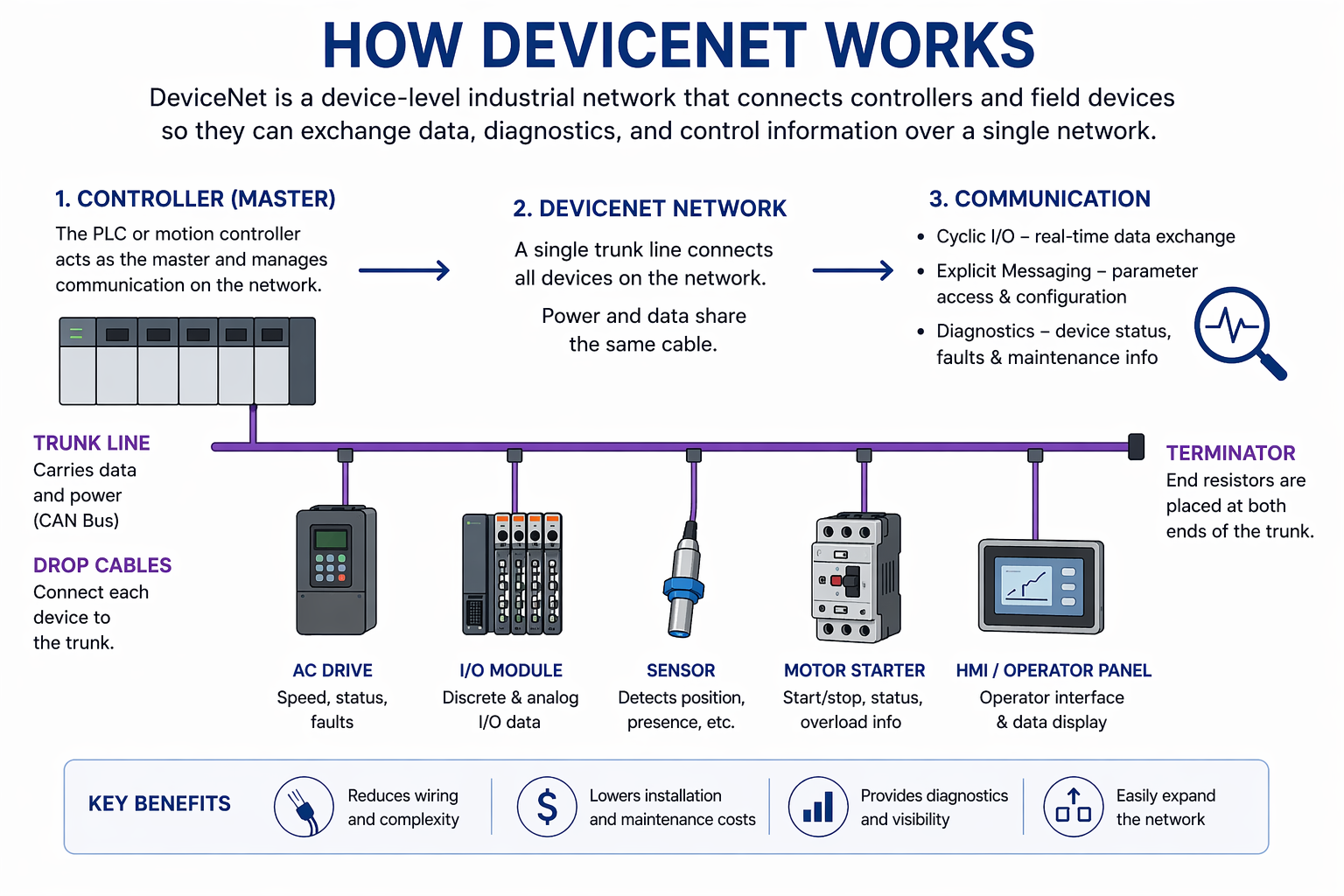
DeviceNet works by allowing multiple field devices to share a common communication network so they can exchange commands, feedback, diagnostics, and configuration data. In an industrial system, this lets the control architecture communicate with distributed hardware more efficiently than a fully point-to-point wired design.
The protocol became popular because it could support a broad range of device-level communication needs inside one machine. A drive could report operating status, an I/O module could exchange machine signals, and a control device could communicate commands and monitor responses through the same overall network structure. That made DeviceNet useful in systems where machine builders wanted cleaner wiring, more organized integration, and better access to device-level information.
This also improved troubleshooting. When a machine component is part of a communication network rather than just hardwired in isolation, it becomes easier to identify what device is present, whether it is communicating correctly, and whether it is reporting any faults or status conditions that need attention.
Why DeviceNet Was Important in Automation
DeviceNet became widely used because it solved several practical problems at once. It reduced wiring, supported distributed machine design, improved diagnostics, and helped organize communication between multiple intelligent components. For OEMs, that meant more efficient machine layouts and easier expansion. For end users, it often meant less time spent tracing wires and more time working with useful device-level information.
It was especially useful in applications where multiple automation products had to work together in one coordinated system. Motion control hardware, distributed I/O, field devices, and other intelligent components could be integrated more cleanly through a shared communication network. That made DeviceNet a strong fit for packaging equipment, handling systems, machine tools, and other industrial applications where multiple devices needed to exchange information in a structured way.
Even now, DeviceNet remains relevant because the installed base is still large. Many facilities continue to rely on equipment that was originally built around DeviceNet, and those systems often need service, replacement parts, and protocol-matched hardware to stay productive.
DeviceNet Examples in Real Automation Hardware
One of the easiest ways to understand DeviceNet is to look at how it appears in actual industrial products.
In the Bosch Rexroth IndraDrive environment, certain control sections use the CO communication option associated with CANopen and DeviceNet master communication. One example is the CSB01.1C-CO-ENS-MA1-NN-S-NN-FW. In a real machine, a control section like this can play an important role in how the drive system fits into the broader communication architecture. If the machine was built around DeviceNet, the communication option becomes a critical part of replacement compatibility.
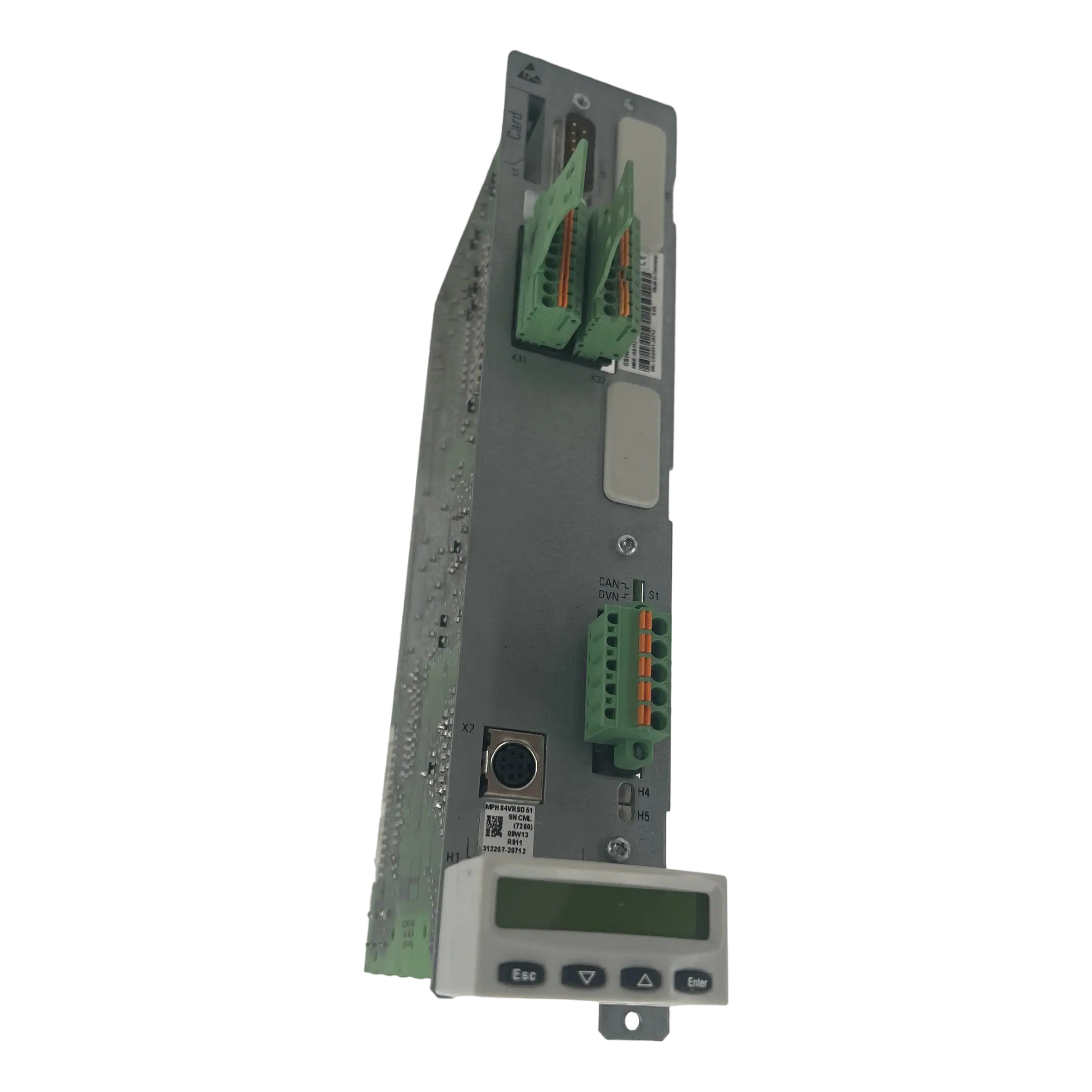
Another Bosch Rexroth example is the CSH01.1C-CO-ENS-EN2-NNN-NN-S-XP-FW. This model shows how DeviceNet support can appear in an advanced control section used within a high-performanects commissioning, diagnostics, integration, and long-term serviceability.
A useful non-Rexroth example is the Beckhoff IP3202-B520-0000. This product helps show that DeviceNet was not limited to drive communication alone. In an automation system, a DeviceNet-capable I/O module like this brings distributed field-level signals into the network structure, which helps reduce wiring and makes the system easier to organize. Looking at both motion-related and I/O-related examples gives a better picture of how DeviceNet functioned across an entire machine.
Why the Communication Option Matters
When working with DeviceNet hardware, the protocol is not a minor specification. It is a core part of how the machine communicates. Two parts may belong to the same general product family while supporting different communication methods, and that difference can determine whether the replacement part will actually work in the original system.
This is especially important with legacy motion-control hardware. A drive control section might look correct from a voltage or application standpoint, but if the communication option does not match the machine network, the replacement can still fail to integrate properly. In real service situations, that can create unnecessary downtime, additional troubleshooting, and extra cost.
DeviceNet and Legacy Machine Support
A big reason DeviceNet still comes up in industrial automation is that older machines do not disappear just because newer protocols exist. Many systems remain in service for years or even decades, especially when the mechanical side of the machine still performs well. In those cases, maintenance teams often want to keep the machine running with the least disruption possible rather than redesigning the entire communication architecture.
That makes DeviceNet support highly relevant in the replacement market. When a legacy machine depends on DeviceNet, sourcing the right communication version of a drive control section or I/O component can save time and reduce risk. It also helps preserve the original machine logic and network design, which is often the most practical path for keeping production equipment online.

Final Thoughts
DeviceNet became an important industrial communication protocol because it made machines easier to wire, easier to organize, and easier to diagnose at the device level. It helped connect drives, I/O, and other intelligent field devices into a shared communication structure that improved both machine design and serviceability.
If your equipment still relies on DeviceNet communication, choosing the right replacement part is about more than matching the series name. The communication option has to fit the original machine architecture, or a simple swap can turn into a longer compatibility issue. Wake Industrial is set up to keep older systems running with dependable turnaround and availability. Just call 1-877-968-1360 or email sales@wakeindustrial.com to get a comprehensive and competitive quote from Wake Industrial.
(Please be advised that Wake Industrial does not offer troubleshooting assistance through phone or email. For repair, replacement, or refurbishment needs, we invite you to use our quote form or call us at 1-877-968-1360.)
Request a Quote

Cary, NC 27513












