


What the “One Big Beautiful Bill” Means for U.S. Manufacturing and Automation
29 May, 2025 | One Big Beautiful Bill, OBBBA, One Big Beautiful Bill Manufacturing Taxes , Automation, Rexroth, Bosch Rexroth Indramat, Indramat, MSK030B-0900-NN-M1-BG1-NNNN, Manufacturing Tax Breaks, workforce pell grant, 529 education savings, HCS01.1E-W0018-A-03, Bosch Taxes, Automation Tax Breaks

What the “One Big Beautiful Bill” Means for U.S. Manufacturing and Automation
The U.S. House of Representatives recently passed a sweeping legislative package nicknamed the “One Big Beautiful Bill Act.” This one-stop omnibus bill bundles together tax reforms, spending changes, and workforce initiatives in a single piece of legislation. Having narrowly cleared the House on May 22, 2025, by a 215–214 vote, the bill now awaits debate in the Senate. Given its broad scope, many professionals outside of policy circles may be unfamiliar with what this bill entails. In this blog, we’ll break down what the One Big Beautiful Bill is and, most importantly, how its tax incentives and workforce development measures could impact the U.S. manufacturing and industrial automation sectors.
What Is the “One Big Beautiful Bill Act”?
The One Big Beautiful Bill Act (sometimes abbreviated OBBBA) is a comprehensive budget reconciliation bill advancing through Congress. In essence, it’s a catch-all policy package championed by House leaders to address several priorities in one go – hence the name. The bill’s contents range from tax code changes to education and labor programs, all wrapped into a single proposal. It extends many provisions of the 2017 Tax Cuts and Jobs Act (TCJA) that were set to expire, while also adding new measures across various domains. For example, it raises the State and Local Tax (SALT) deduction cap from $10,000 to $40,000, allocates funding for defense and border security, and introduces new rules for social programs like Medicaid and nutrition assistance. It even proposes a 10-year moratorium preventing states from enacting their own AI regulations – a detail that could affect high-tech industries and automation initiatives.
While the bill is sweeping, its core economic focus is on avoiding a looming tax increase (as key TCJA tax cuts expire in 2025) and spurring investment in the economy. House Ways and Means Committee Chairman Jason Smith packaged these changes together in what he termed “one big, beautiful bill” – aiming to tackle everything from tax relief to workforce training in one legislative effort. For engineers, plant managers, and business owners, the most relevant pieces of this bill are the tax incentives for businesses and the workforce development provisions. These are designed to boost American manufacturing, encourage automation upgrades, and address the skilled labor shortage in industrial sectors. Below, we dive into those aspects and what they could mean for your operations.
Tax Incentives Aimed at Revitalizing Manufacturing
One of the biggest components of the One Big Beautiful Bill is a sweeping tax package intended to stimulate business investment in the United States. By extending and expanding key tax cuts, the bill seeks to create a pro-growth tax environment that encourages manufacturers to expand factories, adopt new technologies, and reshore production. Here are some of the major tax incentives in the bill that could benefit the manufacturing and automation sectors:
Permanent Lower Tax Rates and Pass-Through Deduction
The bill would make permanent the tax rate cuts from the 2017 tax law for both corporations and individuals. For the 96% of U.S. manufacturers structured as pass-through businesses (e.g. LLCs, S-corps), it also enhances the Section 199A Qualified Business Income deduction – raising it from 20% to 23% of income. According to the National Association of Manufacturers, locking in these provisions gives manufacturers greater certainty to plan, invest, hire, and expand operations.
Restoration of Full Expensing
The bill restores 100% bonus depreciation for business investments. In practical terms, this allows manufacturers to immediately write off the full cost of new equipment in the year it’s purchased, rather than depreciating it over many years. This kind of full expensing was a feature of recent tax law that began phasing out. By bringing back full expensing for machinery, robotics, and other capital expenses, the bill would significantly lower the after-tax cost of automation upgrades. For example, an industrial plant that purchases and installs a new Bosch Rexroth Indramat MSK030B-0900-NN-M1-BG1-NNNN to operate their printing presses may be eligible to deduct 100% of that investment immediately. This, obviously, is an innate benefit to upcoming factories and factories looking to modernize their development lines. This may relieve the initial financial burden of upgrading and it may shorten the payback period for high-tech equipment, making this a more financially attractive alternative.
Immediate R&D Expensing
Alongside capital equipment expensing, the legislation would also restore immediate expensing for research and development costs. Recent changes had forced companies to amortize R&D spending over 5 years, which many argue stifled innovation. Under the new bill, if a robotics firm or automation integrator spends money on developing a new control system or custom machinery, those R&D costs could be deducted right away. Industry groups note that full expensing and R&D incentives demonstrate a commitment to innovation, job creation, and economic expansion. For manufacturers, this means more incentive to invest in developing new products, smarter production processes, and cutting-edge automation technologies without a tax penalty for doing so.
Enhanced Interest Deductibility
The bill also aims to ease limits on interest deductions for business loans. Manufacturing is a capital-intensive sector – companies often finance equipment purchases or factory expansions. By relaxing strict caps on interest expense deductions, the legislation would make borrowing for growth less costly. Combined with full expensing, this gives factories more leeway to finance major upgrades – whether that’s building a new facility or installing a fleet of new CNC machines and robotic cells – with the confidence that interest costs remain tax-deductible at more generous levels.
Extension of Opportunity Zones and Credits
The House bill extends Opportunity Zone incentives and certain business tax credits which can indirectly benefit manufacturing projects, especially in underserved areas. For instance, a company building a new production plant in a designated Opportunity Zone could attract investment more easily thanks to these extended tax breaks.
Reversing or Sunsetting Certain Credits
On the flip side, the One Big Beautiful Bill would scale back many clean-energy tax credits that were passed in recent years. For example, incentives for energy-efficient commercial equipment (HVAC, solar, etc.) are slated to end earlier than planned. This aspect has drawn concern from some in the HVAC and construction industries, who note that ending credits for things like high-efficiency heating/cooling equipment could affect those markets. However, for the broader manufacturing sector, the emphasis of the bill is clearly on traditional industrial growth – prioritizing tax relief for factories and suppliers, even if it reduces subsidies in the clean energy space. Manufacturers involved in renewable energy supply chains might see shifting demand if those customer incentives change, but many general manufacturers are applauding the pro-investment tilt of the tax package.
Taken together, these tax provisions are meant to supercharge investment in American industry. The Small Business & Entrepreneurship Council characterized the bill as a “powerful mix of tax relief and incentives that will supercharge American entrepreneurship, investment, innovation, and opportunity”. In practical terms, a machine shop or assembly plant could upgrade its production line with the latest automation technology and reap significant tax savings on that capital outlay. By lowering effective costs, the legislation could improve the return on investment for automation projects, potentially accelerating the adoption of Industry 4.0 across factories large and small.
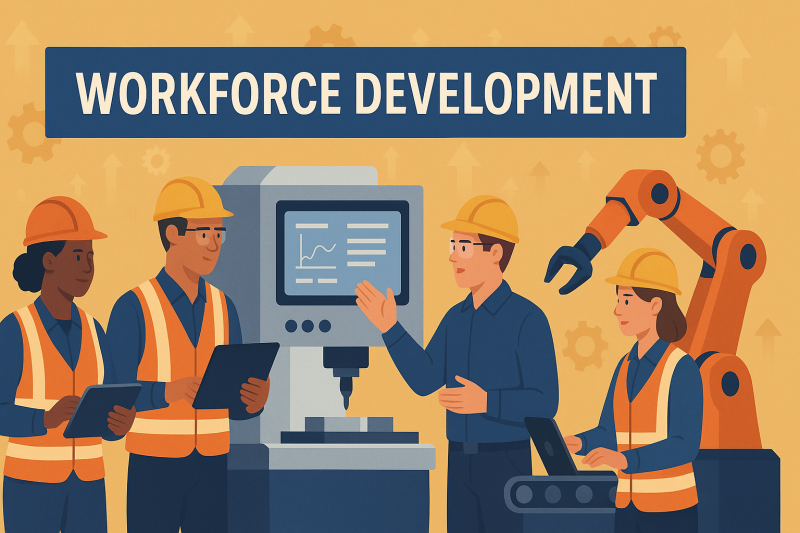
Workforce Development: Bridging the Skills Gap in Manufacturing
Tax breaks alone won’t ensure a manufacturing resurgence if there aren’t skilled workers to run the machines. Recognizing this, the One Big Beautiful Bill also contains workforce development measures aimed at addressing the skills gap in manufacturing and other trades. U.S. industry has been grappling with a shortage of qualified technicians, machinists, and automation specialists – a problem exacerbated by an aging workforce and fewer young workers entering these fields. In fact, a recent industry study projected a net need for 3.8 million manufacturing jobs to be filled between 2024 and 2033, and warned that about 1.9 million of those positions could remain unfilled if current trends continue. This talent gap, if left unaddressed, could limit the effectiveness of any new investment in automation or production capacity.
To tackle this challenge, the bill introduces a couple of important education and training initiatives:
“Workforce Pell” Grants for Trades
The legislation creates a new Workforce Pell Grant program dedicated to skilled trades and in-demand industries. This extends federal Pell grant support to students pursuing vocational and technical training. In other words, aspiring machinists, welding technicians, industrial maintenance workers, or robotics programmers could receive grant money to attend trade schools and certification programs that prepare them for high-paying, sustainable jobs in the country’s most in-demand industries. By lowering the cost barrier for trade education, this measure aims to funnel more talent into fields like manufacturing, automation, and construction – sectors that desperately need fresh, skilled labor. For plant owners, this could mean a larger pool of entry-level technicians familiar with operating and servicing equipment such as CNC machines or automated production lines.
Expanded 529 Savings for Career Training
Another forward-looking provision is an expansion of 529 education savings accounts to cover vocational credentials, apprenticeships, and certifications. Traditionally, 529 plans allow families to save money tax-free for college. Under the House bill, 529 funds could also be used for trade school tuition, apprenticeship program costs, licensing exams, and other career-focused training expenses. This is a change that empowers individuals to invest in education outside of the four-year college path, including technical skills that modern factories require. For example, a young person could use a 529 account to pay for a PLC programming certification course or an industrial robotics apprenticeship, helping them become job-ready for the automation workforce.
By strengthening support for career and technical education, the One Big Beautiful Bill tries to close the gap between job openings in manufacturing and the available skilled workforce. This is crucial, because as automation technology becomes more sophisticated, manufacturers need workers who are not only manually skilled but also comfortable with digital tools and complex machinery. Many small manufacturers report a shortage of automation-savvy technicians and a struggle to keep up with “smart factory” initiatives. In fact, U.S. manufacturing is said to be a few years behind some global peers in adopting Industry 4.0 practices, partly due to workforce constraints. The bill’s focus on trades education and apprenticeships directly targets this issue – helping attract new talent into the field and upskilling the existing labor pool.
Impacts on Manufacturing & Automation: What to Expect
If the One Big Beautiful Bill becomes law, the combined effect of its tax and workforce provisions could be significant for U.S. manufacturers and plant operators. Here are a few key ways this legislation could shape the manufacturing and automation landscape in the coming years:
- Accelerated Modernization of Factories: Generous tax incentives lower the financial hurdles for upgrading industrial equipment. Manufacturers large and small may accelerate plans to modernize production lines, knowing they can write off new machinery costs immediately and enjoy a stable, low-tax environment for years to come. We can expect increased demand for advanced automation solutions – from industrial robots and automated guided vehicles to high-precision motion control systems. For instance, a mid-sized manufacturer might invest in a suite of new Bosch Rexroth Indramat IndraDrive C’s like the HCS01.1E-W0018-A-03 to upgrade their pick and place system for sorting components on an assembly line. They would be able to easily program the drive using IndraDrive software to quickly configure it to their needs and due its small size, can easily be mounted into a control cabinet.
The HCS01 converts three-phase AC mains power (anywhere from 110 V to 500 VAC) into a controlled AC voltage ideal for running servo motors like an MSM019B-0300-NN-M0-CH0 from Indramat. The HCS01 ensures that servo motors receive the continuous power they need and since it’s a drive controller it instructs them on how to operate based on user programming. Thanks to its variety of communication interfaces (Ethernet, sercos III) and multi encoder feedback options it can easily monitor any motor or other power supply it may be attached to so it can easily detect any errors within the entirety of the system. Thus errors can be responded to quickly or the entire system reprogrammed with ease to better fit user needs and minimize downtime. In essence the HCS01.1E-W0018-A-03 can communicate, monitor, and power an entire system. And the manufacturer can remain confident that the bonus depreciation and R&D expenses will substantially offset the upfront cost of purchasing the units.This allows for extra funds that can be put toward repairing or replacing the unit when the time comes. Wake Industrial offers comprehensive support for Rexroth IndraDrive C’s.
- Growth in the Automation Supply Chain: As end-user manufacturers invest in technology, the ripple effect benefits suppliers of industrial equipment and components. Producers of automation hardware could see a boost in orders. This virtuous cycle extends to the aftermarket and maintenance sector as well. Suppliers of replacement parts and repair services will play a crucial role in keeping upgraded facilities running smoothly. With more machines deployed, the demand for reliable automation parts and support is likely to rise. End-users may also have more capital available to them to afford long overdue repairs on legacy equipment that OEMs no longer support but aftermarket firms like Wake Industrial still service and repair.
- Improved Global Competitiveness: By investing in both machinery and workforce, U.S. manufacturing could become more competitive on the global stage. The combination of cutting-edge automation tech and a skilled workforce tends to yield higher productivity. Manufacturers might see lower unit costs and faster turnaround times, making American factories more attractive for production versus overseas facilities. The bill’s architects certainly hope to spark a “manufacturing renaissance” – bringing more production back to U.S. soil. While there are many factors involved in such a shift, policy can be a catalyst. Pro-growth tax policy and workforce training support are two levers that, together, could improve the economics of domestic manufacturing.
- Addressing the Labor Shortage and Future-Proofing the Workforce: On the labor side, it will take time for training initiatives to translate into more skilled workers on the factory floor. But over the next decade, measures like Workforce Pell and expanded apprenticeships could start chipping away at the labor shortage. We may see an uptick in enrollment at trade schools for automation, mechatronics, and advanced manufacturing programs, fueled by the new grants and funding. More young people might consider careers as manufacturing technicians or automation engineers once they see the support available and the attractive, high-tech nature of modern factories. The average age of the manufacturing workforce could start to trend lower as a new generation enters the field. Additionally, current workers could leverage new training opportunities to reskill or upskill. For instance, an assembly line worker learning to operate collaborative robots or to program a Bosch Rexroth PLC system, thereby advancing into a higher-skilled position. All of this bodes well for building a resilient workforce that can adapt alongside rapidly evolving automation technologies.
Of course, it’s important to note that this bill is not yet law. Its fate in the Senate remains uncertain, and there may be changes to specific provisions during the legislative process. Some measures like the reduction of clean energy credits or new restrictions in other areas are politically contentious and could be revised. Business owners should keep an eye on the Senate’s actions, as any modifications would require the House’s agreement again.

Conclusion: A New Chapter for Manufacturing?
The “One Big Beautiful Bill” represents a bold attempt to write a new chapter for American industry via comprehensive legislation. By coupling tax relief for capital investment with investments in human capital, it targets both sides of the manufacturing competitiveness equation. For engineers in automation, plant managers, and manufacturing entrepreneurs, the promise of this bill is an environment where upgrading a production line is more affordable and finding skilled workers is a little easier.
On the flip side, such sweeping changes do come with trade-offs (like added federal debt and the curtailing of certain incentives elsewhere), and real-world outcomes often depend on implementation. Companies will still need to actively engage with educational institutions to ensure training aligns with their needs, and they must plan investments wisely to maximize the available tax benefits. Resources are available to help businesses navigate these opportunities.
In summary, the One Big Beautiful Bill could be a game-changer for the manufacturing and automation sectors. It aims to empower businesses to invest in cutting-edge equipment and people, thereby strengthening American industrial capacity. As we await the Senate’s decision, manufacturers and plant owners would do well to stay informed and start strategizing how to leverage such policies.
Even though the future remains unclear, Wake Industrial is always on standby to support your manufacturing needs. Whether you are looking for a new HCS or to repair an MSK, Wake Industrial delivers high quality manufacturing solutions. Call 1-919-443-0207 to speak with a representative now or fill out the quote form above to receive a quote within 15 minutes during business hours.
Request a Quote

Cary, NC 27513