


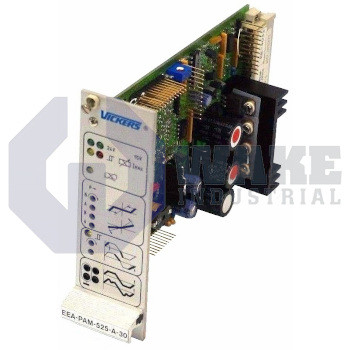
EEA-PAM-525-A-30 Vickers
Wake Industrial LLC is not an authorized distributor of this product.
- Straightforward Pricing: No Rush Fees, No Credit Card Fees
Current response time:
5 Minutes
33 Seconds
The Vickers EEA-PAM-525-A-30 is part of the EEA-PAM Power Amplifiers series and operates with a nominal supply voltage of 24 VDC while requiring 40 W of power. It provides a control supply output current of 50 mA at ±15 V and features reverse-polarity protection along with undervoltage shutdown at 18 VDC. The unit also offers a monitor scaling of 1 V/A and maintain a reference output voltage of ±10 V within 1% of accuracy.


To contact sales for pricing and lead time:
Payment Methods


Shipping Methods


Our Credentials


Product Description:
The EEA-PAM-525-A-30 is a power amplifier module manufactured by Vickers as part of the EEA-PAM Power Amplifiers series. In an automation rack it converts a regulated DC supply into control, reference, and monitor signals required by electro-hydraulic or electro-mechanical actuators. By combining fixed internal references with external enable logic, it supports closed-loop tasks that need dependable current or voltage drive together with diagnostic feedback.
The board operates from a nominal input of 24 VDC and draws up to 40 W, so cabinet power planners must reserve that budget on the 24 volt rail. It tolerates a maximum supply ripple of ±10%; exceeding that range increases output error and can trigger the undervoltage circuit, which disconnects the load at 18 VDC. Reverse wiring on the supply connector will not damage the card because the line is Protected against polarity reversal. Internal regulators generate the dual control supply, keep ripple below 50 mV peak-to-peak, and limit temperature drift to less than 1 mV / °C for stable operation across the cabinet envelope.
The control supply rails deliver ±15 V at up to 50 mA to external signal conditioners, while the reference output provides ±10 V (±1 %) and 5 mA with less than 20 mV ripple for precise command generation. An enable input with a resistance of 22 kΩ accepts logic from PLC cards; when that terminal rises above 9.8 V, the amplifier engages its outputs. For diagnostics, the monitor pin presents a 10 kΩ impedance and scales line current at 1 V⁄A so controllers can read real-time load demand without additional shunt hardware.