


What Is a Programmable Logic Controller (PLC) and What Is It Used For?
10 July, 2026 | programmable logic controller, PLC, what is a PLC, how does a PLC work, programmable logic controller explained, PLC operation, PLC scan cycle, PLC inputs and outputs, industrial PLC, PLC controller, industrial automation controller, PLC programming, ladder logic, PLC applications, PLC advantages, machine control systems, industrial control systems, factory automation, process automation, motion control, PLC CPU module, PLC input output modules, Bosch Rexroth PLC
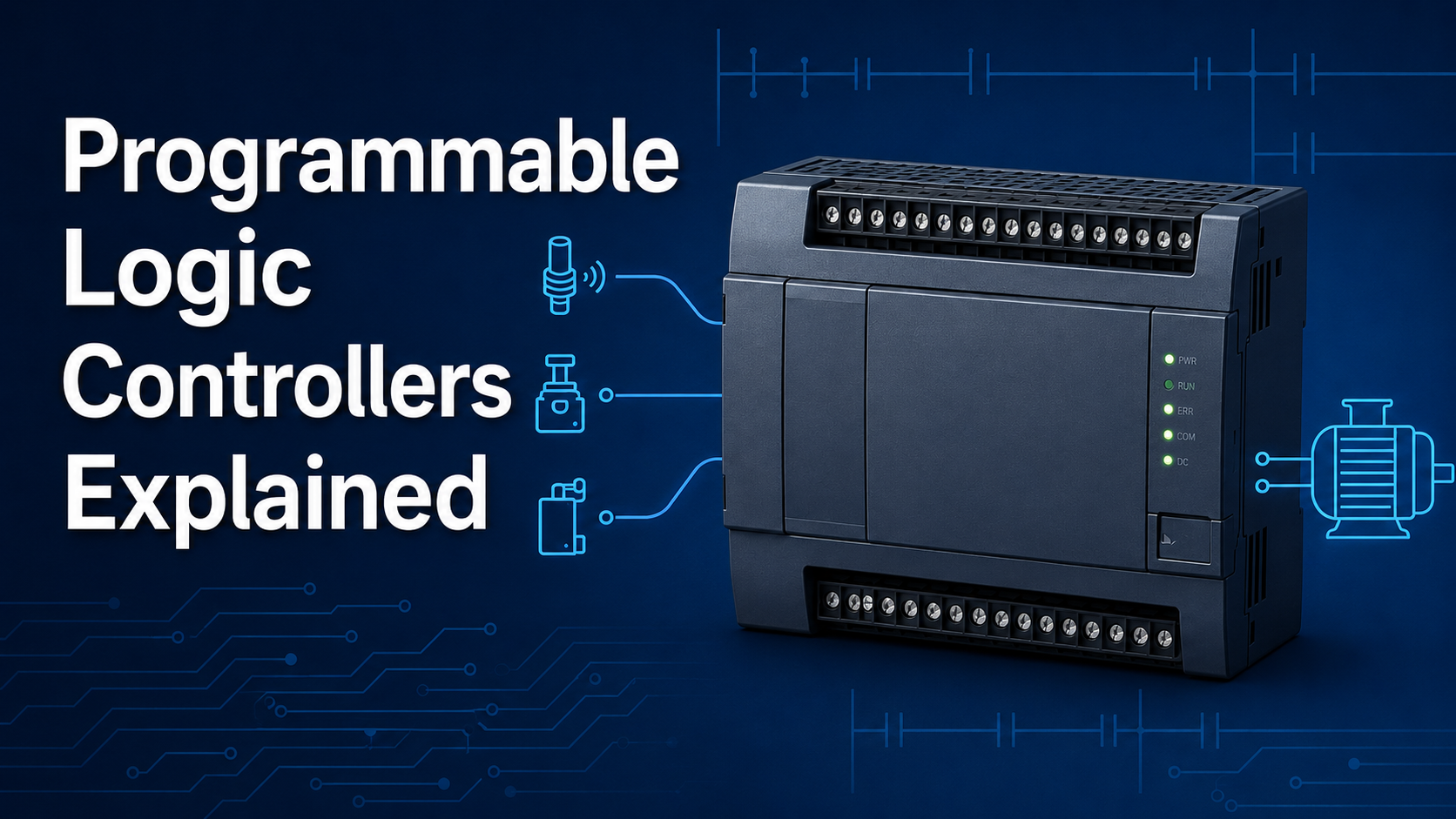
Programmable logic controllers, commonly called PLCs, are rugged industrial computers that control machines and automated processes. They read signals from field devices, execute programmed logic, and command outputs such as motors, valves, alarms, and actuators. Because PLCs are designed for repeatable real-time control in demanding environments, they remain central to manufacturing, material handling, packaging, process equipment, and motion-control systems.
Need a replacement PLC or controller quickly? Wake Industrial supplies and repairs industrial automation hardware, including legacy Bosch Rexroth and Indramat control products. Call 1-919-443-0207 or submit the quote form to check availability.
What Is a PLC?
A PLC is a programmable electronic controller built to operate industrial equipment. Unlike a general-purpose computer, it is designed for continuous service around electrical noise, vibration, temperature changes, dust, and other factory conditions. Its program defines how the controller responds when input conditions change.
Most PLCs do not rely on artificial intelligence to make decisions. They repeatedly execute user-defined logic—such as ladder logic, function block diagrams, or structured text—in a predictable scan cycle. Advanced systems may exchange data with analytics or AI platforms, but the core PLC function is deterministic machine control.
How Does a PLC Work?
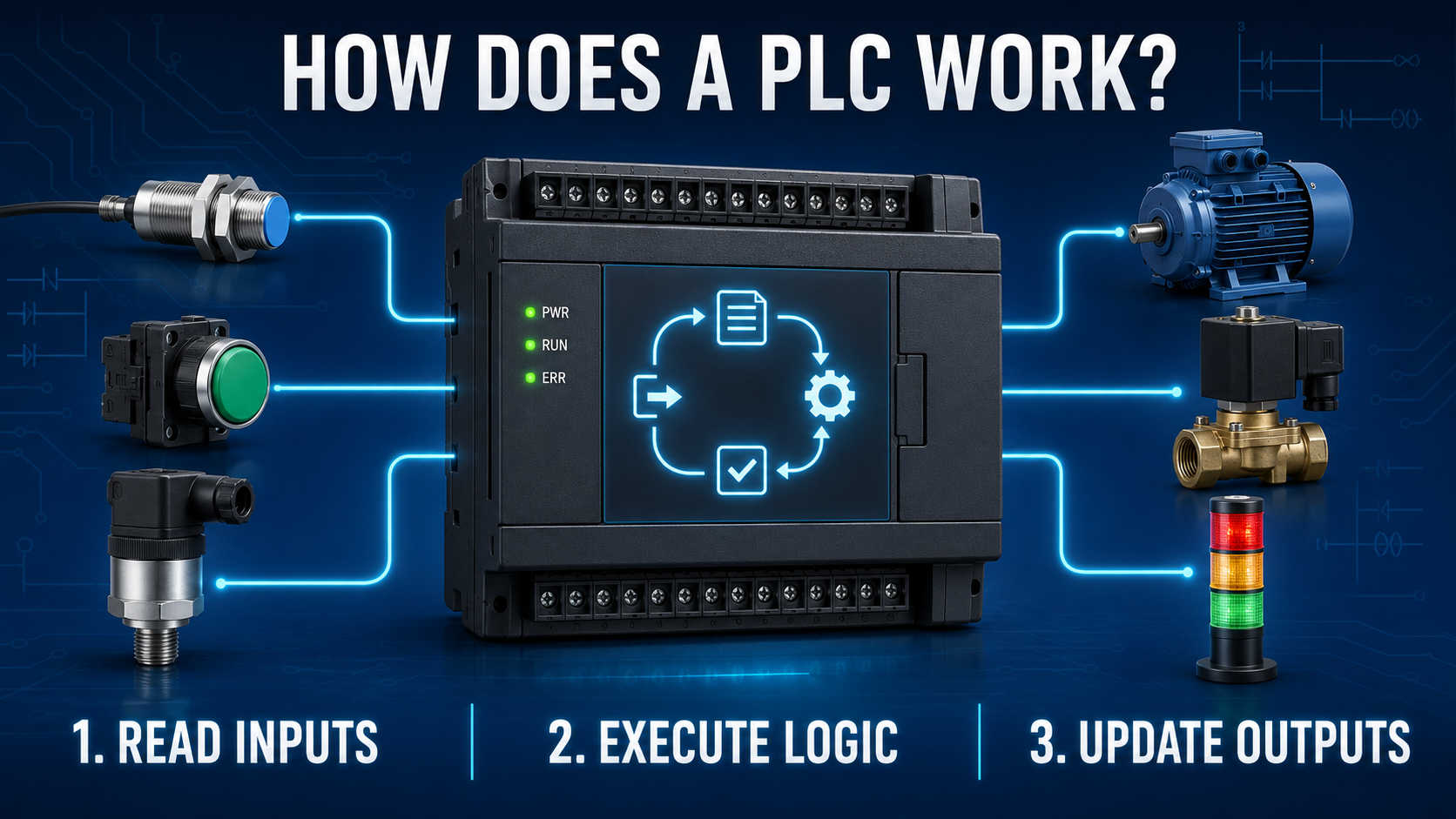
A PLC operates through a repeating control cycle commonly called a scan. It first reads on/off or measured signals from devices such as pushbuttons, limit switches, proximity sensors, pressure transducers, and encoders. The processor then evaluates the control program, including its timers, counters, calculations, interlocks, and stored conditions.
After executing the program, the PLC updates its outputs to energize or adjust connected equipment such as contactors, solenoids, valves, indicator lights, servo systems, and variable-frequency drives. This sequence repeats rapidly so the machine can respond consistently as operating conditions change. Many systems also exchange diagnostics and production data with HMIs, remote I/O, drives, supervisory systems, and plant networks.
What Are PLCs Used For?
PLCs are used wherever a machine or process must respond consistently to changing conditions. In discrete manufacturing, a PLC can coordinate conveyors, clamps, cylinders, feeders, and assembly stations so each operation occurs in the correct sequence. It can also send commands to servo drives, coordinate motion axes, and monitor position or speed feedback.
In process applications, PLCs regulate variables such as temperature, flow, pressure, and liquid level. They also manage permissives and machine interlocks that prevent damaging operating states, although safety-rated functions require properly rated safety hardware. By reporting alarms, cycle status, runtime, production counts, and process values, the controller also gives operators and higher-level systems useful information about machine performance.
Key Advantages of Programmable Logic Controllers
PLCs combine rugged construction with flexible programming. They are designed for continuous service in industrial control cabinets, while their software-based logic allows machine sequences, timers, recipes, and interlocks to be changed without rebuilding an entire relay panel. This flexibility makes it easier to modify equipment as production requirements change.
Status indicators, diagnostic codes, online monitoring, and HMI alarms can help maintenance teams isolate faults more efficiently. Modular PLC platforms can also be expanded with digital, analog, communication, and specialty I/O modules. Their ability to communicate with HMIs, drives, distributed I/O, robots, and plant-level networks makes them useful as the central control point in a larger automation system.
Examples of PLC and Control Parts
| Manufacturer | Part Number | Product Type | Control Features and Application |
| Bosch Rexroth | CML75.1-3P-900-NA-NNNN-NW | IndraControl CML main control unit | A DIN-rail control core for PLC, motion-logic, and machine-control applications, with a 900 MHz processor designation and PROFIBUS interface option. |
| Bosch Rexroth | PPC-R02.2N-N-L2-NN-NN-FW | PPC-R control unit | A 24 VDC controller for motion-control and PLC applications with SERCOS, two serial interfaces, a PCMCIA flash-card slot, and an alphanumeric display. |
| Bosch Rexroth | CLC-P01.1A-FW | CLC motion controller | A legacy plug-in controller with a 25 MHz 68EC020 processor, 512 KB SRAM, EPROM capacity, and selectable RS-232 or RS-485/422 communication. |
| Beckhoff | CX5140-0100 | CX embedded PC controller | A DIN-rail PC-based control platform with a 1.46 GHz Intel Atom E3815 processor, 2 GB DDR3L memory, dual Gigabit Ethernet, USB, and DVI-D interfaces. |
| B&R Automation | 7CP476-020.9 | System 2003 CPU module | A modular industrial CPU with 750 KB SRAM, 1.5 MB FlashPROM, RS-232, an isolated CAN interface, a PCMCIA slot, and screw-in module positions. |
| Okuma | SXP-232A | CNC PLC module board | A system-specific PLC board for Okuma CNC hardware that processes digital and analog signals, supports RS-422, and uses a 40-pin connection interface. |
Get a PLC Repair or Replacement Quote from Wake Industrial
When a PLC, CPU module, or control board fails, the resulting downtime can affect an entire machine or production line. Wake Industrial supplies and repairs industrial control hardware from Bosch Rexroth Indramat, Beckhoff, B&R Automation, Okuma, and other leading manufacturers. Available options include tested replacement units, professional repairs, and support for obsolete or difficult-to-source components.
Request your quote today. Call Wake Industrial at 1-919-443-0207, email sales@wakeindustrial.com, or submit the quote form with your complete part number.

Request a Quote

Cary, NC 27513