


Fieldbus Cables Explained: Types, Selection, and Industrial Applications
Industrial Automation Explained7 August, 2026 | fieldbus cables, industrial fieldbus cables, fieldbus cable types, industrial communication cables, PROFIBUS cables, EtherCAT cables, industrial Ethernet cables, CAN bus cables, automation network cables, PLC communication cables, shielded fieldbus cables, industrial control networks, fieldbus cable selection, replacement fieldbus cables, industrial automation components
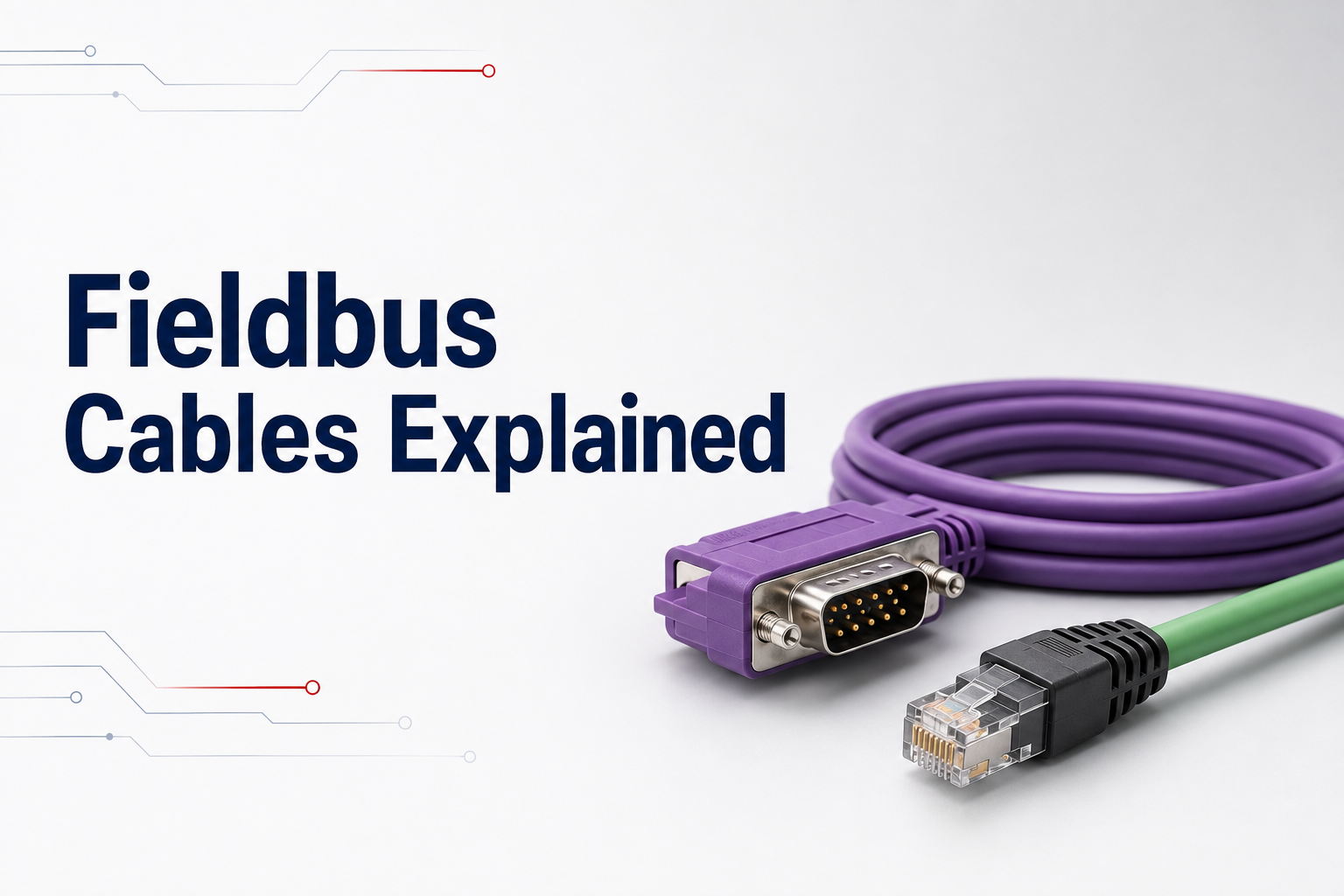
Fieldbus cables provide the physical connections that allow controllers, drives, remote I/O, sensors, actuators, and operator interfaces to exchange data. Although these cables may appear simple, their conductor arrangement, impedance, shielding, connector type, and mechanical construction directly affect network reliability.
Selecting a cable by connector shape alone can cause communication faults, intermittent operation, or complete network failure. The replacement must match the communication protocol, pinout, cable length, installation environment, and movement requirements of the original assembly.
Need a replacement industrial communication cable? Contact Wake Industrial with the complete cable part number and application details. Call 1-919-443-0207, email sales@wakeindustrial.com, or submit a quote request through the form on the page.
What Is a Fieldbus Cable?
A fieldbus cable carries digital communication between industrial control equipment and distributed field devices. Unlike traditional point-to-point wiring, a fieldbus network allows multiple compatible devices to exchange commands, process values, operating status, and diagnostic information through a shared communication architecture.
The term covers several cable designs rather than one universal standard. Classic fieldbus systems such as PROFIBUS DP, PROFIBUS PA, CANopen, DeviceNet, and INTERBUS have different physical-layer requirements. Ethernet-based systems such as EtherCAT, PROFINET, EtherNet/IP, and POWERLINK also require cables and connectors designed for their communication standards.
How Fieldbus Cables Work
Fieldbus cables transmit structured digital messages between the controller and connected devices. The controller may send output commands, speed references, control words, or configuration data. Field devices return process measurements, input states, operating status, alarms, and diagnostic information.
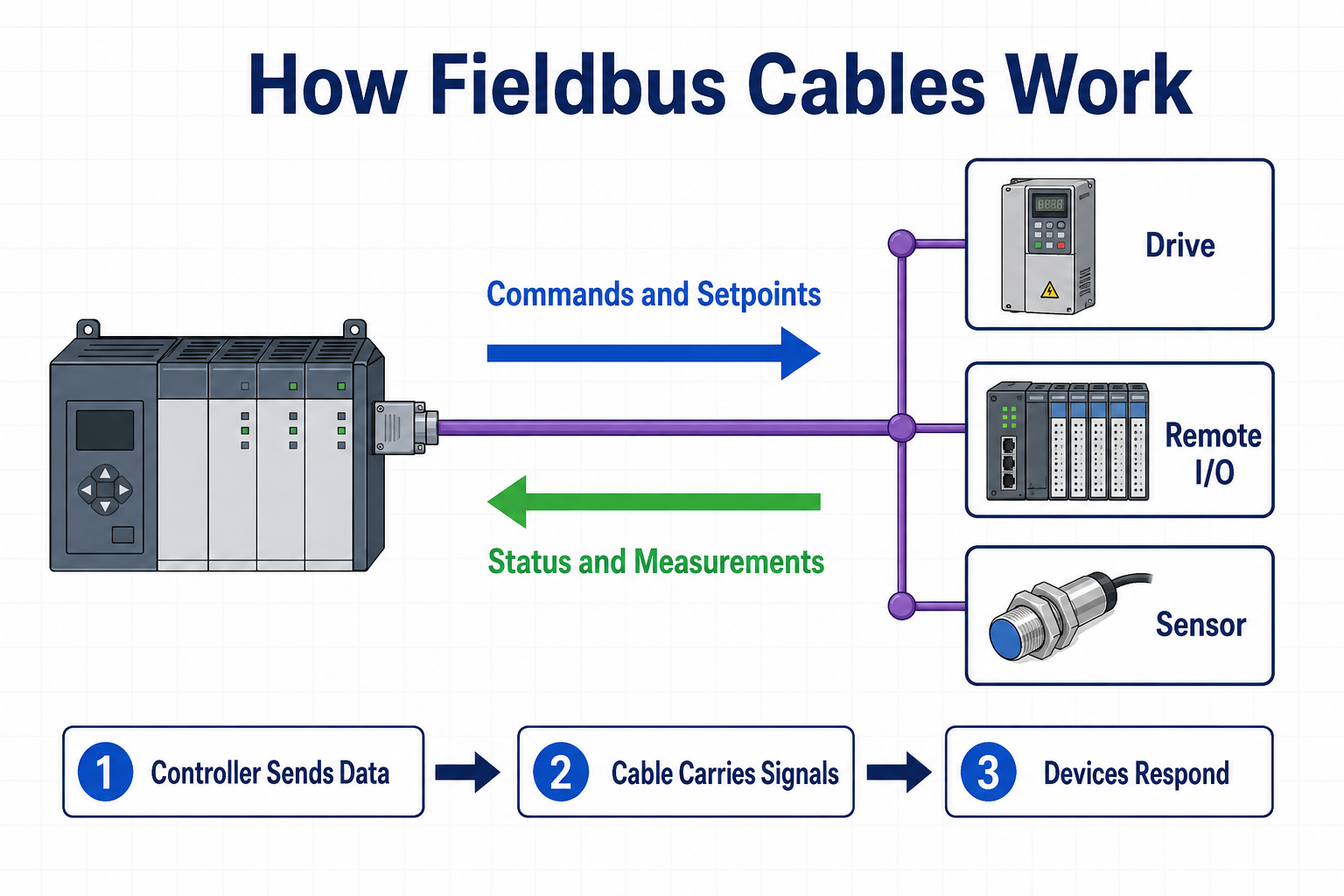
The cable must preserve signal integrity as those messages travel through the network. Conductor impedance, capacitance, shielding, connector termination, and maximum segment length all affect communication quality. If the cable does not meet the physical requirements of the network, data can become corrupted or fail to reach its destination.
Some process automation systems use the same twisted pair to carry communication and DC power. FOUNDATION Fieldbus H1 and PROFIBUS PA are common examples. Other networks use separate power conductors or dedicated communication-only cables.
Common Types of Fieldbus Cables
PROFIBUS Cables
PROFIBUS DP commonly uses shielded twisted-pair cable with RS-485 signaling. Network speed affects the permitted cable length, making correct cable selection and termination especially important. PROFIBUS connectors may include switchable termination resistors to establish the required electrical conditions at each end of a segment.
PROFIBUS PA uses a different physical layer suited to process automation. Its cable can carry digital communication and device power over the same pair, supporting transmitters, valve positioners, and other process instruments.
CAN-Based Fieldbus Cables
CANopen and DeviceNet are based on CAN communication but use application-specific wiring and connector conventions. These systems normally require shielded twisted-pair construction, correct polarity, and termination at the physical ends of the network.
DeviceNet cables can also carry network power. Using a cable with the wrong conductor arrangement, gauge, or pinout can therefore affect both communication and device operation.
Industrial Ethernet Cables
EtherCAT, PROFINET, EtherNet/IP, and POWERLINK use Ethernet-based communication but operate in environments more demanding than a typical office network. Suitable cables may use Cat5 or higher construction, braided and foil shielding, durable industrial jackets, and M8, M12, or RJ45 connectors.
Fixed-installation cables and drag-chain cables are not interchangeable. A cable that performs reliably inside a stationary cabinet may fail prematurely if installed on an axis that flexes continuously. Industrial Ethernet cables are available in fixed, flexible, trailing, and torsion-rated designs for different machine applications.
Fiber-Optic Fieldbus Cables
Some industrial networks, including legacy SERCOS and certain INTERBUS installations, use fiber-optic cables. Fiber is resistant to electromagnetic interference and can provide reliable communication around drives, motors, welding equipment, and other high-power machinery.
Fiber-optic assemblies require the correct transmitter, receiver, connector, and fiber type. Excessive bending, damaged ends, contamination, or incorrect routing can weaken the optical signal and interrupt communication.
Fieldbus Cable Examples
Manufacturer | Part Number | Network / Interface | Length and Connectors | Construction and Application |
Bosch Rexroth | PROFIBUS | Variable-length preassembled cable with connectors at both ends | Connects compatible VAM operator panels to the control module | |
Bosch Rexroth | Industrial Ethernet | RJ45 connectors at both ends | CAT6+ crosslink cable supporting up to 1 Gbit/s, five million bending cycles, and drag-chain installation | |
B&R Automation | POWERLINK / Ethernet | 20 m, RJ45 to RJ45 | Four shielded conductor pairs with a PVC jacket for fixed industrial network installation | |
Beckhoff | EtherCAT | 7 m, M8 four-pin A-coded connectors | Green PUR jacket, shielding, and drag-chain suitability for moving equipment | |
Beckhoff | EtherCAT | 1 m, M8 to RJ45 | Shielded AWG26 star-quad cable with a PUR jacket for dynamic industrial applications |
Need one of these fieldbus cables or another hard-to-find communication assembly? Request a quote using the complete part number. Contact Wake Industrial at 1-919-443-0207 or sales@wakeindustrial.com for pricing and availability.
Common Fieldbus Cable Problems
Communication faults can result from crushed cable sections, broken conductors, worn drag-chain jackets, bent connector pins, loose locking hardware, or contaminated fiber ends. Incorrect termination, poor grounding, damaged shielding, and excessive cable length can produce intermittent failures that are difficult to isolate.
A cable may pass a basic continuity check and still fail during operation. Fieldbus communication depends on electrical characteristics that a standard multimeter cannot fully evaluate. Network analyzers, cable testers, diagnostic counters, and device status indicators can provide more useful information about signal quality and communication errors.
Wake Industrial supplies replacement communication cables and other industrial automation components for legacy and current equipment. Request a quote today with the complete cable part number and required length. Call 1-919-443-0207, email sales@wakeindustrial.com, or use the quote form above.
Request a Quote

Cary, NC 27513












