


SCE905NN-000-01 Pacific Scientific
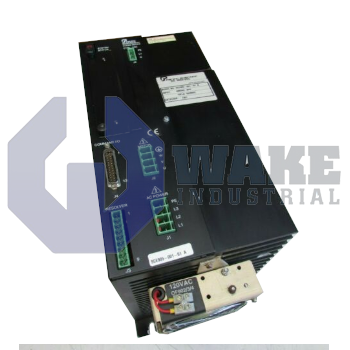
Wake Industrial LLC is not an authorized distributor of this product.
- Straightforward Pricing: No Rush Fees, No Credit Card Fees
Current response time:
3 Minutes
49 Seconds
The Pacific Scientific SCE905NN-000-01 is part of the SCE900 Servo Drives series. This servo drive features a peak current of 31.8 Amps and a continuous current rating of 15.9 Amps at 25 degrees Celsius. It uses convection cooling and supports both analog and incremental digital command interfaces, with dimensions of 370 mm in height, 160 mm in width, and 229 mm in depth, weighing 9.5 kilograms.


To contact sales for pricing and lead time:
Payment Methods


Shipping Methods


Our Credentials


Product Description:
The SCE905NN-000-01 is a digitally regulated servo drive produced by Pacific Scientific and assigned to the SCE900 Servo Drives series. Designed to modulate stator currents in brushless servo motors, the unit forms the power interface between motion controllers and mechanical axes in automated assembly cells, packaging lines, and material-handling stages. By translating velocity or torque commands into controlled three-phase outputs, it maintains accurate positioning and speed while limiting motor heating and overshoot during demanding duty cycles.
The drive delivers a continuous output of 15.9 A at 25 °C, enabling sustained operation on mid-frame motors without entering thermal overload. For rapid accelerations, its current ceiling rises to 31.8 A, allowing short bursts of two-fold torque before the internal protection logic intervenes. Heat is removed passively because the electronics use convection cooling without a fan, which simplifies cabinet layouts. Command signals can be accepted through an analog or incremental digital command input, so the unit can follow ±10 V references from legacy motion cards or step-and-direction streams from PLCs. The power section is housed in a chassis that is only 160 mm wide, leaving room for additional I/O or safety relays.
A mounting height of 370 mm and a cabinet depth of 229 mm allow the drive to fit in shallow enclosures while still providing clearance for cable bends above and below the terminals. With a mass of 9.5 kg, the unit can be moved and mounted without hoisting equipment. The control board uses a Standard configuration, so current-loop bandwidth, velocity gains, and fault-handling parameters follow the factory-default settings documented for the 900 Series. This layout supports straightforward integration into existing motion systems that use the same command structure.
Frequently Asked Questions about SCE905NN-000-01:
Q: What is the continuous current rating for the SCE905NN-000-01 servo drive?
A: The SCE905NN-000-01 can deliver a continuous current of 15.9 A at 25°C.
Q: What cooling method is used by the SCE905NN-000-01?
A: This servo drive is convection cooled and does not require a fan for operation.
Q: What types of command interfaces does the SCE905NN-000-01 support?
A: The SCE905NN-000-01 can interface via analog or incremental digital command inputs.
Q: What is the peak current specification for the SCE905NN-000-01?
A: The peak current capability of this model is 31.8 A.
Q: Which product series does the SCE905NN-000-01 belong to?
A: The SCE905NN-000-01 is part of the 900 Series of servo drives.









