


SC903-024-01 Pacific Scientific
Wake Industrial LLC is not an authorized distributor of this product.
Wake Industrial LLC is not an authorized distributor of this product.
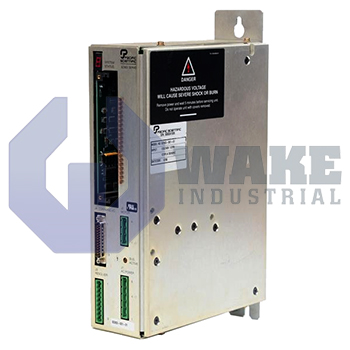
The Pacific Scientific SC903-024-01 is part of the SC900 Servo Drives series and delivers a continuous output current of 7.5 Amps with a peak output current of 15 Amps. It offers a continuous output power of 2.2 kW at 240V and a power stage efficiency of 96%. The drive supports both analog and incremental digital command interfaces and operates without built-in communication features.
Internal Product Review
The SC903-024-01 is a Pacific Scientific SC900 servo drive with an analog or incremental digital command interface and 7.5 A continuous output current. A 96% power stage efficiency and 15.0 A peak output current make the drive a very capable choice for responsive servo motion control.
 Have a part to sell?
 Wake Industrial Warranty
To contact sales for pricing and lead time:
Payment Methods


Shipping Methods


Our Credentials


Product Description:
The SC903-024-01 drive module is manufactured by Pacific Scientific and belongs to the SC900 Servo Drives series. It converts low-level velocity or position references into controlled three-phase output suitable for brushless servo motors. This supports closed-loop motion in automated assembly cells, material-handling gantries, and other precision machinery. The drive is intended for applications that need responsive speed regulation and accurate positioning.
At a 25 °C ambient temperature with natural convection, the power stage can supply a continuous phase current of 7.5 A, allowing midsize motors to maintain torque without overheating. The same thermal conditions support a continuous mechanical output of 2.2 kW when the unit is fed from a 240 V three-phase mains supply. For startups, rapid acceleration, or brief load spikes, the drive delivers a peak current of 15.0 A. This transient capability is paired with a peak mechanical output of 4.5 kW at 240 VAC, giving extra headroom for dynamic duty cycles. Power conversion losses are minimized by a stage efficiency of 96%, which helps reduce cabinet heat and lowers input power demand during sustained operation.
Motor selection is bounded by an inductance window that spans from 2 H down to 2.0 mH line-to-line, letting the drive operate both high-inductance torque motors and low-inductance high-speed designs without current-loop instability. Command references can be supplied through an analog or incremental digital interface, giving compatibility with legacy ±10 V controls or quadrature encoder signals used by contemporary motion controllers. There is no fieldbus communication, so parameter adjustments are handled locally through the selected command signals. This arrangement suits systems that rely on direct command wiring instead of a networked motion bus.









