


SC902TN-001-01 Pacific Scientific
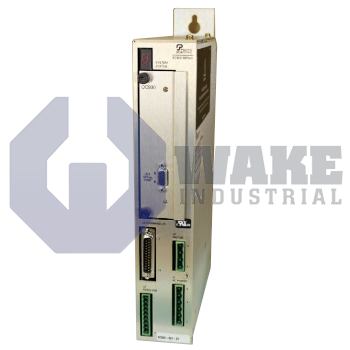
Wake Industrial LLC is not an authorized distributor of this product.
Wake Industrial LLC is not an authorized distributor of this product.
The SC902TN-001-01 is a servo drive manufactured by Pacific Scientific and is part of the SC900 Servo Drives series. It features a continuous output current of 3.75 Amps and a peak output current of 7.5 Amps. The drive supports analog or incremental digital command interfaces and is convection cooled without a fan.
Internal Product Review
The SC902TN-001-01 is a Pacific Scientific SC900 servo drive with an analog or incremental digital command interface and a no-fan convection-cooled design. Continuous output of 3.75 A and peak output of 7.5 A give the unit strong current capacity for responsive servo control. Power stage efficiency of 95% makes the drive a very efficient choice for compact motion systems.
 Have a part to sell?
 Wake Industrial Warranty
To contact sales for pricing and lead time:
Payment Methods


Shipping Methods


Our Credentials


Product Description:
The SC902TN-001-01 is a servo drive manufactured by Pacific Scientific and positioned within the SC900 Servo Drives series. It is intended to regulate brushless servomotors in automated machinery, translating motion commands into controlled three-phase power while monitoring feedback for precise velocity and position control. The drive manages the motor as part of a closed-loop system, so commanded motion can be corrected as load conditions change. This makes it suitable for repeatable machine movements such as indexing, feeding, and positioning. Its role is to provide stable electrical control between the motion source and the motor.
When mounted in free air at 25 °C, the drive can deliver a continuous output current of 3.75 A to the motor windings. From a 240 V three-phase source, it supplies a continuous mechanical output of 1.1 kW, which suits medium-power axes such as index tables or compact conveyors. Motor selection must stay within the controller's inductance window: it supports up to 4 H line-to-line inductance to limit current ripple, while a minimum of 4.0 mH is required for stable current regulation. For rapid accelerations, the unit permits a peak output current of 7.5 A zero-to-peak so the motor can overcome inertia during short demand spikes. Keeping the motor within this electrical range helps the current loop remain predictable during speed changes and load transitions.
The transient power capability reaches 2.2 kW at 240 VAC, allowing brief overloads during short motion bursts. Power stage efficiency is specified at 95%, which helps reduce heat inside the enclosure during continuous operation. Thermal management uses convection cooling without a fan, so the drive operates without forced-air hardware and can be installed in cabinets that rely on passive airflow. The command interface accepts analog or incremental digital reference signals, allowing integration with analog velocity commands or pulse-based position control from external controllers. This flexibility supports systems that use simple wiring and mixed control architectures.









