


SC723B001-01 Pacific Scientific
Wake Industrial LLC is not an authorized distributor of this product.
- Straightforward Pricing: No Rush Fees, No Credit Card Fees
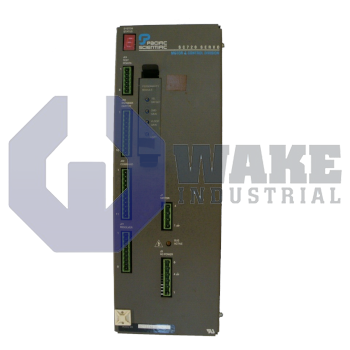
The Pacific Scientific SC723B001-01 is a servo controller from the SC720 Command Controllers series with a weight of 16 pounds and a cabinet depth of 10 inches. It offers continuous output current of 7.5 Amps and peak output current of 15 Amps, with a continuous power output of 2.2 kW at 240 Vac three-phase. The controller provides an accuracy of ±4 arcminutes and has an encoder resolution of 4096 pulses per revolution.


To contact sales for pricing and lead time:
Payment Methods


Shipping Methods


Our Credentials


Product Description:
The SC723B001-01 servo controller is manufactured by Pacific Scientific as part of the SC720 Command Controllers series. It is intended for cabinet installation, where it issues torque or velocity commands to brushless axes in industrial automation systems. This role lets the unit coordinate commanded motion with incoming feedback so the connected axis can respond predictably to changing load conditions. It fits applications that use centralized rack hardware rather than motor-mounted electronics.
With a 240 Vac three-phase supply, the internal bus carries 9 Arms, and the DC link stabilizes at 320 Vdc; when powered from 120 Vac, it holds 160 Vdc. The drive furnishes a continuous output of 7.5 A and can deliver up to 15 A momentarily, producing 2.2 kW of shaft power under rated conditions. Regulation is enforced with a 20 kHz carrier, and that switching activity is monitored through a 0.32 V/A scale at the test jacks so operating behavior can be checked directly. Cabinet depth is 10 in, full-load thermal loss is limited to 77 W, positional precision across the servo loop is maintained within ±4 arcmin, and a shunt network absorbs 40 W continuously or 6 kW briefly to limit DC bus overvoltage during deceleration.
The peak mechanical output reaches 4.5 kW during fast cycles, and a resolver-based encoder emulator supports the feedback path used by the controller's digital converters. Position information enters at a resolution of 4096 ppr, while the internal resolver-to-digital converter interprets angles with 14-bit granularity for smooth velocity transitions and stable speed feedback. The torque and velocity control algorithm uses those feedback values, and the on-board shunt resistor dissipates excess return energy when the axis slows. Total installed mass is 16 lb, which should be considered when allocating space and support inside the cabinet for a centralized control assembly.