


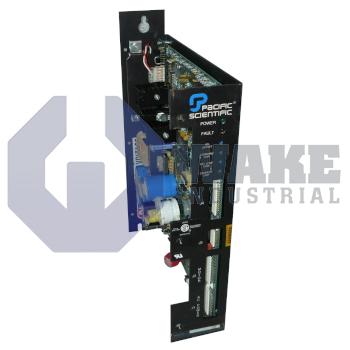
SC402-001-T5 Pacific Scientific
Wake Industrial LLC is not an authorized distributor of this product.
- Straightforward Pricing: No Rush Fees, No Credit Card Fees
Current response time:
6 Minutes
34 Seconds
The Pacific Scientific SC402-001-T5 is a servo drive from the SC400 Servo Drives series with an input voltage of 115/230 VAC and line frequency of 47 to 63 Hz. It delivers a continuous output current of 3.5 Amps and can provide up to 1000 Watts of continuous power at 230 VAC three-phase. This unit achieves a peak output current of 7 Amps and a current loop bandwidth up to 3 kHz.


To contact sales for pricing and lead time:
Payment Methods


Shipping Methods


Our Credentials


Product Description:
The SC402-001-T5 is a digital servo drive manufactured by Pacific Scientific for the SC400 Servo Drives series. Installed between a motion controller and a brushless motor, it converts AC mains into a regulated DC bus and controls torque, speed, and position in automated machinery such as pick-and-place stations, indexing tables, and packaging lines. It rectifies incoming line power, maintains inverter bus stability, and meters current to the motor phases so the axis can respond accurately during starts, stops, and direction changes. This makes the unit suitable for servo applications that require repeatable positioning and steady speed regulation from a compact drive package. Input voltage can be selected for 115/230 VAC lines, and a fault transistor sinks 25 mA at 30 VDC to signal protective shutdowns to the host controller.
The power section creates a DC rail of 160 VDC when the input is 115 VAC and 320 VDC when the input is 230 VAC, providing stable headroom for the inverter stage. This bus level gives the output devices enough voltage margin to maintain commanded motor current as speed and load vary. The output stage can continuously supply 3.50 A, supporting motor operation on either single-phase or three-phase sources. At the control level, a current loop bandwidth of 3 kHz lets the drive track torque commands quickly, while a velocity interface accepts commands of ±10 V for analog speed control. The analog command path allows simple integration with controllers that use standard velocity references rather than a networked command interface.
For short acceleration bursts, the amplifier delivers 7.0 A, enabling peak shaft outputs of 1000 W on the lower input range and 2000 W on the higher range. The difference between continuous and peak output allows the drive to support intermittent overloads while staying within normal thermal limits during routine operation. The PWM bridge switches at a carrier of 20 kHz, which minimizes acoustic noise and reduces torque ripple in low-inductance motors. That switching frequency also supports smoother low-speed operation by keeping current ripple under tighter control. Continuous output power is 700 W on single-phase 230 VAC and 1000 W on three-phase 230 VAC.









