


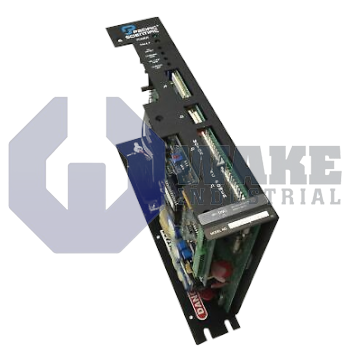
SC402-001-T3 Pacific Scientific
Wake Industrial LLC is not an authorized distributor of this product.
- Straightforward Pricing: No Rush Fees, No Credit Card Fees
Current response time:
5 Minutes
19 Seconds
The Pacific Scientific SC402-001-T3 is part of the SC400 Servo Drives series and supports 115 or 230 VAC input voltage with a frequency range of 47 to 63 Hz. It features a peak output current of 7 Amps and delivers up to 2000 Watts peak power at 230 VAC. This drive has a current loop bandwidth of up to 3 kHz and integral fusing for input protection.


To contact sales for pricing and lead time:
Payment Methods


Shipping Methods


Our Credentials


Product Description:
The SC402-001-T3 servo drive is manufactured by Pacific Scientific within the SC400 Servo Drives series. Designed for industrial automation tasks, the unit converts plant power into a regulated DC bus and a modulated output that controls torque and speed for brushless or brush servomotors. By integrating power conversion, current regulation, and protective circuitry in one enclosure, the drive serves as the electrical link between a motion controller and actuators used on packaging lines, pick-and-place stations, and positioning tables.
Internally, a rectifier and PWM current regulator charge the bus to 160 VDC when the mains is 115 VAC and to 320 VDC when supplied from a 230 VAC source. At 230 VAC, the drive supplies a continuous phase current of 3.5 A, and it can support transient demands up to 7 A during acceleration or shock loads. A current loop bandwidth of 3 kHz lets the controller react quickly to command changes, which helps reduce velocity error. Integral semiconductor fusing disconnects the supply during overcurrent events, while metal oxide varistors on the input absorb surge energy. Pulse-width modulation keeps switching losses low, and the output stage is magnetically and optically isolated from the control logic to help prevent ground loops.
For power budgeting, the drive can deliver peak mechanical outputs of 1000 W from the lower input option or 2000 W from the higher input option. It accepts supply frequencies from 47–63 Hz and can operate on either single-phase or three-phase power, which makes it suitable for varied plant distribution schemes. The allowable mains window has a +10 / −15 percent tolerance, and conversion achieves a form factor below 1.01 to limit ripple. Speed is commanded through an analog reference of ±10 V, and magnetic and optical barriers maintain galvanic isolation between the high-energy inverter bridge and the low-level control electronics.









