


SC105-001-T3 Pacific Scientific
Wake Industrial LLC is not an authorized distributor of this product.
- Straightforward Pricing: No Rush Fees, No Credit Card Fees
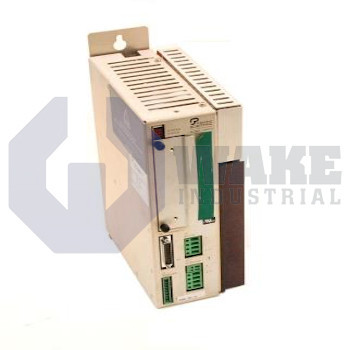
The Pacific Scientific SC105-001-T3 is a standard controller from the SC100 Brushless Servo Controllers series. It operates with a nominal bus voltage of 320 VDC and supports a continuous output current of 40 Amps with an output power of 9 kW. The controller has an efficiency greater than 95 percent and runs on a 230 VAC input voltage across three phases.


To contact sales for pricing and lead time:
Payment Methods


Shipping Methods


Our Credentials


Product Description:
The SC105-001-T3 is a brushless servo controller built by Pacific Scientific within the SC100 Brushless Servo Controllers series. The unit converts three-phase mains power into a regulated DC bus and pulse-width-modulated output that drives permanent-magnet servomotors in automated assembly cells, packaging lines, and material-handling axes. It uses the standard controller configuration and a Tachsyn processor interface to read tachometer feedback for closed-loop velocity regulation.
During steady operation, the controller accepts a three-phase supply of 230 VAC (+10%, -15%) at 47–63 Hz. This input is rectified to a nominal DC bus of 320 VDC, which serves as the working voltage for the IGBT bridge that commutates the motor windings. At stall, it can deliver a continuous output current of 40 A, corresponding to a shaft power capability of 9 kW. These values allow the drive to hold position or run incremental moves without thermal derating. Conversion losses stay low, and overall efficiency exceeds 95%, so only 205 W of heat is produced at full load. The controller senses motor speed through a 2.0 V/Krpm tachometer gradient.
For dynamic moves, the SC105-001-T3 supplies a peak output current of 60 A for up to five seconds, translating to a momentary mechanical power of 17 kW. Excess regenerative energy is absorbed by the integrated shunt regulator, which can continuously dissipate 60 W and momentarily handle 15 kW for 300 ms. The pulse-width modulation stage operates at a carrier frequency of 5 kHz, which helps limit motor ripple while keeping switching losses acceptable. The design maintains full ratings from 0 °C to 50 °C and can be stored between −55 °C and 70 °C without damage. Three input phases provide balanced rectification during normal operation.









