


SC103-001 Pacific Scientific
Wake Industrial LLC is not an authorized distributor of this product.
- Straightforward Pricing: No Rush Fees, No Credit Card Fees
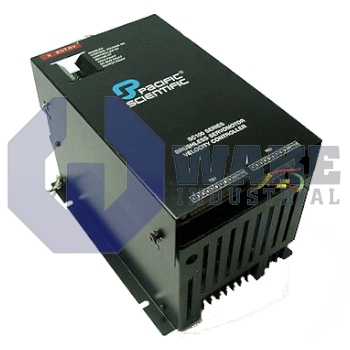
The Pacific Scientific SC103-001 is a brushless servo controller from the SC100 Brushless Servo Controllers series with a nominal bus voltage of 320 VDC and an input voltage of 230 VAC three-phase at 47-63 Hz. It delivers a continuous output current of 15 Amps and a continuous output power of 4.5 kW, with peak values reaching 30 Amps and 9 kW for short durations. The controller operates with an efficiency above 95 percent and maintains full ratings in temperatures from 0 to 50 degrees Celsius.


To contact sales for pricing and lead time:
Payment Methods


Shipping Methods


Our Credentials


Product Description:
The SC103-001 servo controller is manufactured by Pacific Scientific and belongs to the SC100 Brushless Servo Controllers series. Classified as a brushless servo controller, it is supplied as a standard controller without customer-specific customization. In an industrial cell, it converts fixed-frequency mains power into variable, filtered three-phase output that drives brushless servomotors, allowing closed-loop regulation of speed, position, and torque on conveyor indexes, pick-and-place slides, or packaging axes. An integrated shunt regulator protects the DC link during regenerative events.
The controller accepts a three-phase supply of 230 VAC (+10%, -15%) at a line frequency range of 47–63 Hz. After rectification and filtering, a nominal bus of 320 VDC is maintained for the IGBT inverter stage. In continuous stall duty, it can source 15 A to the motor, delivering 4.5 kW of mechanical power without derating. Conversion efficiency is better than 95%, so only minimal energy is lost as heat. The semiconductor bridge commutates at 5 kHz, a switching frequency that helps maintain smooth motor current while limiting device stress. Using three input phases balances the load across plant conductors and keeps harmonic content within customary limits.
For short acceleration bursts, the drive can provide 30 A for up to five seconds, raising output to 9 kW. Excess energy is routed to the braking circuit, which handles a continuous 30 W and up to 8 kW for 300 ms during rapid decelerations. This arrangement helps protect the DC bus when the motor is back-driven by the load. At full rated load, the internal electronics dissipate 105 W, a figure used when sizing forced-air cooling inside a cabinet. Full performance is maintained from 0 °C to 50 °C, and the unit may be stored between −55 °C and 70 °C without degradation.