


R45GENA-R2-NS-NV-00 Pacific Scientific
Wake Industrial LLC is not an authorized distributor of this product.
- Straightforward Pricing: No Rush Fees, No Credit Card Fees
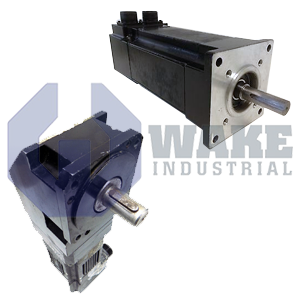
The Pacific Scientific R45GENA-R2-NS-NV-00 is a servo motor in the R Servomotors series with a 4.25 inch square frame size and a stack length of 5 inches. It features a continuous stall torque of 5.7 Nm and a peak torque of 15.1 Nm, with rare earth samarium cobalt magnets. The motor has a standard housing style, English mounting type, and uses a frameless resolver as primary feedback.


To contact sales for pricing and lead time:
Payment Methods


Shipping Methods


Our Credentials


Product Description:
The R45GENA-R2-NS-NV-00 is a brushless servo motor built by Pacific Scientific for the R Servomotors series. Within an automation cell, it translates drive commands into shaft motion for indexing and contouring duties. The motor is intended for use with digital drives that regulate current and monitor feedback to maintain positional accuracy under shifting loads. Its square housing and English mounting interface suit machines built around inch-based dimensions.
A continuous stall capacity of 5.7 Nm allows the motor to apply steady torque indefinitely without exceeding its thermal rating, which is useful for holding and low-speed feed operations. For rapid acceleration, a peak capability of 15.1 Nm is available for short intervals, giving the axis added torque during demanding motion segments. Rotor dynamics are influenced by an inertia of 0.31 kg·m² × 10⁻³, which supports responsive motion while limiting abrupt behavior during reversals. The square frame measures 4.25" on each side, making it compatible with NEMA-style gearheads and brackets. The motor has a 5-inch stack length, which contributes to heat dissipation and torque density. Magnetic excitation uses rare earth samarium cobalt material to maintain stable flux when ambient temperature changes.
Position feedback is delivered by a frameless resolver, transmitter type, size 21, so the drive receives continuous sine-cosine signals for rotor position monitoring during operation. Because there is no brake, the axis must rely on drive torque or an external holding device to keep position when power is removed. The motor also has no shaft seal, so it is better suited to dry environments or to installations that provide external sealing against dust or liquids. These features should be considered when matching the motor to the surrounding machine environment.









