


R32GENC-HS-ND-NV-00 Pacific Scientific
Wake Industrial LLC is not an authorized distributor of this product.
- Straightforward Pricing: No Rush Fees, No Credit Card Fees
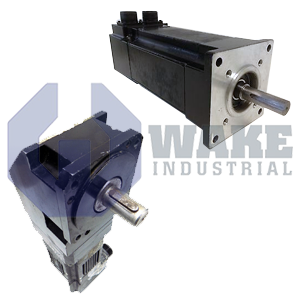
The Pacific Scientific R32GENC-HS-ND-NV-00 is a servo motor in the R Servomotors series with a continuous stall torque of 1.7 Nm and a peak torque of 4.40 Nm. It features a 3.25 inch square frame, no holding brake, and operates at a rated speed of 4000 RPM with a stack length of 2 inches. The servo motor uses rare earth samarium cobalt magnets and has both hall sensors and a 500 ppr line driver encoder for feedback.


To contact sales for pricing and lead time:
Payment Methods


Shipping Methods


Our Credentials


Product Description:
The R32GENC-HS-ND-NV-00 is a brushless servo motor produced by Pacific Scientific and assigned to the R Servomotors series. It is intended for closed-loop motion axes where precise velocity and torque control are required to drive light to medium mechanical loads. The motor is supplied without an internal holding brake, so external holding hardware must be used when static load support is required. Its standard winding also allows it to operate with commonly matched servo drives from the same product family, making it suitable for general motion systems that rely on accurate speed and position response.
Under continuous duty, the motor can develop 1.7 Nm of stall torque while maintaining rated temperature rise. For short transient moves, it can reach a peak of 4.40 Nm, giving extra torque for rapid acceleration or disturbance recovery. Rotor inertia is 0.071 kg·m² × 10⁻³, so the low rotating mass helps reduce settling time and supports responsive velocity-loop tuning. The electromagnetic section uses rare earth (samarium cobalt) magnets, which provide strong flux density and good thermal stability during repeated motion cycles. With standard cooling, the shaft can turn at 4000 rpm, which suits indexing, labeling, and light machining applications that need moderate speed with accurate positioning.
Mechanically, the frame measures 3.25" square, which helps it fit compact equipment that uses common square-mount motor space. A stack length of 2 inches keeps the housing compact while supporting the listed torque capability. Primary commutation feedback is supplied by integrated Hall sensors, and fine position feedback comes from a secondary 500 ppr line-driver encoder for smooth control and accurate signal processing by the drive. English-pattern mounting and Housing Style C support straightforward installation, and the lack of a shaft seal makes the motor better suited for clean environments where enclosure protection is handled at the machine level.









