


P22NRXB-LDN-NS-00 Pacific Scientific
Wake Industrial LLC is not an authorized distributor of this product.
Wake Industrial LLC is not an authorized distributor of this product.
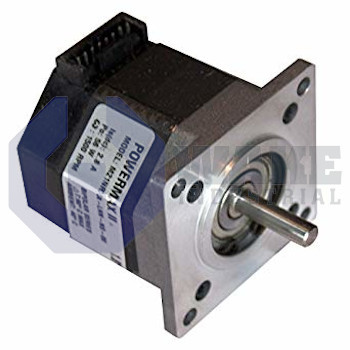
The Pacific Scientific P22NRXB-LDN-NS-00 is part of the POWERMAX II P Motors series and features a NEMA 23 frame size with a holding torque of 1.51 Newton-meters. This stepper motor has a double smooth shaft with a diameter of 6.35 mm, operates with two phases and offers 200 steps per revolution at a step angle of 1.8 degrees. Standard construction and an IP23 protection class complete its design, with a mass of 1.13 kilograms.
Internal Product Review
The P22NRXB-LDN-NS-00 is a Pacific Scientific POWERMAX II P stepper motor with a NEMA 23 frame and 1.51 N·m holding torque. A 1.8° step angle and ±1.5% step accuracy support precise indexing and consistent motion control. IP23 protection makes this motor a strong choice for dependable industrial positioning service.
 Have a part to sell?
 Wake Industrial Warranty
To contact sales for pricing and lead time:
Payment Methods


Shipping Methods


Our Credentials


Product Description:
The P22NRXB-LDN-NS-00 stepper motor is produced by Pacific Scientific within the POWERMAX II P Motors series. It is supplied with a regular lead-wire connection style that terminates in a receptacle, and the unit follows a standard construction format without integrated feedback because the encoder option provides no feedback. The motor body measures 78.8 mm long, uses two rotor stacks, and weighs 1.13 kg, making it a compact choice for NEMA-style mounting in tightly spaced equipment. A standard rotor completes the assembly and supports general-purpose motion profiles.
The motor occupies the NEMA 23 frame envelope and delivers a static holding capability of 1.51 N·m, while its detent torque is only 0.049 N·m, so most of the available torque is produced electromagnetically when the windings are energized. Each full step equals 1.8 degrees, providing 200 indexed positions per revolution with a step accuracy of ±1.5 %, which is suitable for open-loop positioning. Two phases wound to type B draw 4.6 A per phase in the recommended parallel path and encounter just 0.38 Ω of phase resistance; this combination limits copper loss and supports high torque at low speed. Heat leaves the package through a 4.5 °C/W thermal path, and the motor can operate in ambient temperatures from -20 °C to +40 °C. The double-ended smooth shaft is machined to a 6.35 mm diameter for coupling or pulley attachment, and the rotor is supported inside the standard housing with permanent-magnet retention suited to the two-stack layout.
Electrical dynamics are set by a parallel inductance of 2.1 mH, allowing fast current rise during microstepping or acceleration. Coil insulation meets Class B, 130 °C requirements and has an insulation resistance of 100 Megohms; dielectric strength reaches 340 Vdc. The housing has an IP23 rating, so dust ingress is limited and direct spray must be avoided. Motor case temperature must remain below 95 °C to preserve magnet strength and insulation integrity while the drive runs within its intended limits.









