


P21NSXC-LSS-NS-10 Pacific Scientific
Wake Industrial LLC is not an authorized distributor of this product.
- Straightforward Pricing: No Rush Fees, No Credit Card Fees
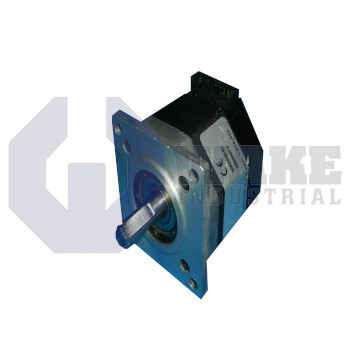
The Pacific Scientific P21NSXC-LSS-NS-10 is part of the POWERMAX II P Motors series and features a NEMA 23 frame size with standard construction. It has a step angle of 1.8 degrees, supports 200 steps per revolution, and operates within a temperature range of -20°C to +40°C. The motor uses Class B insulation rated at 340 Vdc and offers a mounting bolt circle of 2.625 inches.


To contact sales for pricing and lead time:
Payment Methods


Shipping Methods


Our Credentials


Product Description:
The P21NSXC-LSS-NS-10 is a hybrid stepper motor produced by Pacific Scientific and belongs to the POWERMAX II P Motors series. This NEMA 23 device converts digital pulse trains from indexers or drives into incremental shaft rotation for positioning tasks in automated machinery, pick-and-place arms, and small conveyors. By applying controlled phase currents to its stator windings, the motor generates discrete detent positions that provide open-loop motion control without an encoder. This makes it suitable for applications that require repeatable stepping accuracy with straightforward drive control.
Mechanically, the motor uses a NEMA 23 frame whose housing measures 2.25 inches across the flats. A receptacle connector with eight pins handles field wiring, and the standard construction with a single-stack rotor keeps the overall length compact. With no encoder feedback, the motor operates in open loop. Each command pulse turns the shaft 1.8 degrees, so one revolution equals 200 steps. Position error stays within ±1.5 %. The motor uses winding code C with a standard rotor, and the NEMA mounting style simplifies attachment to gearheads or lead-screw plates.
Installation clearances are set by a 2.625 in bolt circle that aligns with NEMA face adapters and helps maintain concentricity. Electrically, the windings use Class B insulation rated to 130 °C and are tested to withstand 340 Vdc impulse without breakdown. A resistance of 100 Megohms between phases and frame confirms dielectric integrity after thermal cycling. The motor maintains its published characteristics throughout an ambient range of -20 °C to +40 °C, allowing cabinet or exposed mounting in typical plant environments. The insulation system and dielectric strength support dependable phase-to-frame isolation during normal industrial operation.









