


SR3658-2255-7-56B Pacific Scientific
Wake Industrial LLC is not an authorized distributor of this product.
- Straightforward Pricing: No Rush Fees, No Credit Card Fees
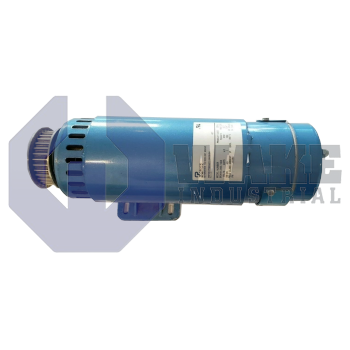
The Pacific Scientific SR3658-2255-7-56B is a permanent magnet DC motor from the Permanent Magnet DC Motors series, featuring a rugged fused commutator and polyester impregnated armature. It has a nominal voltage of 180 VDC and rated current of 4.5 Amps, with large sealed bearings and field replaceable brushes.


To contact sales for pricing and lead time:
Payment Methods


Shipping Methods


Our Credentials


Product Description:
The SR3658-2255-7-56B is a DC motor built by Pacific Scientific and grouped in the Permanent Magnet DC Motors series. Within an automation cell, this motor serves as the prime mover that converts direct current from a drive into mechanical rotation for conveyors, small presses, or metering rolls. Its straightforward torque delivery suits installations where speed is regulated by an external armature controller rather than by feedback-heavy servo loops. Because it is a brushed DC design, output speed is commonly adjusted through the applied armature voltage, while load current rises as torque demand increases. That operating style makes the motor practical for equipment that needs simple speed trimming and reliable low-speed torque.
Magnet excitation is provided by a permanent magnet DC field, removing the need for a separate shunt winding and lowering idle losses. The armature circuit is intended for a 180 VDC supply, and under continuous load the motor draws 4.5 A. Current transfer at the rotor is handled by a rugged fused commutator, whose fused copper segments help resist bar lift during speed changes and repeated electrical switching. Shaft support comes from large sealed bearings that retain grease and help keep airborne contaminants away from the rolling elements. The absence of a separate field supply simplifies wiring around the motor and its controller.
The armature uses polyester-impregnated windings, so resin penetrates the slots to hold the conductors in place and improve insulation against moisture. Resin bonding also helps limit winding movement during vibration and repeated heating cycles. The motor also uses field-replaceable brush assemblies, which allow brush changes without removing the endbells. In addition, constant-force springs keep brush contact pressure stable as the carbon wears, helping maintain consistent electrical contact during operation.