


PCE843-001-T Pacific Scientific
Wake Industrial LLC is not an authorized distributor of this product.
Wake Industrial LLC is not an authorized distributor of this product.
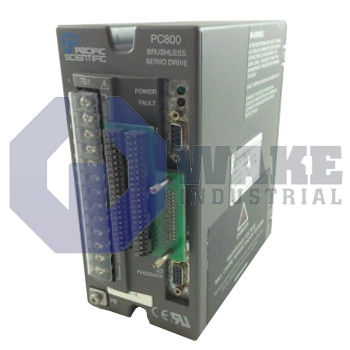
The Pacific Scientific PCE843-001-T is a servo drive from the PC800 - PCE800 Brushless Servo Drives series. It offers a continuous output current of 3.75 ARMS at 40°C and continuous power of 2.6 kW at 480 VAC. The drive supports a peak output current of 7.5 ARMS for 3 seconds and features a power stage efficiency of 97%.
Internal Product Review
The PCE843-001-T is a Pacific Scientific brushless servo drive with a SERCOS command interface and 97% power stage efficiency. Continuous 2.6 kW output at 480 VAC and 7.5 ARMS peak current give this unit impressive servo performance for demanding motion applications.
 Have a part to sell?
 Wake Industrial Warranty
To contact sales for pricing and lead time:
Payment Methods


Shipping Methods


Our Credentials


Product Description:
The PCE843-001-T is a brushless servo drive produced by Pacific Scientific within the PC800 – PCE800 Brushless Servo Drives series. It functions as the power conversion and control stage between a plant’s AC mains and a matched servomotor, regulating torque, speed, and position commands that originate from a motion controller or PLC. In automated assembly cells, packaging lines, and electronic pick-and-place equipment, the drive’s closed-loop current and velocity control enables repeatable movement profiles, while its compact 121.7 mm × 192 mm × 254 mm housing eases cabinet integration.
The drive delivers a continuous output current of 3.75 ARMS at 40 °C, supporting thermally stable operation when mounted in densely populated enclosures. Under 480 VAC supply, it can supply up to 2.6 kW of continuous mechanical power to the motor, and its design allows a momentary surge to 6.4 kW for rapid acceleration events. For load spikes lasting up to three seconds, the output current rises to 7.5 ARMS, allowing inertia-laden axes to reach commanded speed without a drive trip. The power stage converts PWM energy with a measured efficiency of 97%, minimizing panel heat dissipation and reducing the required cooling airflow.
Dynamic events are handled by an internal shunt that absorbs up to 35 J of regenerated energy while switching at a current ripple frequency of 16 kHz to maintain low torque ripple on the motor shaft. When larger overhauling loads occur, a shunt regulator rated for 10 kW directs excess DC bus voltage to an external 66 Ω resistor and maintains galvanic separation from control electronics with a minimum isolation strength of 1500 V. These protective elements, combined with a 5 mH minimum motor inductance requirement, support consistent braking and voltage stability during frequent deceleration cycles.









