


PC833-001-T Pacific Scientific
Wake Industrial LLC is not an authorized distributor of this product.
Wake Industrial LLC is not an authorized distributor of this product.
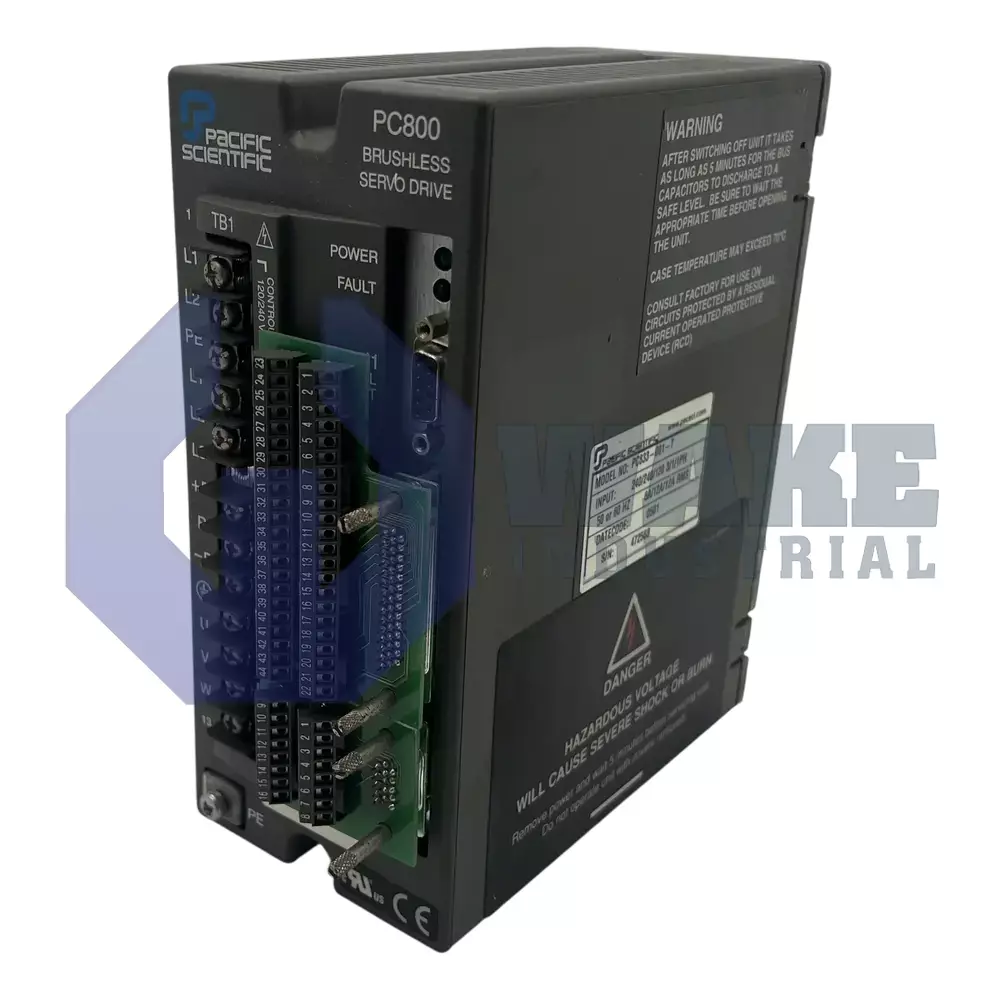
The Pacific Scientific PC833-001-T is a servo drive from the PC800 - PCE800 Brushless Servo Drives series, delivering a continuous power output of 1.5 kW and a power stage efficiency of 98%. It supports a bus voltage of 320 VDC at 240 Vac 3-phase and provides a peak output current of 10.6 Amps. The drive has an inrush peak current of 300 Amps with a 1.5 millisecond pulse width.
Internal Product Review
The PC833-001-T is a Pacific Scientific brushless servo drive rated for 1.5 kW continuous power on 240 Vac 3-phase input. Power stage efficiency of 98% and a 20 kHz output ripple frequency support clean, responsive motor control in demanding servo applications. Excellent drive performance for motion platforms, highlighted by 10.6 A peak output current.
 Have a part to sell?
 Wake Industrial Warranty
To contact sales for pricing and lead time:
Payment Methods


Shipping Methods


Our Credentials


Product Description:
The PC833-001-T is a brushless servo drive produced by Pacific Scientific in the PC800-PCE800 Brushless Servo Drives series. The unit converts three-phase AC input to a regulated DC bus and high-frequency PWM output that governs torque, velocity, and position of matched servomotors in industrial automation cells, packaging lines, and material-handling axes. It serves as the amplifier between the motion controller and the motor, delivering commanded currents while protecting the motor-drive system from electrical or thermal overload.
The DC link is maintained at 320 VDC when the drive is supplied from a 240 V three-phase source, leaving headroom for quick current changes. With forced-air cooling, the amplifier delivers 1.5 kW and up to 5.3 A; without extra airflow, current is limited to 3.6 A. For acceleration and impact loads, current can rise to 10.6 A, giving motors extra torque without exceeding thermal limits. A switching network running at 20 kHz minimizes audible noise and reduces shaft ripple. During steady operation, the line draws about 6 A RMS, and regenerated energy can be dissipated through an external resistor at a 6% duty cycle.
Energy generated by decelerating axes is first absorbed internally; the bus capacitor can take up to 30 J before the shunt regulator activates. When the threshold is crossed, the onboard transistor diverts surplus power to an external brake resistor at a peak rate of 12.8 kW. Overall power-stage losses are low, with an efficiency of 98%, reducing panel heat. Start-up demands are higher, and an inrush limiter manages 300 A peaks that last only 1.5 ms. Motor leads may extend to 50 m, allowing the drive to remain close to the controller while the actuator sits on moving machinery. Proper operation requires a connected motor with phase inductance between 2.0 mH and 2 H.









