


PC833-001-N Pacific Scientific
Wake Industrial LLC is not an authorized distributor of this product.
Wake Industrial LLC is not an authorized distributor of this product.
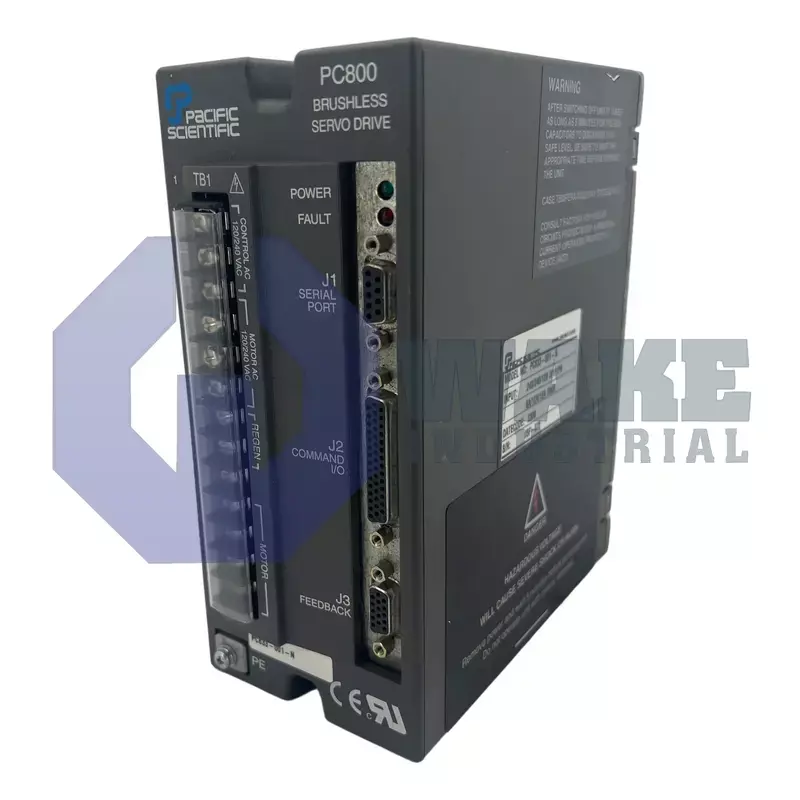
The Pacific Scientific PC833-001-N is a brushless servo drive from the PC800 - PCE800 Brushless Servo Drives series, offering a continuous output current of 3.6 ARMS and a peak output current of 10.6 ARMS. It provides an output power of 1.5 kW at 240 Vac 3-phase and achieves an efficiency of 98%. The drive supports a maximum motor cable length of 50 meters and handles a regen peak power of 12.8 kW.
Internal Product Review
The PC833-001-N is a Pacific Scientific brushless servo drive that stands out with 98% efficiency and 1.5 kW output power. Continuous output current of 3.6 ARMS and peak output current of 10.6 ARMS support strong servo performance through changing load demands. A 20 kHz ripple frequency is a valuable advantage for smooth motor control.
 Have a part to sell?
 Wake Industrial Warranty
To contact sales for pricing and lead time:
Payment Methods


Shipping Methods


Our Credentials


Product Description:
The PC833-001-N is a brushless servo drive produced by Pacific Scientific for the PC800-PCE800 Brushless Servo Drives series. It serves as the power stage between a 240 VAC three-phase mains supply and a matched permanent-magnet motor, delivering regulated current loops so that external motion controllers can impose accurate torque, speed, or position commands on automated equipment. By converting line energy into a 320 VDC bus and handling regenerative energy during deceleration, the unit supports compact cabinet layouts while maintaining low thermal stress during continuous industrial duty. This makes it suitable for indexing, conveying, and other coordinated axis applications that require stable servo response.
The drive sustains a continuous output of 3.6 ARMS and can reach a momentary ceiling of 10.6 ARMS to cover dynamic load changes. A rated output power of 1.5 kW is available when the line supply delivers 6 A per phase, and overall conversion efficiency is held at 98% to reduce wasted energy. Internally, the capacitor bank stores 30 J of bus energy to ride through short voltage dips. Motor connections may extend up to 50 m, and the drive accepts motor inductance from 2.0 mH to 2 H. Peak winding demand is limited to 15 A, measured zero to peak, while an inrush limiter confines the charging surge to 1.5 ms to protect upstream breakers. This operating range allows the unit to support both compact motor assemblies and longer cable runs inside larger machines.
During acceleration, the power stage can deliver an ideal maximum of 4.5 kW. At startup, the bus can draw an instantaneous 300 A spike before settling to normal operation. During deceleration, regeneration is handled continuously at 800 W and can peak at 12.8 kW without external braking resistors, provided thermal limits are observed. The switching bridge uses a carrier frequency of 20 kHz, which helps reduce audible noise and limit current ripple in the connected motor. These regenerative capabilities are useful on axes that decelerate frequently or reverse direction under load.









