


PC833-001-A Pacific Scientific
Wake Industrial LLC is not an authorized distributor of this product.
Wake Industrial LLC is not an authorized distributor of this product.
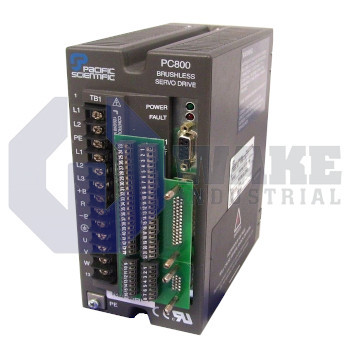
The Pacific Scientific PC833-001-A is part of the PC800 - PCE800 Brushless Servo Drives series. This drive provides a continuous output current of 3.6 ARMS with a peak output current of 10.6 ARMS and an idealized peak power of 4.5 kW. It supports a maximum motor cable length of 50 meters and achieves a power stage efficiency of 98%.
Internal Product Review
The PC833-001-A is a Pacific Scientific brushless servo drive with 1.5 kW continuous power at 240 Vac 3-phase and 98% power stage efficiency. Strong dynamic performance comes from 10.6 ARMS peak output current and a 20 kHz ripple frequency, making this unit a very capable choice for responsive motion control.
 Have a part to sell?
 Wake Industrial Warranty
To contact sales for pricing and lead time:
Payment Methods


Shipping Methods


Our Credentials


Product Description:
The PC833-001-A brushless servo drive is produced by Pacific Scientific within the PC800–PCE800 Brushless Servo Drives series. Designed for closed-loop control of permanent-magnet servomotors, the unit converts 240 V three-phase input into a regulated, high-frequency output that governs speed and torque in automated machinery such as packaging stations, gantry axes, and process lines. Installation flexibility is supported by a maximum motor-cable length of 50 m, allowing cabinet placement away from moving axes.
It delivers a continuous power of 1.5 kW from a 240 V AC three-phase supply while drawing a line current of 6 A under rated conditions. The drive supplies a continuous output of 3.6 ARMS, which rises to 10.6 ARMS for short overloads, and its current crest capability reaches 15 A on a zero-to-peak basis. Forced-air cooling increases the sustainable current to 5.3 ARMS, allowing motors to hold higher torque without a thermal trip. Bus capacitors can absorb 30 J of returned energy during deceleration, and the internal stage runs at a ripple frequency of 20 kHz to reduce torque ripple. With a power stage efficiency of 98%, most of the input energy is transferred to the motor rather than lost as heat. Compatible machines must present motor inductances between 2.0 mH and 2 H to support stable current regulation.
For transient events, the drive can release a peak mechanical power of 4.5 kW. Excess kinetic energy is routed to the shunt, where it can be dissipated continuously at 800 W or momentarily at 12.8 kW; system design must keep total regenerated energy within the stated 6% duty cycle to prevent thermal overload. The specified inductance window and low-loss switching help maintain current-loop stability when long leads are used. The regeneration limits also support safe deceleration profiles during demanding indexing or tension-control sequences.