


OC950-501-01 Pacific Scientific
Wake Industrial LLC is not an authorized distributor of this product.
- Straightforward Pricing: No Rush Fees, No Credit Card Fees
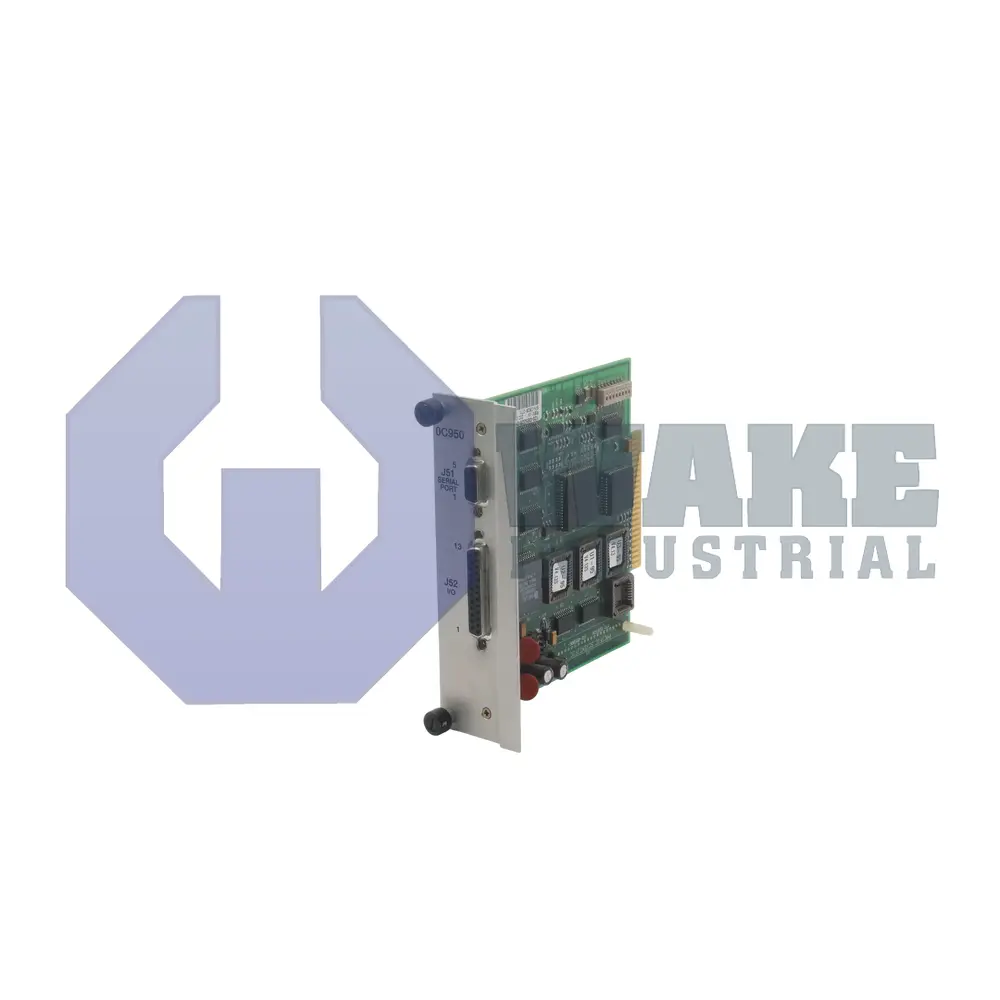
The OC950-501-01 is an option card from the OC950 Option Cards series by Pacific Scientific. It provides 21 bi-directional I/O channels and uses a 25-contact female D-subminiature output connector. The card has a 32kx8 NVRAM program memory and supports serial communication via RS-232 or RS-485.


To contact sales for pricing and lead time:
Payment Methods


Shipping Methods


Our Credentials


Product Description:
The OC950-501-01 option card is produced by Pacific Scientific for the OC950 Option Cards series and installs in compatible motion controllers to expand discrete I/O and serial communication. By combining digital channels with an onboard interface converter, the board lets a host processor read sensors, switch actuators, and exchange diagnostic data without taking up additional rack space. It serves as a compact interface layer between the controller backplane and field devices used in industrial automation cells, especially where several external signals must be handled from one controller slot.
The card provides 21 bidirectional channels, and each point can operate as an input or as an open-drain output for flexible signal assignment. A filter time constant of 100 µs helps suppress contact bounce so noise is less likely to reach high-speed logic. Serial data is handled in a 10-bit data word, and communication is selectable between RS-232/RS-485 without parity for simpler host protocol framing. The board uses a 10 kΩ pull-up network tied to +12 VDC to bias unused inputs to a known level, while the output stages use open-drain DMOS transistors through a 25-contact female D-Sub connector. Incoming serial traffic reaches the controller through a 9-contact D-Sub, and memory is provided by 32K x 8 NVRAM, which removes the need for battery backup after power loss.
Nonvolatile memory retains data for 10 years, which helps preserve machine parameters during long shutdown periods. Each DMOS output can sink up to 100 mA, and the shared user supply provides a regulated 5 V ±5% rail at 200 mA for external sensors. For input sensing, low-level recognition occurs at 1.0 V minimum, while high-level recognition occurs at 3.5 V maximum. This arrangement allows the card to interface with conditioned field signals while also supporting direct loads such as relays or light stacks within the stated output limit.









