


6410-005 Pacific Scientific
Wake Industrial LLC is not an authorized distributor of this product.
- Straightforward Pricing: No Rush Fees, No Credit Card Fees
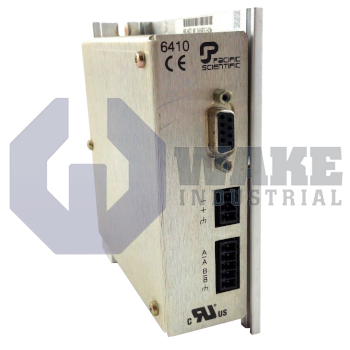
The Pacific Scientific 6410-005 is a stepper drive from the 6410 Stepper Drives series, featuring a two-phase bipolar chopper drive circuit and peak current of 7.1 A. It supports a step rate up to 2 MHz and provides a maximum resolution of 1/256 step with a supply voltage range from 24 to 75 VDC.


To contact sales for pricing and lead time:
Payment Methods


Shipping Methods


Our Credentials


Product Description:
Pacific Scientific builds the 6410-005 as part of its 6410 Stepper Drives series. This unit is a microstepping drive intended for two-phase hybrid stepper motors used in pick-and-place stations, indexing tables, and other positioning tasks where digital controllers issue step and direction pulses. By shaping and regulating phase current, the drive converts low-level logic commands into controlled motor torque, allowing precise motion without encoder feedback.
The power section chops the bus voltage at 20 kHz, a frequency high enough to keep audible noise and current ripple low. Current is routed through a two-phase bipolar chopper circuit that applies alternating polarity to each winding, supporting bidirectional torque with minimal losses. The programmable current limit reaches 5 A rms per phase, enabling the drive to run NEMA-23 and NEMA-34 motors at their rated torque. Resolution can be set as fine as 1/256 step, which reduces mechanical resonance and improves velocity smoothness in applications that require fine positioning. Incoming pulse streams are accepted at rates up to 2 MHz, so high-speed indexers can command 50,000 revolutions per minute when the motor is configured for 25 microsteps per full step.
The supply range spans 75 Vdc down to 24 Vdc, so the drive can operate from higher DC buses or share power with other low-voltage actuators. For brief load surges, the output stage can deliver a peak of 7.1 A before returning to the programmed current limit. The maximum ambient temperature is 50 °C, and no derating is required when cabinet temperatures remain below that level; a 60 °C chassis limit keeps internal components within safe junction temperatures. Storage is permissible from −55 °C to 70 °C, and the unit draws no more than 5 A from the supply under worst-case operating conditions.









