


105-094001-01 Pacific Scientific
Wake Industrial LLC is not an authorized distributor of this product.
Wake Industrial LLC is not an authorized distributor of this product.
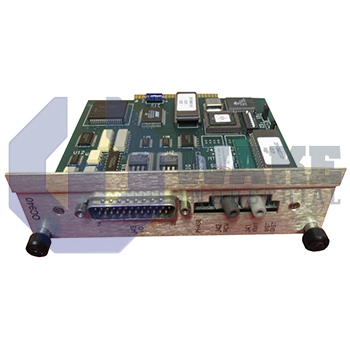
The Pacific Scientific 105-094001-01 is part of the 105 Motion Control Cards series and connects using a SERCOS fiber optic ring interface. It features eight digital inputs and eight digital outputs, with an open drain output type that can sink up to 250 mA. This card has a default baud rate of 2 Mbaud and uses a DB25 user I/O connector.
Internal Product Review
The 105-094001-01 is a Pacific Scientific motion control card designed for SERCOS fiber optic ring communication and SC900 Servocontroller integration. Eight digital inputs and eight digital outputs support clean machine-level interfacing and streamlined panel wiring. Low-power 2 Mbaud operation makes the card a strong fit for responsive, efficient motion architectures.
 Have a part to sell?
 Wake Industrial Warranty
To contact sales for pricing and lead time:
Payment Methods


Shipping Methods


Our Credentials


Product Description:
The 105-094001-01 motion control card is produced by Pacific Scientific for the 105 Motion Control Cards series. Designed for multi-axis machines, it resides beside an SC900 servo controller and issues synchronized position commands across a fiber network. Within an automated line, the card serves as the network node that maps field-level switches, lights, and drives to the deterministic communication ring so the host PLC can coordinate motion, monitor state, and handle interlocks without extra gateway hardware.
The card uses a default serial rate of 2 Mbaud, allowing the optical channel to exchange telegrams every cycle without overrun. The interface is a SERCOS fiber-optic ring, which supports real-time motion telegrams and electrical isolation between cabinets. Two ports labeled In and Out pass light to adjacent nodes without additional splitters. Transmission amplitude is factory set to low power, which minimizes LED aging while preserving signal margin over short cabinet spans. Local I/O capacity includes 8 digital inputs and 8 digital outputs; the inputs accept sourcing or sinking signals, while the outputs switch external loads through open-drain transistors. An onboard rotary selector provides address programming, and its eight-position range simplifies ring configuration when multiple drives share the channel.
Input circuitry is tuned for reliable edge detection. A hysteresis window of 1.3 V helps prevent false toggling when signals dwell near the 50 percent trip threshold, and a pull-up of 4.42 kΩ biases unused channels to a stable state. With 24 V sources, each input draws 3.75 mA and switches state at 50 percent of the applied level, matching common industrial sensor practice. Output drivers can sink up to 250 mA per channel, and the open-drain topology accommodates a wide range of field voltages. All user wiring exits through a DB25 connector, so the board can be replaced without re-terminating individual conductors.









