


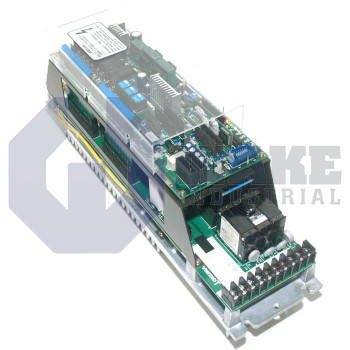
BLII-D50A Okuma
Wake Industrial LLC is not an authorized distributor of this product.
Wake Industrial LLC is not an authorized distributor of this product.
MPN: 1006-0612-0444002
The Okuma BLII-D50A is part of the BL Servo Drives series and features a 50 Amp amplifier capacity. It operates with a 3-phase 200 V main circuit supply and is compatible with OSP5020 and OSP7000 controls. The drive functions in cabinet temperatures from 0 to 45 °C and can handle humidity up to 75 percent during operation.
Internal Product Review
The BLII-D50A is an Okuma servo drive with 50 A amplifier capacity and compatibility with OSP5020 and OSP7000 controls. A 3-phase 200 V main circuit supply and 180-220 V RMS input range support stable machine integration, making the BLII-D50A a dependable choice for precise axis control.
 Have a part to sell?
 Wake Industrial Warranty
To contact sales for pricing and lead time:
Payment Methods


Shipping Methods


Our Credentials


Product Description:
The BLII-D50A servo amplifier is produced by Okuma as part of the BL Servo Drives series. The module sits between the facility mains and the brushless motor winding, modulating current in response to position and velocity commands. In a CNC cell, it enables rapid feed, spindle orientation, and contour moves by converting fixed supply energy into the real-time power profile demanded by the machine’s numerical controller. By integrating this dedicated drive rather than a generic inverter, Okuma maintains deterministic axis behavior aligned with its proprietary motion algorithms.
It delivers up to 50 A of amplifier output, supplying sufficient peak torque for mid-capacity machining axes. The power stage is energized from a 3-phase 200 V bus that tolerates line swings between 180-220 V RMS at network frequencies of 49-62 Hz. Control electronics are isolated on a separate 1-phase 100 V feed, reducing noise coupling between logic and motor power. Drive sequencing, current loops, and feedback handling are managed by the SVCII Board (1-Axis), while command words and status data are exchanged with OSP5020 or OSP7000 controllers through the native interface. The separate power feeds reduce interference between control and motor circuits during operation.
The logic supply remains stable within a window of 90-121 V RMS, ensuring the digital circuitry continues to function during moderate undervoltage or overvoltage events. Cabinet installation must hold ambient air between 0 to 45 °C, and the heat-sink assembly itself can run up to 55 °C without derating; units kept in storage tolerate -20 to 60 °C. Continuous service should not exceed a maximum humidity of 75% RH, although brief spikes to 95% relative humidity are permissible when condensation is prevented. Chassis vibration should not exceed 0.5 G maximum. The amplifier is intended for indoor cabinet installation where temperature, humidity, and vibration remain within those limits.









