


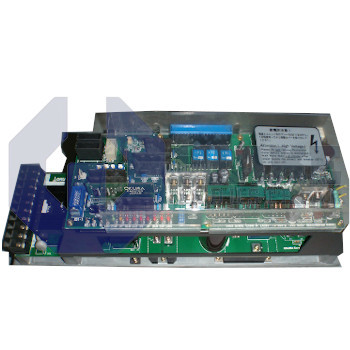
BLII-D15A Okuma
Wake Industrial LLC is not an authorized distributor of this product.
Wake Industrial LLC is not an authorized distributor of this product.
MPN: 1006-0610-22-07
The Okuma BLII-D15A servo drive is part of the BL Servo Drives series and is designed for 1-axis control. It operates with a main circuit voltage of 200 V AC in a 3-phase system and a control circuit voltage of 100 V AC in a single-phase system. The unit supports input frequencies from 49 to 62 Hz and can operate within a temperature range of 0 to 55°C.
Internal Product Review
The BLII-D15A from Okuma is a single-axis servo drive designed for precise motion control within the BL Servo Drives series. It operates reliably in environments up to 55°C and tolerates humidity up to 75% RH, making it suitable for demanding industrial settings. With a main circuit voltage of 200 V AC in a 3-phase configuration, this unit ensures stable and efficient power delivery for various automation tasks.
 Have a part to sell?
 Wake Industrial Warranty
To contact sales for pricing and lead time:
Payment Methods


Shipping Methods


Our Credentials


Product Description:
The BLII-D15A is a single-axis servo drive produced by Okuma within the BL Servo Drives series. It conditions and delivers power to a matched servo motor so that position, velocity, and torque loops can be closed accurately in machining centers, transfer systems, and other automated cells. By integrating power conversion and feedback processing in one enclosure, the unit streamlines axis control on CNC equipment and reduces the need for separate interface hardware between the controller and the motor. This arrangement supports coordinated motion while keeping the drive package compact enough for cabinet-based machine installations.
The drive manages a single-axis motion channel, which simplifies wiring and parameter handling where only one controlled joint is required. All logic and feedback electronics are energized through a single-phase control supply at 100 V AC, and this circuit remains stable as long as the incoming mains stay between 90 and 121 V AC. Power to the motor is taken from a separate bus that accepts three-phase mains in the 180 to 220 V AC range and delivers a nominal output of 200 V AC. This separation allows the low-level electronics and the high-power stage to operate on suitable voltages for control accuracy and motor power delivery. The control and power sections share an input band of 49 to 62 Hz, allowing connection to standard industrial grids without a line-frequency converter.
Ambient air inside the electrical cabinet must remain between 0 and 45 °C, while internal components can operate up to 55 °C and may be stored down to −20 °C. Relative humidity must not exceed 75% RH so condensation does not form on live circuits. Real-time feedback ports expose operating data: the speed terminal yields ±10 V / ±3750 rpm, giving a linear analog representation of motor velocity, and the torque port provides 10 V per torque limit so external controllers can monitor or trim load. These analog outputs support diagnostics and allow supervisory systems to observe drive behavior without additional transducers or separate signal conditioners.









