


BL-D30A Okuma
Wake Industrial LLC is not an authorized distributor of this product.
- Straightforward Pricing: No Rush Fees, No Credit Card Fees
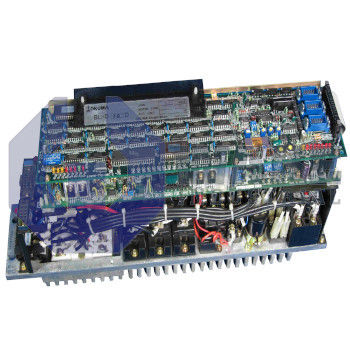
The Okuma BL-D30A is part of the BL Servo Drives series and uses an SVC-A control board. It supports a maximum of 6 axes per DC supply unit including models like DC-S1A and DC-S3A and uses DIP switches for setup by motor model. The drive features an LED alarm indicator, NFB circuit breaker, and a terminal box interface with connectors CN1 to CN11.


To contact sales for pricing and lead time:
Payment Methods


Shipping Methods


Our Credentials


Product Description:
The BL-D30A belongs to the BL Servo Drives series produced by Okuma for multi-axis machine-tool automation. As a servo drive amplifier, it conditions DC bus power and regulates phase current so that the attached servo motor tracks numerical control commands with low following error. The unit combines power semiconductors, logic, and protective circuitry to form a closed-loop axis interface between the CNC and the mechanical load. Closed-loop regulation helps the axis respond to changing cutting loads and positioning moves while maintaining commanded motion.
An alarm circuit reports fault states through a front-panel LED, allowing overcurrent, overtemperature, or encoder errors to be identified quickly without external instruments. For branch protection, the drive uses a built-in NFB that trips on excessive line current and removes power without requiring a separate molded-case breaker. Field wiring is landed on grouped connectors CN1, CN2, CN3, CN4, and CN11; these headers carry command signals, resolver feedback, and 24 V I/O, which helps keep panel wiring organized because no loose terminals are required. Control algorithms run on the SVC-A Board, a plug-in module that executes velocity and position loops while monitoring transistor temperatures and DC bus voltage. Each amplifier section is sized for 1 motor, which eliminates cross-coupling and simplifies tuning in multi-axis machining centers.
DC power is delivered by the supply modules DC-S1A/DC-S3A; a shared bus lets as many as 6 axes draw energy while soft-charge resistors limit inrush. Motor model parameters are loaded through the front DIP banks, and the factory designates this setup mode as DIP switch by motor model, so settings can be selected directly on the unit. Command and power conductors exit through a gasketed terminal box, giving strain relief and finger-safe access when the cabinet door is open.









