


BDU-30D Okuma
Wake Industrial LLC is not an authorized distributor of this product.
- Straightforward Pricing: No Rush Fees, No Credit Card Fees
Current response time:
5 Minutes
38 Seconds
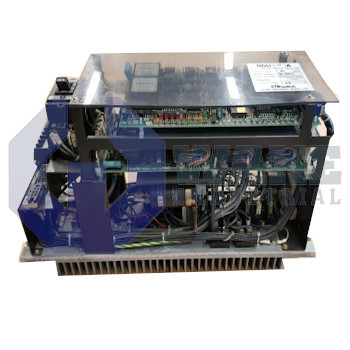
The Okuma BDU-30D is part of the BDU Servomotor Drives series and supports one BL motor. It uses a flux vector brushless drive topology and accepts a 3-phase 220 VAC input supply. The drive has five check terminals and a 300 VDC DC bus output, with analog command signals sourced from an ECP board.


To contact sales for pricing and lead time:
Payment Methods


Shipping Methods


Our Credentials


Product Description:
The BDU-30D is a servo amplifier manufactured by Okuma within the BDU Servomotor Drives series. It interfaces between a CNC control system and the machine’s brushless axis motor, converting three-phase line power into a regulated DC bus while obeying velocity or torque references issued by the controller. In industrial automation, the unit helps maintain stable motor performance so that cutting paths and feed rates remain precise under changing load conditions. This makes it suitable for axis applications where the control must react quickly to load variation during acceleration, deceleration, and contouring moves.
The drive accepts a mains supply of three-phase 220 VAC and rectifies it to a DC link stabilized at 300 VDC. Internal power modules implement flux vector brushless control, allowing instantaneous torque response by calculating real-time rotor position from feedback signals. Five dedicated diagnostic points, referenced as five check terminals, allow probing of logic levels, gate signals, and bus voltage without dismantling the chassis. Motion references arrive as an analog command, and this continuous voltage signal is filtered and scaled before it is passed to the current regulators so motor current follows the programmed demand. This combination of bus regulation and current control supports repeatable motor behavior during rapid speed changes and load disturbances.
The reference path originates on the machine’s ECP Board, so any drift or noise at that assembly is reflected directly in the amplifier input, underscoring the need for shielded cabling. Over-voltage detection trips when the DC link rises above 430 VDC, typically during rapid deceleration or regenerative events, and it forces an orderly shutdown to protect the IGBT bridge. A complementary low-voltage circuit halts operation if the link falls below 220 VDC, preventing undervoltage misfires. The power stage is dimensioned to drive a single BL motor, matching the single-axis architecture used in many Okuma lathes and milling machines. This single-axis arrangement keeps the feedback and protection functions focused on one motor channel rather than a multi-motor output stage.









