


BDU-30A Okuma
Wake Industrial LLC is not an authorized distributor of this product.
Wake Industrial LLC is not an authorized distributor of this product.
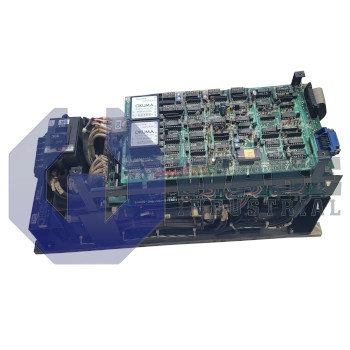
The Okuma BDU-30A is part of the BDU Servomotor Drives series and features transistor PWM drive technology with a high-res OSP encoder for feedback. It operates with an input voltage of 200 to 220 VAC, 3-phase, and has an output current of 21 Amps. The amplifier uses a digital RCON command signal and has a DC bus voltage of 300 VDC.
Internal Product Review
The BDU-30A is an Okuma servomotor drive that stands out with transistor PWM technology and 21 A output current. Digital RCON command signaling paired with a high-resolution OSP encoder supports precise response and stable motion control. A 300 VDC bus architecture makes the unit a strong fit for demanding machine tool service.
 Have a part to sell?
 Wake Industrial Warranty
To contact sales for pricing and lead time:
Payment Methods


Shipping Methods


Our Credentials


Product Description:
The BDU-30A is a servo amplifier in the BDU Servomotor Drives series manufactured by Okuma. Designed to power and regulate a single-axis brushless motor, the unit converts three-phase line power into controlled DC and then synthesizes variable AC for motion control. In an automation cell, it links the machine’s CNC controller with the motor, delivering torque commands while monitoring feedback to keep positioning and velocity accurate.
The internal DC link is maintained at 300 VDC, and this bus voltage stores energy in capacitors so the inverter section can draw instantaneous current without line sag. A protective threshold trips the unit at 430 VDC to shield semiconductor devices from excessive regeneration, while a low-voltage cutoff engages at 220 VDC to prevent undervoltage misfires. Line power enters on the three input phases at 200-220 VAC, and the converter is compatible with supply frequencies of 50/60 Hz, allowing installation in regions that use either standard. Seven DCP LEDs provide visual status for the power supply section, and ten SVC LEDs indicate servo diagnostics without requiring external instruments. The amplifier build option list identifies this module as a base unit with BDC and SVC functions active.
During operation, the inverter delivers up to 21 A of phase current to the motor through a three-phase output bridge that shares the same topology as the input. Position data is returned by a high-resolution OSP encoder, enabling tight loop gains for contouring axes and spindle orientation. Pulse-width modulation based on a transistor PWM stage shapes the sinusoidal drive waveforms, so torque ripple stays low even under rapid acceleration. One amplifier handles a single motor, and a DC power supply can support as many as six axes in parallel.









