


TBM-12941-A Kollmorgen
Wake Industrial LLC is not an authorized distributor of this product.
- Straightforward Pricing: No Rush Fees, No Credit Card Fees
Current response time:
4 Minutes
42 Seconds
The Kollmorgen TBM-12941-A is part of the TBM Frameless Motors series and has a rated power of 865 Watts and a rated speed of 1520 RPM. It features a continuous stall torque of 8.3 Newton-meters, a peak stall torque of 27.1 Newton-meters, and a torque constant of 0.624 Newton-meters per Arms. The motor has a length of 64.14 millimeters and weighs 3.17 kilograms.


To contact sales for pricing and lead time:
Payment Methods


Shipping Methods


Our Credentials


Product Description:
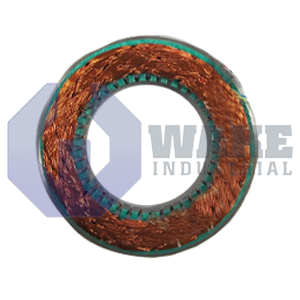
The TBM-12941-A is a frameless brushless motor segment produced by Kollmorgen in the TBM Frameless Motors series. It is supplied as separate rotor and stator components for direct integration into machinery where space is limited. The motor is suited for industrial automation tasks such as collaborative robot joints, gimbals, or precision rotary axes that require high torque density.
The electromagnetic profile starts with a continuous output limit of 8.3 N-m of stall torque that can be maintained without overheating when adequate cooling is provided. Delivering that torque requires a continuous stall current of 13.9 Arms, which is the sustained drive current the controller must supply. During normal operation, the rotor can reach a rated mechanical velocity of 1520 RPM, and at that speed the winding set converts electrical input into a mechanical rated power of 865 W. The motor’s torque constant of 0.624 N-m/Arms shows how much torque is produced for each ampere of phase current and helps support current-loop tuning.
Short-duration overload events are handled by a peak stall torque capability of 27.1 N-m, which supports brief acceleration demands above the continuous rating. Mechanical integration is simplified by the unit’s compact construction weight of 3.17 kg and an active rotor inertia of 0.000721 kg-m², a combination that allows fast changes in angular velocity without requiring high servo gains. Dynamic response is further influenced by the phase inductance of 0.92 mH; lower inductance supports rapid current transitions for tight torque control, while the associated 0.25 ohm resistance limits copper losses. Static friction of 0.346 N-m and viscous damping of 0.271 N-m/kRPM help determine open-loop startup behavior and settling time once motion ceases.









