


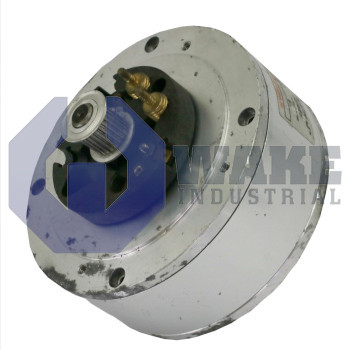
U9D-A/TERMINAL Kollmorgen
Wake Industrial LLC is not an authorized distributor of this product.
MPN: 0P009A02102-1
No Tariffs On US Orders- Straightforward Pricing: No Rush Fees, No Credit Card Fees
Current response time:
6 Minutes
43 Seconds
The Kollmorgen U9D-A/TERMINAL is part of the PLATINUM U Servomotors series. This servomotor provides a parallel torque of 45 oz-in with a back EMF of 2.5 V/kRPM and parallel current of 15.5 Amps at 3,000 rpm. In series operation, it delivers 50 oz-in of torque, a back EMF of 5.0 V/kRPM, and a current of 8.7 Amps at 3,000 rpm.


To contact sales for pricing and lead time:
Payment Methods


Shipping Methods


Our Credentials


Product Description:
The U9D-A/TERMINAL is a rotary motor produced by Kollmorgen for the PLATINUM U Servomotors series. It delivers commanded motion in automated machinery by translating drive current into precise shaft rotation. This allows conveyors, pick-and-place heads, and labeling modules to position loads accurately within a closed-loop system. The motor is suited to motion tasks that require repeatable speed and position control from a compact servo package.
In the parallel winding configuration, the motor develops a back electromotive force of 2.5 V/kRPM, which represents the countervoltage generated for every 1000 rpm. That electrical constant is useful when comparing the motor to the available amplifier voltage. When operated at 3000 rpm in the same connection, it draws 15.5 A from the amplifier and outputs 45 oz-in of continuous torque, matching applications that need high dynamic response without excessive current demand. At that speed, the required line potential is 12.5 V, which supports low-voltage bus designs in multi-axis platforms. For installations that favor reduced current ripple, the stator can be rewired in series; in that mode, the induced back emf rises to 5.0 V/kRPM, indicating a doubled voltage constant with higher coil impedance.
When the series connection is selected, steady-state operation at the same speed requires 8.7 A, easing thermal loading on the drive while still supplying 50 oz-in of torque for heavier linear stages or small servo presses. The higher winding impedance also raises the bus requirement to 23.9 V, aligning the motor with mid-range DC supplies common in distributed control cabinets. The two winding connections provide different voltage and current requirements while keeping the same mechanical form. This allows the motor to be matched to different drive and cabling requirements without changing the mechanical envelope.









