


NEXTSTEP-SYSTO3 Kollmorgen
Wake Industrial LLC is not an authorized distributor of this product.
Wake Industrial LLC is not an authorized distributor of this product.
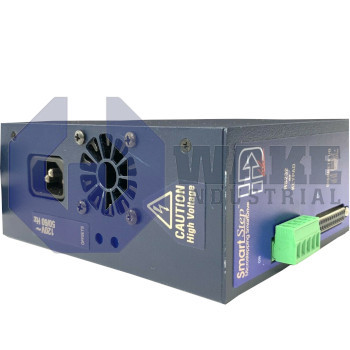
The Kollmorgen NEXTSTEP-SYSTO3 is part of the NEXTSTEP Microstepping Drives series and supports 2-phase hybrid permanent magnet motors. It features a maximum pulse rate of 2 MHz, a switching frequency of 20 kHz, and can operate at ambient temperatures up to 50°C. The drive measures 5.4 by 5.4 by 2.5 inches and provides standard resolutions up to 50,000 microsteps.
Internal Product Review
The NEXTSTEP-SYSTO3 is a Kollmorgen microstepping drive for 2-phase hybrid PM motors, and the 2 MHz max pulse rate gives it excellent command throughput. A 250 ns minimum step width and 0.4 µs direction setup time support sharp, high-speed step response. An opto-isolated NPN fault output adds clean diagnostics, making this drive a strong choice for precise motion systems.
 Have a part to sell?
 Wake Industrial Warranty
To contact sales for pricing and lead time:
Payment Methods


Shipping Methods


Our Credentials


Product Description:
The NEXTSTEP-SYSTO3 microstepping drive is produced by Kollmorgen within the NEXTSTEP Microstepping Drives series. It functions as a pulse-input indexer that regulates phase currents in two-phase hybrid permanent-magnet stepper motors, allowing precise incremental motion in pick-and-place stages, small conveyors, and laboratory dispensers. By converting high-frequency command pulses from a controller into controlled winding currents, the unit establishes the position and velocity of the connected motor and fits into compact control panels used in distributed automation cells.
Its compact enclosure measures 5.4 x 5.4 x 2.5 in, so it can mount beside PLC I/O blocks without special brackets. The drive accepts differential or single-ended step signals at rates up to 2 MHz; pulses as short as 250 ns are recognized, provided the direction line is asserted for at least 0.4 µs before the edge. Internally, bipolar choppers modulate the output at 20 kHz, smoothing current transitions and minimizing audible noise. Eight standard resolutions from 5,000 to 50,000 steps per revolution and four low-resolution settings down to 200 steps are selectable through onboard DIP switches, while an opto-isolated NPN fault output reports thermal or drive trips to the host control. A third-harmonic waveform limit of -4% helps keep motor torque ripple low.
For thermal management, the drive can operate in ambient air up to 50 °C. If the internal heat sink reaches 65 °C, an overtemperature trip disables the outputs and asserts the diagnostic transistor. The optocoupler inputs draw only 6.5–15 mA, so standard TTL or 24 VDC lines can drive them directly. A native full-step increment of 1.8° aligns with common hybrid motors, and the selectable microstep tables refine that angle to reach the highest resolution options without mechanical gearing. When the equipment is powered down, it may be stored safely between -40 °C and 80 °C without recalibration.