


MX92-FF-206U Kollmorgen
Wake Industrial LLC is not an authorized distributor of this product.
Wake Industrial LLC is not an authorized distributor of this product.
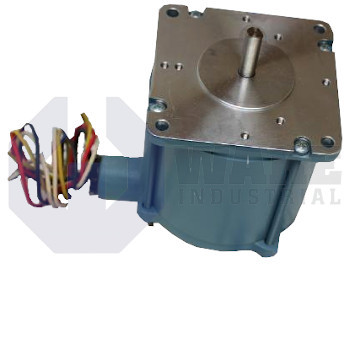
The Kollmorgen MX92-FF-206U is a stepper motor from the MX Hazardous Duty Stepper Motors series with a holding torque of 370 oz-in and a step angle of 1.8 degrees. It features a rated current of 4.0 A per phase, has two phases, and a full step count of 200 per revolution. This motor supports an axial shaft load of 50 lb, radial shaft load of 25 lb, and weighs 9.0 lb.
Internal Product Review
The MX92-FF-206U is a Kollmorgen hazardous duty stepper motor built for precise industrial indexing. A 370 oz-in holding torque paired with a 1.8° step angle gives the motor strong low-speed authority and accurate step positioning. A 4.0 A rated current per phase supports dependable output, making the MX92-FF-206U a strong choice for hazardous-duty motion systems.
 Have a part to sell?
 Wake Industrial Warranty
To contact sales for pricing and lead time:
Payment Methods


Shipping Methods


Our Credentials


Product Description:
The MX92-FF-206U is a two-phase stepper motor developed by Kollmorgen within the MX Hazardous Duty Stepper Motors series. Designed for classified environments where dust or gas may be present, the unit converts incremental drive pulses into precise angular movement so that indexing tables, valve actuators, or conveyors can position loads without feedback devices. Its 0.375-inch shaft, 9-pound frame, and sealed construction allow it to handle axial forces up to 50 lb and radial forces up to 25 lb while maintaining insulation integrity in automation cabinets.
At stall, the motor can generate a holding torque of 370 oz-in, so loads can remain fixed while the shaft is at rest. Each electrical pulse advances the rotor by 1.8°, yielding 200 full steps per revolution; this discrete resolution helps maintain repeatable positioning during start-stop cycles. The windings are rated for 4.0 A per phase, which is the current required to reach the published torque curve without overheating. Rotor inertia is 0.0174 oz-in-s², a low value that supports quick acceleration while helping reduce overshoot in lightly loaded axes. These values help determine suitable couplings, gears, and pulleys for the permitted shaft loading range.
The motor’s electrical values affect current rise, heat dissipation, and insulation margin during operation. The stator coils exhibit a phase inductance of 11 mH, so the applied voltage must rise quickly enough to reach current setpoints at higher step rates. The direct current resistance is 1.0 ohm per phase, which influences copper loss and driver sizing. Motor-to-ambient heat flow is represented by a thermal resistance of 1.7 °C/W; with this value, a 10 W power dissipation would raise the winding temperature by about 17 °C above the housing. For dielectric strength, the insulation system withstands up to 340 Vdc and maintains 100 MΩ resistance, which supports operation with high bus voltages during microstepping or regeneration.









