


MTC306A1-E2C1 Kollmorgen
Wake Industrial LLC is not an authorized distributor of this product.
- Straightforward Pricing: No Rush Fees, No Credit Card Fees
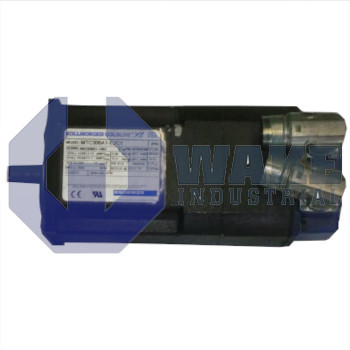
The Kollmorgen MTC306A1-E2C1 is part of the MTC Servo Motors series and features a rated power of 0.82 kW with a rated speed of 2500 rpm. It delivers a continuous stall torque of 3.60 N-m and a peak torque of 11.24 N-m. This servo motor has a continuous current of 2.73 ARMS and operates with a brake voltage of 24 VDC.


To contact sales for pricing and lead time:
Payment Methods


Shipping Methods


Our Credentials


Product Description:
The MTC306A1-E2C1 is a brushless servo motor manufactured by Kollmorgen within the MTC Servo Motors series. Designed for closed-loop motion axes, it converts electrical input into regulated torque and speed for positioning tables, feeders, and similar automation loads. The frame incorporates an eight-pole rotor and a 24 VDC fail-safe brake interface so that the motor can hold a vertical axis when power is removed. Its windings are insulated for line voltages up to 250 V RMS, aligning with many mid-level servo amplifiers.
Under continuous operation at 25 °C, the motor can deliver 3.60 N·m of stall torque while drawing a phase current of 2.73 A RMS. At its nominal operating point, the shaft turns at 2500 rpm and the electrical output equals 0.82 kW, matching medium-power indexing or metering tasks. The phase windings present an inductance of 60 mH, which smooths the current slope and allows stable current-mode control with standard PWM inverter carriers. With a phase resistance of 7.75 Ω, the copper loss stays modest, supporting thermal balance during continuous duty.
For intermittent moves, the drive can reach a shaft torque of 11.24 N·m when the amplifier supplies up to 11.1 A RMS. These peaks are enabled by the rotor’s low inertia of 0.000111 kg·m², which lets the axis accelerate quickly without overshooting. Heat stored during such bursts dissipates according to a thermal time constant of 31 min, permitting short overloads without exceeding insulation limits. A back-EMF constant of 75.9 V RMS/krpm and a torque sensitivity of 1.255 N·m/A make velocity and torque estimation straightforward for the controller, while static friction of 0.052 N·m keeps dither demands minimal during standstill holding.









