


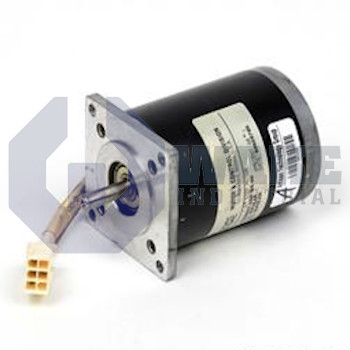
H22NRFB-JNN-NS-00 Kollmorgen
Wake Industrial LLC is not an authorized distributor of this product.
- Straightforward Pricing: No Rush Fees, No Credit Card Fees
Current response time:
4 Minutes
41 Seconds
The Kollmorgen H22NRFB-JNN-NS-00 is part of the H Hybrid Motors series and features a 2.25 inch diameter NEMA 23 frame with standard construction. It operates with 8 lead connections, a low inertia rotor, and has a step angle of 1.8 degrees which provides 200 steps per revolution. The motor has insulation class B rated at 130°C, a smooth single shaft, and supports an operating temperature range from -20°C to +40°C.


To contact sales for pricing and lead time:
Payment Methods


Shipping Methods


Our Credentials


Product Description:
The H22NRFB-JNN-NS-00 is a hybrid stepper motor produced by Kollmorgen within the H Hybrid Motors series. It delivers incremental rotary motion for indexers, pick-and-place axes, and other positioning duties where open-loop accuracy and repeatability are adequate for the process. Standard NEMA face mounting and lead-wire terminations simplify installation in compact motion assemblies. In pulse-driven systems, the motor advances in repeatable increments and can hold a commanded position at standstill when the phases remain energized. That operating style is common in compact automation equipment where the controller uses simple pulse commands and predictable step response.
This motor occupies the NEMA 23 frame class and fits into a compact housing that measures 2.25 in. across the lamination stack. Two rotor stacks share a low-loss magnetic path, while the windings emerge as an 8-lead harness that supports series or parallel connection. This wiring arrangement gives the drive system flexibility when matching available voltage and current. The internal rotor is engineered for Low Inertia starts and stops, complementing the smooth single-ended shaft that carries no seal or key. Because the shaft is smooth rather than keyed, torque is usually transferred through a clamping hub or similar friction-based coupling. Electrical insulation follows Class B (130 °C) practice and withstands transient potentials up to 340 Vdc with a resistance of 100 Megohms.
The motor uses a native step angle of 1.8 degrees, yielding 200 discrete positions per revolution with a maximum error band of ± 1.5 %. This fine pitch supports direct coupling to gear-free linear stages and other mechanisms that need consistent indexing without mandatory microstepping. Continuous service is supported between −20 °C to +40 °C, and the stator iron is arranged in two laminations that help manage core loss across that range. The regular lead-wire connection style eases routing through cable track, and it also helps when the motor is installed on moving axes that use repeated cable bends. The motor is best suited for clean, dry enclosures where low drag and precise response are more important than splash protection.









