


M.1017.3095 Danaher
Wake Industrial LLC is not an authorized distributor of this product.
- Straightforward Pricing: No Rush Fees, No Credit Card Fees
Current response time:
3 Minutes
29 Seconds
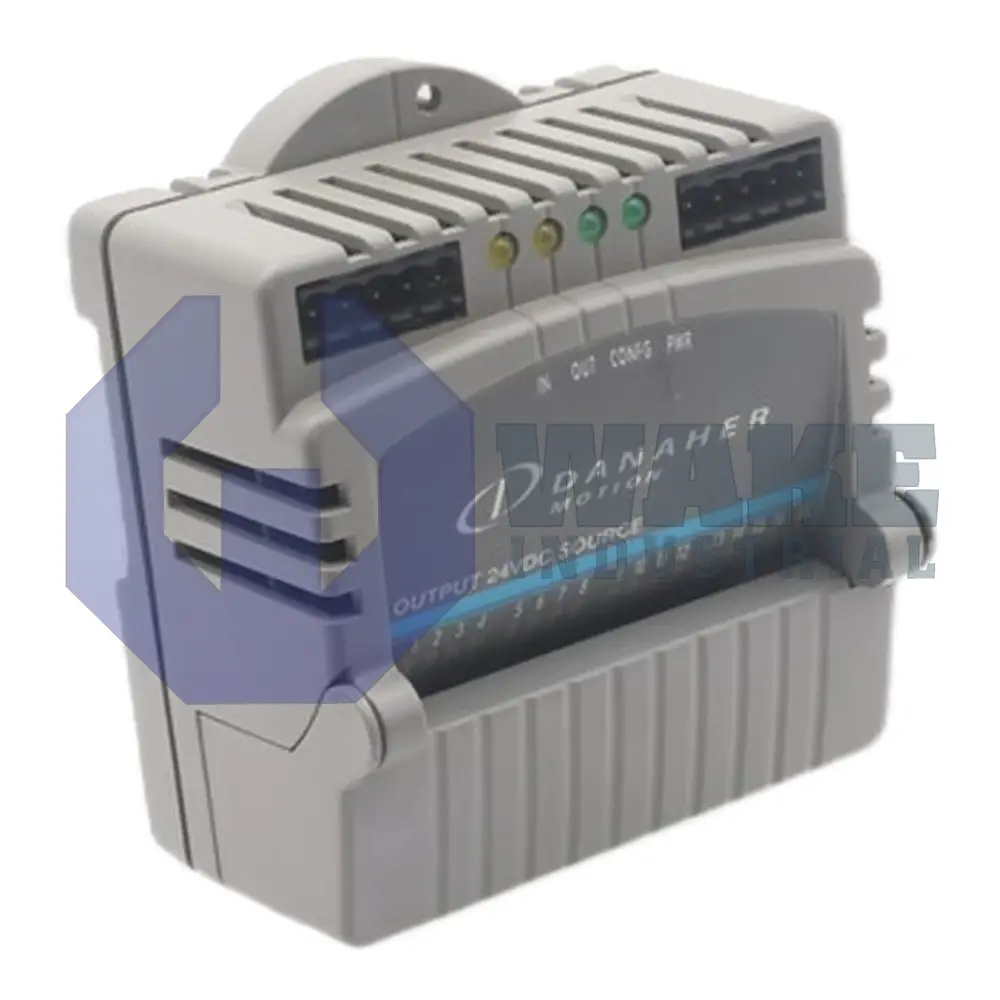
The Danaher M.1017.3095 is part of the Block IO Analog Modules series and features 16 output points arranged in 2 groups of 8. The module operates with a nominal DC supply of 24 VDC, has a maximum group current of 4 Amps, and a maximum switch current of 0.5 Amps. It supports an inrush current of 2.5 Amps for 250 microseconds and has surge current protection up to 25 Amps.


To contact sales for pricing and lead time:
Payment Methods


Shipping Methods


Our Credentials


Product Description:
The M.1017.3095 is an output slice produced by Danaher for the Block IO Analog Modules series. This 16-point driver links controller logic to field devices that require sourcing outputs. In a rack, it energizes external loads while preserving isolation and group protection, distributing DC power to sensors, relays, or small actuators. The module occupies one backplane slot and uses the 24 V system bus to translate PLC commands into switched lines for space-constrained, high-density machine I/O.
At power-up, the module draws an inrush current of 2.5 A that lasts only 250 µs, minimizing stress on upstream fusing while charging its internal capacitors. Each of the two output groups can deliver up to 4 A, and the on-state voltage drop is limited to 1 VDC maximum, so heat dissipation on the board remains controlled even under continuous loading. A single point may switch currents as high as 0.5 A, permitting direct control of most indicator lamps and miniature solenoids. Off-state leakage is capped at 0.5 mA, preventing nuisance activation of sensitive coils. During fault recovery, the module waits 100 ms before retrying the channel, aligning with common PLC watchdog windows. The short-circuit pulse clamp of 130 µs protects semiconductor switches from extended overloads.
The module’s baseline consumption from the backplane is 100 mA, and it operates from a nominal 24 VDC supply, making power budgeting straightforward in a densely populated rack. During transient events, each channel can withstand a surge of 25 A, after which the driver restores normal conduction once the fault clears. Command latency is controlled, with both turn-on and turn-off times limited to a maximum of 50 µs, providing predictable edge alignment for time-critical sequencing. Sixteen output points are arranged as two banks of eight to simplify field distribution and fuse sizing. The channel architecture also maintains thermal stability during sustained switching cycles.









