


VT 1610-3X/E0/VT10210A/U123 Bosch Rexroth Indramat
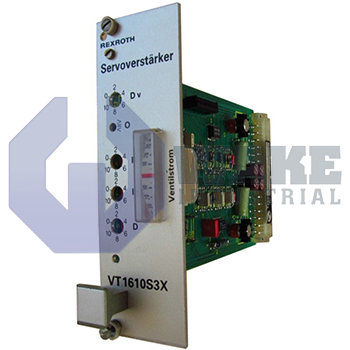
Wake Industrial LLC is not an authorized distributor of this product.
Wake Industrial LLC is not an authorized distributor of this product.
MPN: R900976078
Ask for AvailabilityThe Bosch Rexroth Indramat VT 1610-3X/E0/VT10210A/U123 is a servo amplifier in the VT 1600 Servo Amplifiers series. It has a maximum output current of ±60 mA and requires less than 200 mA of current. This amplifier uses a DIN 41612 Form D connector standard and features a relay coil resistance of 2000 Ohms with a 1 millisecond duty cycle.
Internal Product Review
The VT 1610-3X/E0/VT10210A/U123 is a Bosch Rexroth Indramat VT 1600 servo amplifier with a DIN 41612 Form D connector and a current requirement below 200 mA. Precise control performance benefits from a 340 Hz dither frequency and ±60 mA maximum output current, making the unit a strong choice for stable servo amplification.
 Have a part to sell?
 Wake Industrial Warranty
To contact sales for pricing and lead time:
Payment Methods


Shipping Methods


Our Credentials


Product Description:
The VT 1610-3X/E0/VT10210A/U123 is a plug-in servo amplifier card produced by Bosch Rexroth Indramat for the VT 1600 Servo Amplifiers series. Installed on a eurocard backplane, the unit conditions command signals and supplies controlled current to proportional or servo valves used in hydraulic positioning and pressure-control loops. By converting low-level control voltages into regulated valve drive current, the board forms the link between a motion controller and the electro-hydraulic actuator in automated machinery.
The card mates to a DIN 41612 Form D connector, allowing quick replacement without discrete wiring. It draws operating power of <200 mA from the system’s ±15 V rail, minimizing load on the cabinet supply. Valve energization is limited to a peak of ±60 mA, a range compatible with many proportional spool valves. Internal electronics superimpose a dither signal at 340 Hz, and this oscillation reduces static friction to improve spool centering. The amplitude of that dither is fixed at 3 mAss, providing repeatable modulation regardless of command level. For auxiliary switching, an onboard relay offers coil resistance of 2000 Ω, permitting direct energization from the amplifier’s logic outputs without external resistors.
The relay achieves full pull-in and release within 1 ms, so valve feedback circuits can be interrupted or enabled without noticeable delay in closed-loop response. A backplane address area configured for 32 poles lets the amplifier share bus lines with multiple axis cards while maintaining discrete identification. No linear or switching regulator is fitted, so the power stage relies on the host supply being within tolerance. This arrangement simplifies thermal design and preserves board space for signal conditioning components.









