


VT 3000 S 32 Bosch Rexroth Indramat
Wake Industrial LLC is not an authorized distributor of this product.
Wake Industrial LLC is not an authorized distributor of this product.
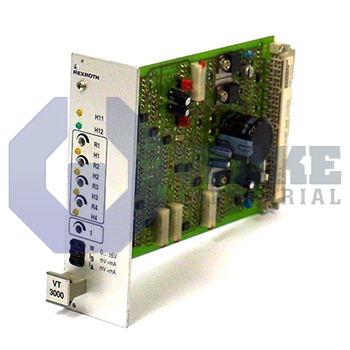
The Bosch Rexroth Indramat VT 3000 S 32 is part of the VT 3000 Analog Amplifiers series and operates with a supply voltage of 24 VDC ±10%. This amplifier features a maximum output current of 800 mA and a power requirement of 30 W. It includes 6 relays and offers an additional command input of ±6 V.
Internal Product Review
The VT 3000 S 32 is an analog amplifier designed for dependable industrial control, with a 24 VDC ±10% supply voltage and 30 W power requirement. A 10 V differential input and 800 mA maximum output current support stable signal processing and confident actuation performance. Six relays add useful interface flexibility, making this amplifier a strong choice for precise analog control.
 Have a part to sell?
 Wake Industrial Warranty
To contact sales for pricing and lead time:
Payment Methods


Shipping Methods


Our Credentials


Product Description:
The VT 3000 S 32 is an analog amplifier card produced by Bosch Rexroth Indramat as part of the VT 3000 Analog Amplifiers series. Installed in a valve controller rack, the card shapes low-level control voltages into proportional current so that hydraulic or electromechanical actuators can be driven with repeatable accuracy inside automated machinery. By occupying a single Eurocard slot, it provides a compact interface that links PLC signal rails to power stages without external conditioning hardware.
The module accepts an additional command input of ±6 V that can be summed with the main reference for auxiliary trimming functions. Its differential input is rated for 10 V, and the input control channel tolerates excursions up to ±9 V while maintaining linear drive behavior; a minimum input load of 500 Ω prevents overloading upstream sources. The amplifier operates from a rack backplane supply of 24 VDC ±10%. Downstream, the power stage can supply up to 800 mA of continuous output current before reaching saturation, and protection is provided by an onboard fuse rated at 2.5 A. These limits set the electrical operating range for valve coils and other inductive loads connected to the card.
Total consumption does not exceed 30 W, allowing dense cabinet packing without excessive thermal planning. The output stage supports loads down to 19.5 Ω, enabling direct connection to low-impedance proportional solenoids, and a temperature drift of 0.5 ‰/K keeps gain changes small across typical machine room ranges. A 20 mA bias current is available for feedback circuits, while six relays switch auxiliary functions such as enable, ramp, or fault override. Mechanical clearances are standardized: the component side uses seven rack divisions, the conductor side uses one division, and the faceplate spans eight divisions, simplifying card spacing and airflow planning in modular control enclosures.









