


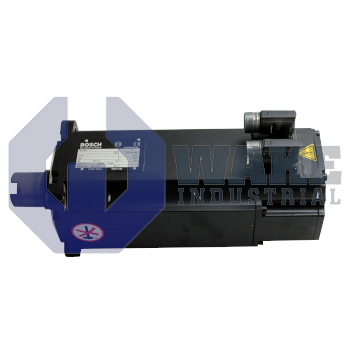
SF-A4.0230.030-14.015 Bosch Rexroth Indramat
Wake Industrial LLC is not an authorized distributor of this product.
MPN: 1070082189
No Tariffs On US Orders- Straightforward Pricing: No Rush Fees, No Credit Card Fees
The Bosch Rexroth Indramat SF-A4.0230.030-14.015 is part of the SF Servo Motors series and features a rated speed of 3000 rpm with a torque constant of 1.57 Nm per Amp. It provides a holding brake torque of 18 Nm and locked-rotor torque of 22 Nm, with a brake current of 0.7 Amps and rotor inertia of 0.0054 kg·m².


To contact sales for pricing and lead time:
Payment Methods


Shipping Methods


Our Credentials


Product Description:
The SF-A4.0230.030-14.015 is a servo motor in the SF Servo Motors series from Bosch Rexroth Indramat. It converts drive amplifier output into controlled shaft motion for positioning tasks in machine tools, pick-and-place stations, and similar automated machinery. The design combines permanent-magnet excitation with an electromagnetic holding brake, so a mechanical load can remain fixed when supply power is switched off. Its operating concept suits axes that must hold position at rest and then return to commanded motion without noticeable drift.
The holding brake draws 0.7 A during engagement, which adds a modest electrical load to the brake circuit. Once energized, it produces a restraining moment of 18 Nm to secure medium-inertia linkages against back-driving. At motor stall, the stator windings can accept up to 14 Arms, enabling rapid field buildup for strong startup thrust. Under rated running conditions, the shaft stabilizes at 3000 rpm, balancing output speed with thermal performance during continuous operation. During deceleration, the brake mechanism adds 0.00031 kg·m² of rotational mass, which should be considered when setting stopping response and motion tuning. This balance of speed, current capacity, and brake inertia is useful in compact servo axes that cycle frequently.
When a jam or indexing lock occurs, the electromagnetic structure can develop 22 Nm of locked-rotor torque. The rotor mass contributes only 0.0054 kg·m², which helps the motor recover quickly once motion resumes and supports responsive axis behavior. Each ampere delivered by the power stage produces approximately 1.57 Nm/A of electromagnetic torque, allowing current commands to translate directly into predictable torque output during positioning and speed control. That current-to-torque relationship also supports proportional control during acceleration, holding, and recovery from brief disturbances.









